
What Is a Credit Score in Simple Terms?
A credit score is a three digit number, usually from 300 to 850, that sums up how you have handled borrowed money. Lenders use it to judge how likely you are to pay them back on time. A higher score means less risk to a lender. A lower score means more risk.
Your score is not a grade on your character, and it is not a measure of how much money you earn. It is built only from your credit report, a record of your loans, credit cards, and payments. Your income, savings, and job are not part of a FICO score.
What Is a Credit Score, Exactly?
Think of your credit score as a short summary of your borrowing history. Every time you use a credit card or take out a loan, the lender reports that account to one or more of the three major credit bureaus: Equifax, Experian, and TransUnion. A scoring company turns that report into a single number.
Two scoring models are used most often in the United States. FICO Scores are the most widely used, used by 90 percent of top lenders, according to Experian. VantageScore is the other main model. It was created by the three credit bureaus themselves. Both models produce a score from 300 to 850, but they weigh the details a little differently. That is why the score you see from one source can differ from the score you see from another. You do not have one single credit score. You have several, and they usually sit close together.
Your Credit Score and Your Credit Report Are Not the Same Thing
The credit report is the full record. It lists each account, its balance and limit, and whether each payment was on time. The credit score is the number calculated from that record. If the report is the book, the score is the one line summary on the back cover. This matters because you fix your score by fixing your report. An error on your report, such as an account you never opened or a payment marked late when you paid on time, can drag your score down.
What Do the Score Ranges Mean?
Most FICO Scores run from 300 to 850. FICO groups scores into five bands. Here is what each band means, using the ranges published by myFICO.
| Range | Rating | What it means |
|---|---|---|
| 300 to 579 | Poor | Well below average. Many lenders will not approve new credit. |
| 580 to 669 | Fair | Below average. Some lenders will approve you, but terms are usually costly. |
| 670 to 739 | Good | Near or slightly above average. Most lenders consider this a good score. |
| 740 to 799 | Very good | Above average. You can qualify for most credit accounts and better rates. |
| 800 to 850 | Exceptional | Well above average. Lenders see you as a very low risk. |
A good FICO score is 670 to 739. You do not need a perfect 850 to borrow at fair terms. VantageScore uses the same 300 to 850 range but different labels: subprime from 300 to 600, near prime from 601 to 660, prime from 661 to 780, and superprime from 781 to 850.
The Five Things That Build Your FICO Score
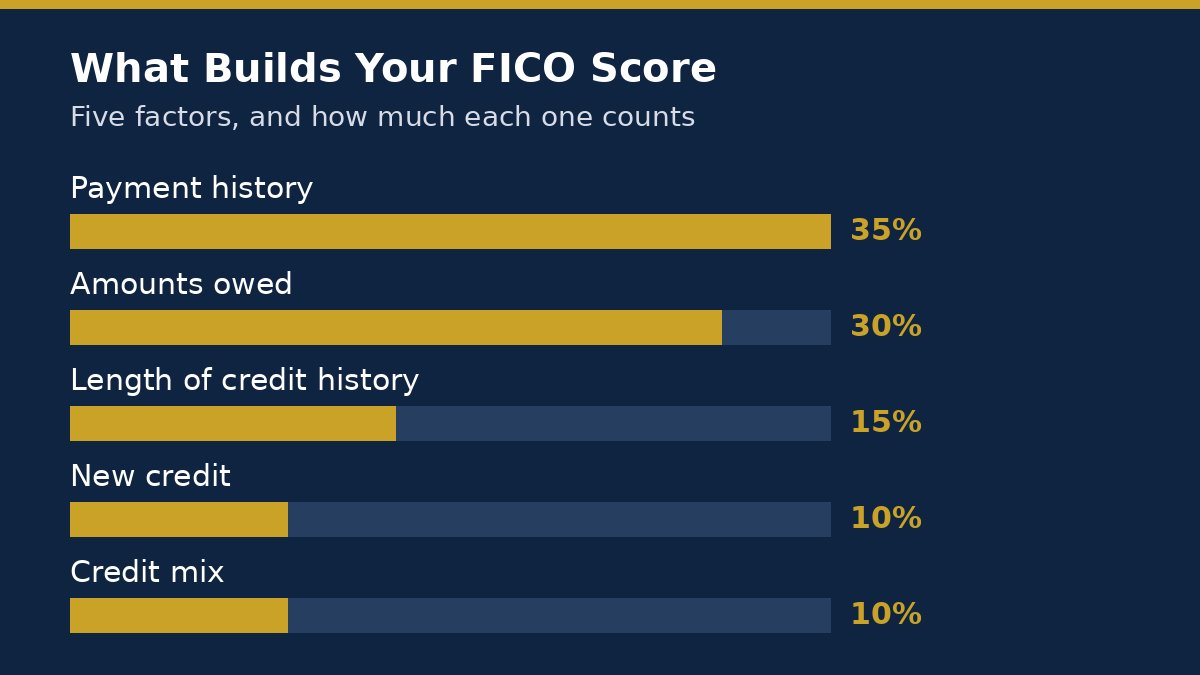
FICO builds its score from five groups of information in your credit report. Each group has a weight, and the weights add up to 100 percent. These are the figures published by myFICO, and you can read them on the myFICO page that explains what is in your credit score.
1. Payment history, 35 percent
This is the biggest piece. It records whether you paid each account on time. A payment only counts as late for your score once it is at least 30 days past the due date. A single late payment can stay on your report for up to seven years, though its effect fades with time. Paying on time, every time, is the single most powerful habit you can build. Our guide on what happens if you miss a credit card payment explains the damage a missed payment can do.
2. Amounts owed, 30 percent
This looks at how much you owe in total, and how much of your available credit you are using. That second part is called credit utilization. If your card limit is 1,000 dollars and your balance is 300 dollars, your utilization is 30 percent. Lower is better. Credit experts generally advise keeping utilization below about 30 percent, and people with the highest scores usually keep it under 10 percent. The worked example below shows the exact math.
3. Length of credit history, 15 percent
This looks at how long you have been using credit, including the age of your oldest account and the average age of all your accounts. A longer history helps, which is one reason to think twice before closing your oldest card.
4. New credit, 10 percent
This looks at how many new accounts you have opened recently. Each application usually creates a hard inquiry, which can lower your score by a few points for a short time. Several applications in a short period can look risky to a lender, so apply for one card at a time.
5. Credit mix, 10 percent
This looks at the types of credit you have, such as credit cards, a car loan, or a mortgage. Having more than one type, handled well, can help a little. This is the smallest factor, so do not open a loan just to improve your mix. It is never worth paying interest for a small score gain.
Why Your Credit Score Matters
Your score does not decide your worth, but it affects real costs. Lenders check it when you apply for a credit card, a car loan, or a mortgage. A higher score can mean approval where a lower score means a refusal, and a lower interest rate. That is why the interest charges on a card matter so much, and our guide on how credit card interest charges work shows how interest adds up when a balance is carried. Landlords and insurers may also check a version of your credit report. A good score gives you more choices and lower costs.
How to Check Your Credit Score and Report for Free
You can get a free copy of your credit report from each of the three bureaus, Equifax, Experian, and TransUnion, once a week at AnnualCreditReport.com. This is the only site authorized by federal law for these free reports, and the Consumer Financial Protection Bureau explains the process on its page about getting a free copy of your credit reports.
Two things to know before you check. First, the free reports do not include your credit score, only the full record the score is built from. Many banks and card issuers show you a score for free on your statement or in their app. Second, checking your own report or score never lowers it. Your own check is a soft inquiry. Only a hard inquiry, when a lender checks your credit because you applied, can lower your score, and then only by a few points for a short time.
When you get your reports, read them line by line. Look for accounts you do not recognize, balances that look wrong, and payments marked late that you paid on time. If you find an error, dispute it yourself for free with the bureau that issued the report. You do not need to pay a company to do this. An accurate negative item, such as a real late payment, cannot be removed early by anyone, no matter what a credit repair advert promises.
Worked Example: How Credit Utilization Moves the Math
Meet Maya. Maya has one credit card with a limit of 2,000 dollars. Her balance is 1,200 dollars. Credit utilization is the balance divided by the limit, times 100 to make a percent. The math is 1,200 divided by 2,000, which equals 0.60. Multiply by 100 to get 60 percent. Maya is using 60 percent of her available credit, which is high.
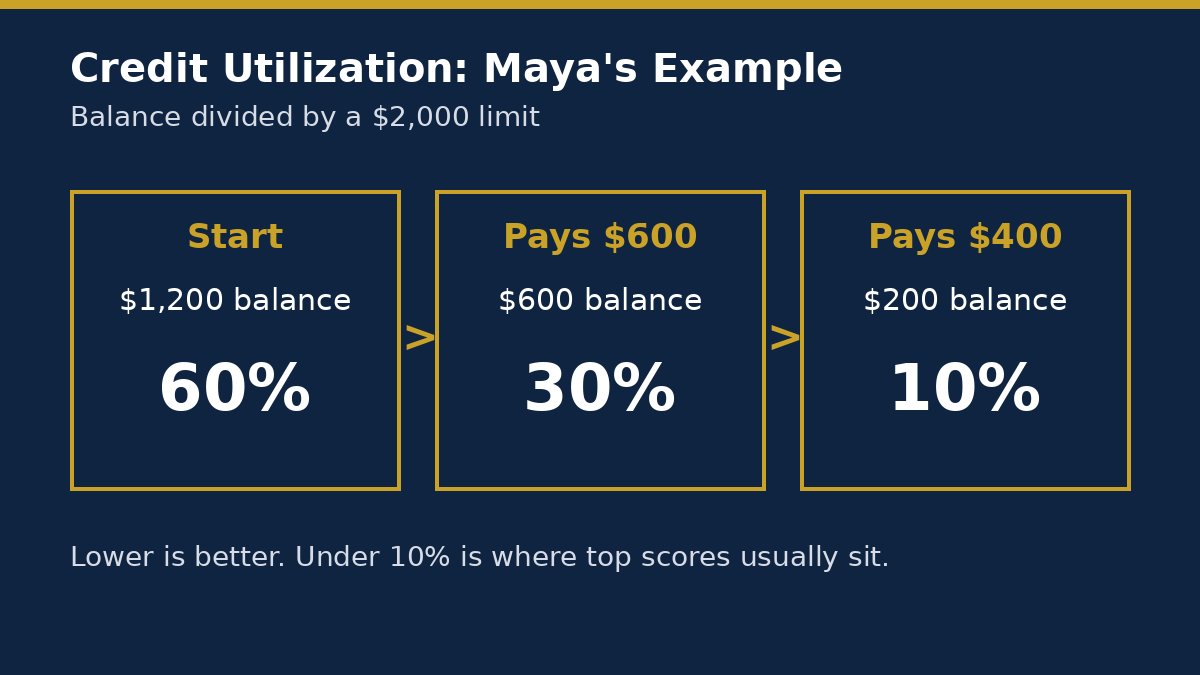
Maya pays 600 dollars toward the card. Her new balance is 1,200 minus 600, which equals 600 dollars. Her new utilization is 600 divided by 2,000, which equals 0.30. Multiply by 100 to get 30 percent. One payment moved her from 60 percent to 30 percent.
Maya pays another 400 dollars the next month. Her new balance is 600 minus 400, which equals 200 dollars. Her new utilization is 200 divided by 2,000, which equals 0.10. Multiply by 100 to get 10 percent. She is now in the range where people with the highest scores usually sit, under 10 percent.
Try the same math with your own cards. Add up your balances, add up your limits, and divide. If the result is above 30 percent, paying the balance down is the fastest honest way to improve that part of your score.
How to Improve Your Credit Score, Step by Step
There is no quick fix. What works is a short list of steady habits.
Step 1: Pay every bill on time
Set up autopay for at least the minimum payment on every account, then pay more by hand when you can. A single on time payment streak, month after month, is the strongest signal you can send. If money is tight, paying the minimum on time still protects your payment history. Our guide on how to pay off credit card debt walks through a plan for clearing a balance without missing payments.
Step 2: Bring utilization down
Pay balances down, starting with the card closest to its limit. Do not close a card just because you paid it off, because closing it removes its limit from your total and can push your utilization up. If you carry a balance, a payoff plan helps. The debt snowball method clears the smallest balance first for quick wins, while the debt avalanche method clears the highest interest balance first to save the most money. Pick the one you will stick with.
Step 3: Leave old accounts open
Your oldest card helps your length of credit history. If it has no annual fee, keep it open and use it for one small purchase now and then, paid off in full. If the fee is not worth it, ask the issuer about switching to a no fee card instead of closing it.
Step 4: Apply for new credit rarely
Each application adds a hard inquiry. Space applications out, and only apply for credit you actually need.
Step 5: Check your reports and fix errors
Pull all three reports at AnnualCreditReport.com and read them. Dispute any error with the bureau, for free. An error removed from your report can lift your score, because the score is only as good as the record behind it.
Step 6: Build a small buffer so a surprise does not become a missed payment
A missed payment often starts as a cash flow problem, not a choice. A small emergency fund means a car repair does not force you to skip a payment. Our guide on how much to keep in an emergency fund shows how to build that buffer in small steps.
Common Mistakes Beginners Make
The first mistake is paying only the minimum every month. The minimum keeps you current, but the balance barely moves and interest keeps growing. Pay more than the minimum whenever you can.
The second mistake is closing a card the moment it is paid off. The open limit was helping your utilization, and the account age was helping your history. Keep it open unless the fee makes it costly.
The third mistake is opening several new cards at once for a signup bonus. Each application is a hard inquiry, and several new accounts at once shorten your average account age.
The fourth mistake is never checking your reports. A free weekly check is worth the few minutes it takes. A mistake you never see is a mistake you never fix.
The fifth mistake is paying a credit repair company to remove accurate information. Accurate negative items stay on your report for up to seven years, and no company can legally remove them early. You can dispute errors yourself, for free.
Frequently Asked Questions
What is a good credit score?
A good FICO score is 670 to 739, on a scale from 300 to 850. Scores of 740 to 799 are very good, and 800 or above is exceptional. You do not need a perfect score to borrow at fair terms.
How long does it take to build a credit score from nothing?
If you have no credit history, you need at least one account open and reported for about six months before a FICO score can be calculated. A first card, used for small purchases and paid on time, is the usual starting point.
Does checking my own credit score lower it?
No. Checking your own report or score is a soft inquiry and has no effect at all. Only a hard inquiry, when a lender checks your credit because you applied, can lower your score, and then only by a few points.
How often should I check my credit report?
Check all three reports at least a few times a year, and more often if you are about to apply for a loan or a card. You can get each report free once a week at AnnualCreditReport.com.
Can I fix a bad credit score?
Yes, but not overnight. Pay every bill on time, bring your utilization down, leave old accounts open, and fix any errors on your reports. Negative items fade with time, and a late payment stays on your report for up to seven years.
Conclusion
A credit score is a three digit number from 300 to 850 that sums up your borrowing history for lenders. FICO weighs five factors: payment history at 35 percent, amounts owed at 30 percent, length of credit history at 15 percent, new credit at 10 percent, and credit mix at 10 percent. A good score is 670 to 739, and it opens up more choices and lower costs.
You can check your reports free every week at AnnualCreditReport.com, and checking your own credit never hurts your score. The habits that raise it are simple: pay on time, keep your utilization low, leave old accounts open, apply rarely, and fix errors when you find them. Start with one step this week. Pull your reports, work out your utilization with the math above, and set up autopay on every account.
This article is for general information and education only. It is not legal or financial advice.
