
What Happens If I Only Pay the Minimum on My Credit Card?
What happens if I only pay the minimum on my credit card?
If you only pay the minimum on your credit card, the account stays current and you avoid a late fee, but the balance shrinks very slowly. Most of each payment goes to interest, and only a small part reduces what you owe. A balance of 1,000 dollars can take more than six years to clear, and the interest can cost almost as much as the original balance. Paying a fixed amount above the minimum clears the same balance far faster and far cheaper.
The minimum payment is a floor, not a plan. It is the smallest amount your card company will accept each month without treating the account as late. It keeps the account open, but it does almost nothing to get you out of debt.
For a full guide to clearing card debt, see How Do I Pay Off Credit Card Debt?
What is a minimum payment?
A minimum payment is the smallest amount you must pay by the due date to keep your credit card account current. Pay at least that amount on time, and you will not be charged a late fee, and the payment will not be reported late to the credit bureaus.
Paying the minimum does not stop interest. Interest keeps building on whatever balance is left. It also does not protect the grace period, which only applies when you pay the full statement balance by the due date. Once you carry a balance, new purchases usually start collecting interest from the day you make them.
The minimum is set by your card agreement, and every card company uses its own version. The number on your statement is that formula applied to your balance that month. It is not a suggestion about how to pay the balance off.
How the minimum payment is usually worked out
Card companies usually work out the minimum payment in one of two ways, and most add a small fixed floor.
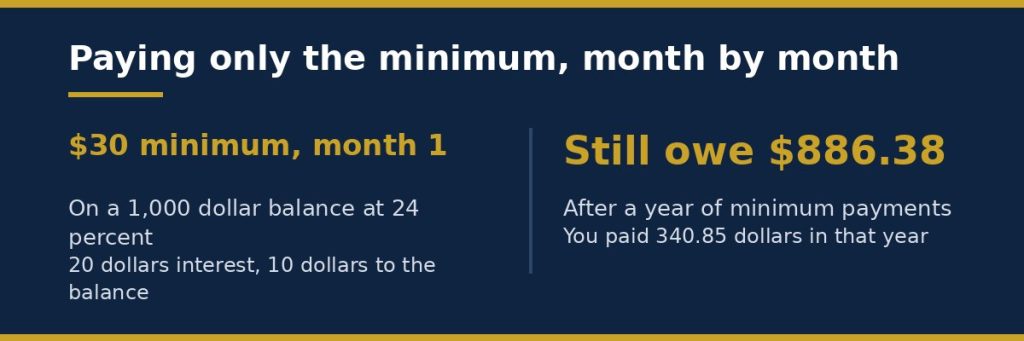
The most common method is interest plus a small slice of the balance. The company adds that month’s interest charge to about 1 percent of the balance. On a 1,000 dollar balance at a 24 percent example annual rate, the interest for one month is 20 dollars and 1 percent of the balance is 10 dollars, so the minimum would be 30 dollars. That is the method used in the worked example below. The Consumer Financial Protection Bureau explains how card companies work out the interest you owe: https://www.consumerfinance.gov/ask-cfpb/how-does-my-credit-card-company-calculate-the-amount-of-interest-i-owe-en-51/
The other common method is a flat percentage of the balance, often between 1 and 3 percent. On a 1,000 dollar balance at 2 percent, the minimum would be 20 dollars.
Almost every card also has a fixed floor, often 25 dollars. If the formula gives a number below the floor, the floor applies instead. If your whole balance is less than the floor, the minimum is the full balance.
The exact formula varies by card and is printed in your card agreement and often on the statement. Check your own statement to see which method your card uses. The numbers in this article are examples, not your card’s terms.
Why minimum-only payments cost so much
Minimum-only payments are so expensive for a simple reason: the payment shrinks as the balance shrinks, so the amount going to the balance gets smaller every month.
Look at the example below. In month 1, the minimum payment is 30 dollars, and 10 dollars of it reduces the balance. By month 3, the payment has fallen to 29.40 dollars, and only 9.80 dollars reduces the balance. After a full year of minimum payments, you still owe 886.38 dollars of the original 1,000 dollars. You paid 340.85 dollars over the year, yet the balance fell by only 113.62 dollars. The rest went to interest.
This is the trap. The payment feels small and manageable, so it is easy to keep making it month after month, while the balance barely moves and the interest keeps coming.
Your statement warns you about this. Under United States law, every credit card statement must carry a Minimum Payment Warning box. It shows how long minimum-only payments would take, how much interest that would cost, and the monthly payment that would clear the balance in three years. The Consumer Financial Protection Bureau explains what that box means: https://www.consumerfinance.gov/ask-cfpb/a-box-on-my-credit-card-bill-says-that-i-will-pay-off-the-balance-in-three-years-if-i-pay-a-certain-amount-what-does-that-mean-do-i-have-to-pay-that-much-if-i-pay-that-much-and-make-new-purchases-will-i-still-owe-nothing-after-three-years-en-36/
A worked example, with real math
Here is a worked example. Every number here is an example. The balance is 1,000 dollars, the annual rate is an example 24 percent, and no new purchases are added. The minimum payment here is the month’s interest plus 1 percent of the balance, with a 25 dollar floor.
First, work out the monthly interest rate. The example annual rate is 24 percent, so divide by 12: 24 divided by 12 equals 2 percent a month. On a 1,000 dollar balance, one month of interest is 1,000 times 0.02, which equals 20 dollars.
Plan A: pay only the minimum each month
Month 1: interest is 20 dollars, and 1 percent of the balance is 10 dollars, so the minimum payment is 30 dollars. Of that, 20 dollars covers interest and 10 dollars reduces the balance, leaving 990 dollars.
Month 2: interest on 990 dollars is 990 times 0.02, which equals 19.80 dollars. One percent of the balance is 9.90 dollars, so the minimum payment is 29.70 dollars. Of that, 19.80 dollars covers interest and 9.90 dollars reduces the balance, leaving 980.10 dollars.
Month 3: interest on 980.10 dollars is 19.60 dollars, and 1 percent of the balance is 9.80 dollars, so the minimum payment is 29.40 dollars. The new balance is 970.30 dollars.
The payment falls a little each month. After 12 months, the balance is still 886.38 dollars. After 24 months, it is still 782.06 dollars. In month 20 the 25 dollar floor takes over. Check: 833.33 times 0.03 equals 25 dollars, so below a balance of about 833 dollars the floor applies.
Carried to the end, Plan A takes 74 months, which is 6 years and 2 months. The total paid is 1,886.98 dollars, so the interest paid is 1,886.98 minus 1,000, which equals 886.98 dollars. You pay almost 887 dollars of interest on a 1,000 dollar balance, nearly doubling what the original purchases cost.
Plan B: pay a fixed 100 dollars each month
Now suppose you pay a fixed 100 dollars every month on the same balance at the same example rate, with no new purchases.
Month 1: interest is 20 dollars. You pay 100 dollars, so 80 dollars reduces the balance, leaving a new balance of 920 dollars.
Month 2: interest on 920 dollars is 18.40 dollars. You pay 100 dollars, so 81.60 dollars reduces the balance, leaving a new balance of 838.40 dollars.
Month 3: interest on 838.40 dollars is 16.77 dollars. You pay 100 dollars, so 83.23 dollars reduces the balance, leaving a new balance of 755.17 dollars.
Notice the difference. In Plan A, the amount reducing the balance gets smaller each month. In Plan B, it gets bigger each month, because the interest charge falls as the balance falls while the payment stays the same.
Plan B takes 12 months: 11 payments of 100 dollars, plus a final payment of 27.03 dollars. The total paid is 1,127.03 dollars, so the interest paid is 1,127.03 minus 1,000, which equals 127.03 dollars.
The comparison
Plan A, minimum only: 74 months, total paid 1,886.98 dollars, interest 886.98 dollars.
Plan B, fixed 100 dollars a month: 12 months, total paid 1,127.03 dollars, interest 127.03 dollars.
Paying a fixed 100 dollars a month instead of the minimum saves 759.95 dollars in interest and clears the balance 62 months sooner. The fixed payment is only about 70 dollars more than the first minimum payment of 30 dollars, yet it saves more than 750 dollars and more than five years.
If your balance is larger, the same pattern applies on a bigger scale. For a plan to clear a 10,000 dollar balance, see How to Pay Off $10,000 Credit Card Debt
What happens if you pay less than the minimum, or miss it
Paying less than the minimum is not the same as paying the minimum. If your payment is below the amount due, the card company can treat it as a missed payment.
A missed payment can bring a late fee, and the card company may apply a higher penalty interest rate. If the payment is 30 days late or more, the card company can report it to the credit bureaus, and a late mark can lower your credit score for years. Missing payments can also cost you a promotional rate, such as a 0 percent introductory rate.
If you cannot make the minimum payment, contact your card company right away, before the due date if you can. The Consumer Financial Protection Bureau says many companies are willing to work with you during a financial emergency: https://www.consumerfinance.gov/ask-cfpb/what-should-i-do-if-i-cant-pay-my-credit-card-bills-en-1697/
Do not ignore the bill. The interest keeps building, the fees add up, and the account can be sent to collections. If the debt feels unmanageable, read When Should I Ask for Help With Debt?
How to pay the balance off faster, step by step
Step 1: Stop adding new charges to the card while you pay it down. Every new purchase adds to the balance and to the interest. Use cash or a debit card for spending until the balance is cleared.
Step 2: Read your statement. Find the minimum payment, the annual rate, and the Minimum Payment Warning box. The box shows how long minimum-only payments would take, what they would cost, and the payment that would clear the balance in three years. That three-year payment is a useful target if you can afford it.
Step 3: Pick a fixed monthly payment above the minimum and pay that same amount every month. A fixed payment is the key, because it does not shrink as the balance shrinks. Even 20 or 30 dollars above the minimum makes a real difference.
Step 4: Pay on time every month, and pay more than the minimum even in a tight month. A small extra payment still cuts the interest.
Step 5: Put any extra money toward the balance. A tax refund or a work bonus can cut months off the payoff time. If you have more than one card, put the extra money on one card at a time. For help choosing which card to attack first, see Which Debt Should I Pay First, Smallest or Highest Interest?
Step 6: If the interest rate is the problem, ask the card company for a lower rate, or look at a balance transfer or a consolidation loan. A lower rate means more of each payment goes to the balance. Read What Is Debt Consolidation? for a plain explanation, and only take it on if the new terms are genuinely better and you will not run the card balance back up.
If you are torn between paying debt and investing, clear high-interest card debt first, because the card rate is usually higher than any return you could reasonably expect from investing. For the full comparison, see Should I Pay Off Debt or Invest First?
Common mistakes to avoid
Do not treat the minimum payment as a payoff plan. It is the floor the card company accepts, not the amount that gets you out of debt.
Do not keep spending on the card while paying the minimum. New purchases add interest from the day you make them once you carry a balance, so the balance can stay flat or even grow while you pay.
Do not pay only the minimum because the statement makes it look normal. The minimum is shown prominently, and the warning box is small. Read the warning box before you decide what to pay.
Do not miss a payment because the minimum felt too small to matter. A missed payment brings fees, a possible penalty rate, and a possible late mark on your credit report. If money is tight, pay at least the minimum, on time.
Do not drain your emergency fund to pay the card in full. A small cash cushion stops the next unexpected bill from going straight back onto the card.
Do not take on a new card or a consolidation loan and then run the old card balance back up. That leaves you with two debts instead of one.
Frequently asked questions
What happens if I only pay the minimum on my credit card?
The account stays current and you avoid a late fee, but the balance shrinks very slowly, because most of each payment goes to interest. A 1,000 dollar balance at an example 24 percent rate can take 74 months to clear and cost about 887 dollars in interest.
How is the minimum payment calculated?
It varies by card. The most common method is the month’s interest plus about 1 percent of the balance, with a fixed floor, often 25 dollars. Another common method is a flat percentage of the balance, often 1 to 3 percent.
Is paying only the minimum bad for my credit score?
Paying the minimum on time does not hurt your score the way a late payment does. But a balance that stays high keeps your credit use high, and high credit use can weigh on your score. Paying the balance down faster usually helps.
What is the Minimum Payment Warning on my statement?
It is a box the law requires on every credit card statement. It shows how long minimum-only payments would take, how much interest that would cost, and the monthly payment that would clear the balance in three years.
How much should I pay instead of the minimum?
Pay a fixed amount above the minimum every month. Even 20 or 30 dollars extra helps. In the worked example, a fixed 100 dollars a month cleared a 1,000 dollar balance in 12 months and saved about 760 dollars in interest compared with minimum-only payments.
Conclusion, and your first step today
Paying only the minimum keeps your card account current, but it is an expensive way to carry a balance. On a 1,000 dollar balance at an example 24 percent rate, minimum-only payments take 74 months and cost about 887 dollars in interest, while a fixed 100 dollars a month clears it in 12 months for about 127 dollars of interest.
Your first step today is small: read your statement, find the Minimum Payment Warning box, and pick a fixed monthly payment above the minimum that you can afford. Set it up as an automatic payment if you can, so you do not have to decide again each month. Then stop adding new charges to the card until the balance is gone.
This article is for general information and education only. It is not legal or financial advice.
