

How to Save Money on Your Electric Bill: The Highest-Impact Fixes
The fastest way to save money on your electric bill is to fix the biggest uses of electricity first. Heating and cooling, hot water, and large appliances use the most power in most homes. Lighting, laundry, and devices left on standby use less, but they still add up. If you start with small changes and ignore the big ones, your bill will barely move.
This guide shows you how to save money on your electric bill by starting with the highest-impact fixes, with a worked example using clearly labelled example numbers.
The direct answer: what saves the most?
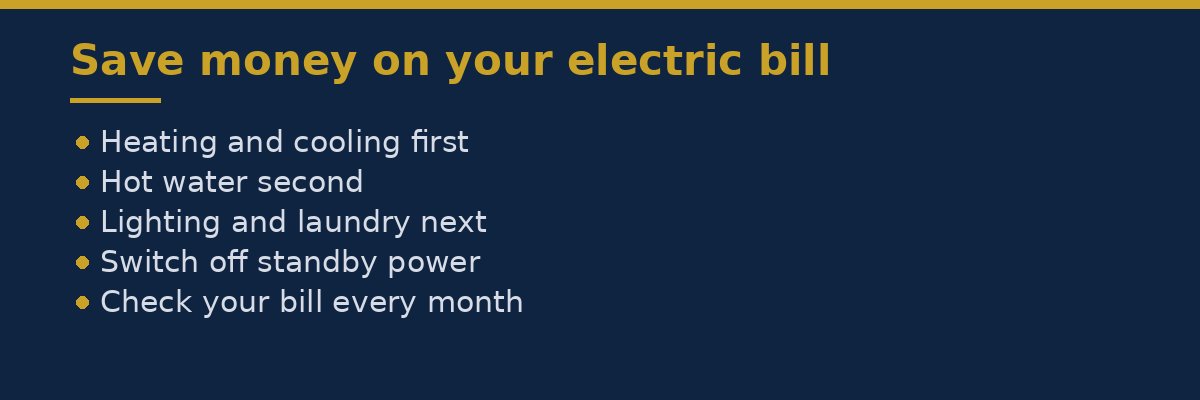
In most homes, heating and cooling save the most, because they run for many hours and use a lot of power. Hot water is next, because heating water takes a lot of energy. After that, look at laundry, drying, and cooking, then lighting, then devices left on standby. That order matters. Turning off one light saves a little. Turning down heating or cooling by a small amount, and using it only when you need it, can save much more.
Step 1: Read your bill and find your starting point
Before you change anything, read your last two or three electric bills. Look for three facts: how much you pay each month, how much electricity you use, and whether your use is higher in summer or winter. Your bill may show your use in kilowatt hours, often written as kWh. A kilowatt hour is simply a unit of electricity use. The more units you use, the higher your bill.
Write down your average monthly bill for the last three months. That is your starting point. If your bill is much higher in one month, look for the reason. Was it a hot month with more cooling, a cold month with more heating, or a month when you were home more? A bill that jumps for a clear reason is easier to fix than a bill that is always high for no clear reason.
Check whether your bill includes a fixed charge, a charge you pay even if you use very little electricity, plus a charge for the units you use. Do not compare your bill to a neighbour bill. Homes are different in size, insulation, heating, cooling, and how many people live there. Compare your bill to your own bill last month, and to your own bill last year, if you have it.
If you want a simple starting point for your whole budget, our guide to how to create a monthly budget shows how to fit a utility bill into a monthly plan.
Step 2: Heating and cooling, the highest-impact fix
Heating and cooling are usually the largest part of an electric bill, especially if you use electric heating or air conditioning. Small changes here save the most.
First, change the temperature by a small amount. In summer, set cooling a little higher than usual. In winter, set heating a little lower than usual. A change of one or two degrees is often comfortable after a day or two, and it can cut the time your system runs. Second, heat or cool only the rooms you use. Close doors to rooms you do not use, and do not heat or cool an empty room all day.
Third, use the timer. Set heating or cooling to turn off when you are out, and to turn on shortly before you come home. There is no need to heat or cool an empty home all day. A simple timer, or a programmable thermostat if you have one, can do this for you. Fourth, stop drafts. Check windows and doors for gaps where warm or cool air escapes. A simple draft strip, a door seal, or closing curtains at night can help keep the temperature steady, so your system runs less. In summer, close curtains on sunny windows during the hottest part of the day. In winter, open curtains on sunny windows during the day, and close them at night.
Fifth, keep filters and vents clean, if your system has them. A blocked filter makes the system work harder, and use more power, for the same result. Do not open or repair electrical equipment yourself if you are not qualified to do so. Start with temperature, timing, and drafts, which cost little or nothing, and see how much your bill falls first.
Step 3: Hot water, the second highest-impact fix
Heating water takes a lot of energy, so hot water is often the second largest use of electricity in a home. Small changes here can save real money.
First, take shorter showers. A shower that is two minutes shorter uses less hot water, and less electricity to heat that water. Do not leave the water running while you brush your teeth or wash your hair. Second, wash clothes in cold water when the care label allows it. Most modern washing powders and liquids work well in cold water, and many clothes do not need hot water to get clean. Check the label first, and use cold water for everyday loads.
Third, fix a dripping hot tap. A tap that drips hot water wastes both water and the electricity used to heat it. Fourth, check the temperature of your water heater, if you can do so safely. Many water heaters are set higher than needed. If you are not sure what setting is safe, ask a qualified technician, and do not guess.
Step 4: Laundry, drying, cooking, and the fridge
Laundry is a regular cost, and a few simple changes can lower it. Wash full loads, not half loads. A washing machine uses almost the same amount of power for a half load as for a full load, so two half loads cost more than one full load. Wait until you have a full load, unless the clothes are needed urgently. Use a shorter wash cycle for clothes that are not very dirty. Many machines have a quick or eco cycle that uses less power and less water.
Dry clothes outside or on a rack when you can, instead of using a tumble dryer. A tumble dryer uses a lot of power, and it runs for a long time. Even drying half your loads outside, on a dry day, can cut this cost. If you must use a dryer, clean the lint filter each time, so air can flow freely and the dryer finishes faster.
Cooking uses power, but it is often less than heating, cooling, or hot water. Use a lid on a pot when you boil water or cook food, so the food cooks faster and uses less power. Use a microwave, a slow cooker, or a small oven for small meals, instead of a large oven, if you have the choice. Keep your fridge working well. Do not leave the fridge door open while you decide what to eat, and check that the door seal closes properly, so cold air does not escape. Do not put hot food straight into the fridge. Let it cool first.
Step 5: Lighting and standby power
Lighting is easy to see, and easy to fix, but it usually saves less than heating, cooling, or hot water. Do it after the bigger fixes, not before them. Turn off lights in rooms you are not using. This is the simplest saving, and it costs nothing. Use energy saving bulbs, such as LED bulbs, when an old bulb needs replacing. LED bulbs use less power than old bulbs for the same amount of light, and they last longer. Do not replace every bulb at once if they still work. Replace them one by one, as they burn out, so you do not waste money. Use natural light during the day, where you can, instead of turning on lights in the middle of the day.
Many devices use a small amount of power even when they are off, if they are left plugged in and on standby. A television, a game console, a computer, a printer, and a phone charger can all use standby power. One device uses very little, but many devices, all day and all night, add up. Turn off devices at the plug when you are not using them, if it is safe and practical to do so. A power strip with a switch makes this easy: turn off the whole strip at night, and turn it on again in the morning. Do not turn off a device that needs to stay on, such as a fridge, a medical device, or a security system. Unplug phone and laptop chargers when they are not charging a device, and do not leave a computer on all night if you do not need it.
Worked example: an example electric bill broken down
This example uses clearly labelled example numbers only. These are not real electricity prices, and they are not your real bill. They are used only to show how savings can add up.
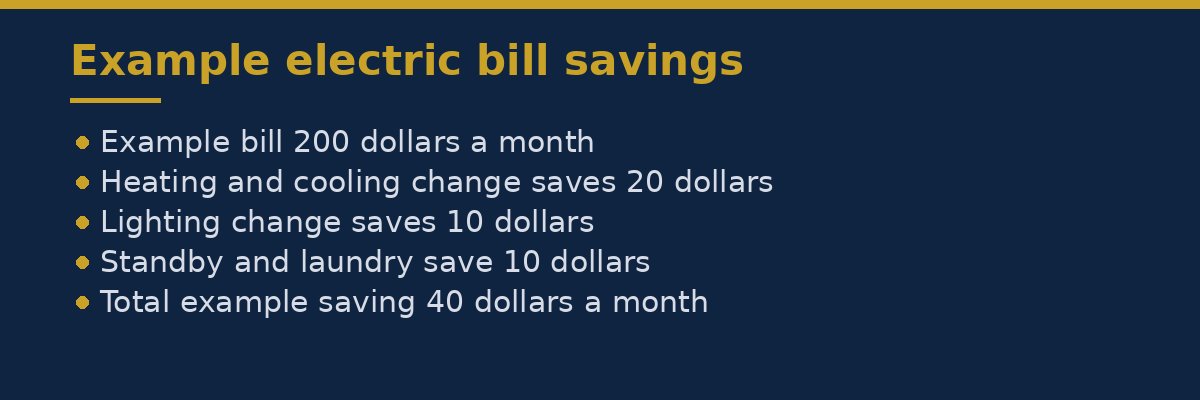
Imagine an example monthly electric bill of 200 dollars. Here is one simple way to break it down, as an example only. Heating and cooling: 80 dollars. Hot water: 40 dollars. Laundry and drying: 20 dollars. Cooking and fridge: 30 dollars. Lighting: 15 dollars. Standby and small devices: 15 dollars. Add those together: 80 plus 40 is 120, plus 20 is 140, plus 30 is 170, plus 15 is 185, plus 15 is 200 dollars. That matches the example total.
Now imagine you make three changes. First, you change the heating and cooling temperature by a small amount, use the timer, and close curtains to stop drafts. As an example, say that saves 25 percent of the heating and cooling cost. 25 percent of 80 dollars is 20 dollars. That is 80 times 0.25, which equals 20.
Second, you take shorter showers and wash clothes in cold water. As an example, say that saves 10 dollars from the hot water and laundry costs together. Third, you switch to LED bulbs as old bulbs burn out, turn off standby devices at night, and dry half your laundry outside. As an example, say that saves 10 dollars from lighting, standby, and drying together.
Add the example savings together: 20 plus 10 plus 10 is 40 dollars a month. The example bill falls from 200 dollars to 160 dollars a month. Over 12 months, 40 dollars a month is 480 dollars, because 40 times 12 equals 480. Your real bill and your real savings will be different, because your home, your climate, and your habits are different. The point of the example is the order: heating and cooling first, then hot water, then the smaller changes.
A simple monthly check to keep savings going
Once you have made the changes, check your bill each month. Write down the total, and compare it to the same month last year, if you have it, and to last month. If the bill falls, keep doing what you are doing. If it rises again, check whether the weather changed, whether you were home more, or whether a habit slipped. Make one change at a time, and give it a month to show up on your bill.
For more ideas on cutting regular costs, our guide to how to cancel subscriptions to save money can help you find other monthly savings, and our guide to how to save money on groceries shows how food savings fit into the same budget. The US Department of Energy publishes free energy saving guidance for homes: Energy Saver, US Department of Energy. If you need to repair or change any electrical equipment, speak to a qualified professional.
Common mistakes when trying to save on electricity
The first mistake is starting with the smallest saving. Turning off lights is good, but it will not fix a bill that is high because heating runs all day. Start with heating, cooling, and hot water. The second mistake is buying expensive gadgets before making free changes. Make the free changes first: temperature, timing, drafts, shorter showers, full laundry loads, and turning off standby power. The third mistake is comparing your bill to someone else bill. Compare your bill to your own past bills, not to a neighbour. The fourth mistake is giving up after one high bill. Look at the average over three months, not one month alone, before you decide whether a change worked.
Frequently asked questions
How can I save money on my electric bill fast?
Start with heating and cooling, because they usually use the most power. Change the temperature by a small amount, use a timer so heating or cooling does not run in an empty home, and stop drafts. Then look at hot water, with shorter showers and cold water washing. Those changes cost little or nothing, and they can show up on your next bill.
What uses the most electricity in a home?
In most homes, heating and cooling use the most, followed by hot water, then large appliances such as laundry dryers, cookers, and fridges. Lighting and small devices use less, although they still add up over a month. Your own home may be different, so check your bill and your habits to see where your power goes.
How much can I save on my electric bill?
It depends on your home, your climate, and your habits. The worked example in this guide uses an example bill of 200 dollars a month, and example savings of 40 dollars a month, or 480 dollars over 12 months. Those are example numbers only, not a promise. Your real saving will be different, and it will be larger if your bill is high because of heating, cooling, or hot water, and smaller if your bill is already low.
Conclusion
How to save money on your electric bill comes down to order. Fix heating and cooling first, then hot water, then laundry and cooking, then lighting and standby power. Make free changes before you spend money on new equipment. Check your bill each month, and compare it to your own past bills, not to someone else.
Your first step today is simple. Read your last electric bill, write down your average monthly total for the last three months, and make one heating or cooling change, such as setting a timer, changing the temperature by a small amount, or closing curtains to stop drafts.
This article is for general information and education only. It is not legal or financial advice.
