
How to Pay Off Debt Fast With a Low Income
Paying off debt fast with a low income is possible, but it looks different from paying off debt on a high income. You cannot fix a tight budget by cutting a large amount you do not have. You fix it by protecting essentials first, paying minimums on every debt, sending every spare dollar to one debt at a time, and asking for help that is made for low income households.
This post is only about the low income angle: budgeting when money is tight, hardship programmes, negotiating with creditors, community help, prioritising essentials, and finding extra money when there is very little to spare.
The direct answer for a low income
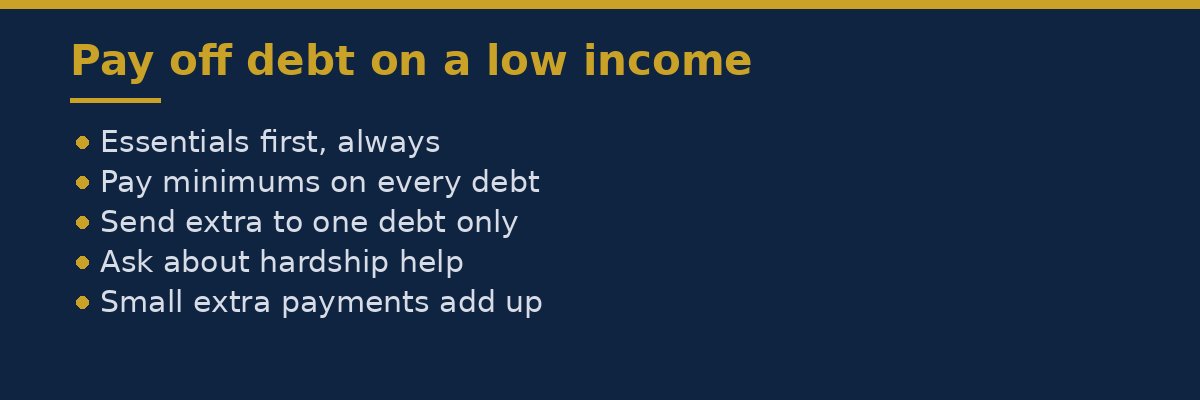
If your income is low, start in this order. First, list your take home pay and your essential costs: rent, food, utilities, transport to work, and minimum debt payments. Second, pay those essentials and minimums first, before anything else. Third, pick one debt to attack with extra money, and pay only the minimum on the others. Fourth, call your creditors and ask about hardship help, lower payments, or a pause in interest. Fifth, look for small, steady ways to find extra money, even 25 or 50 dollars a month, and send it to that one debt.
Fast, on a low income, usually means steady and focused, not large and sudden. A small extra payment every month, without missing a minimum, will move a debt down over time.
Step 1: Know your real numbers on a low income
Start with your real take home pay, after tax, for a normal month. If your hours change, use your lowest normal month, not your best month. If you get paid weekly, add your weekly pay for the month, and use the average of the last three months if you need a steadier figure.
Then list every debt you have, with four facts for each one: who you owe, how much you owe in total, the minimum payment, and the due date. Include credit cards, personal loans, store cards, car loans, medical bills, and any other debt. Do not leave out a small debt because it feels embarrassing, or a large debt because it feels scary. You cannot make a plan with half the numbers.
Then list your essential costs: rent or mortgage, food at home, utilities, transport to work, basic phone, insurance you must keep, and minimum debt payments. Everything else is a want, even if it feels important.
If your essentials and minimums add up to more than your take home pay, do not skip a minimum payment in silence. Ask for help, from a creditor, a nonprofit credit counsellor, or a community service, as explained below. Skipping a payment without telling anyone usually adds fees, while asking early can lead to a lower payment or a temporary plan.
Our guide to how to make a debt payoff plan covers the basic plan structure in more detail.
Step 2: Protect essentials first, always
On a low income, the order of payment matters more than the size of the payment. Pay in this order: food, rent, utilities, transport to work, and minimum debt payments. These keep a roof over your head, keep you fed, keep the lights on, and keep you able to earn.
Do not pay extra on a debt before you have paid rent, food, and utilities for the month. Do not send extra money to a credit card while your electricity bill is unpaid. That is not a debt plan, it is a new problem.
If you have to choose between two essentials, pay the one that keeps you housed and working first, and call the other provider the same day to ask about a payment plan or extra time. Keep a small buffer if you can, even 50 dollars, for a cost that always appears, like a bus fare rise, a medicine, or a school cost. A plan with no buffer breaks the first time real life happens.
Step 3: Pick one debt and focus your extra money
When money is tight, splitting a small extra amount across every debt does very little. Sending the whole extra amount to one debt does more, because that debt falls faster, and when it is gone, its minimum payment becomes extra money for the next debt.
Choose your one debt in one of two simple ways. If you need a quick win to stay motivated, pick the smallest debt first, and pay it off, then move to the next smallest. This is often called the snowball method. If you want to save the most interest over time, pick the debt with the highest interest rate first. This is often called the avalanche method. Either way is fine. The key is to pick one, stick to it, and pay only the minimum on the others.
Do not take on a new debt to pay an old debt, unless a qualified adviser has looked at your full situation and explained the risks to you. Get advice first, in person, from a nonprofit service, before you sign anything.
Worked example: a low income debt plan with real maths
This example uses round numbers that are stated clearly, so you can follow the maths. It is an example only, not a promise about your situation.
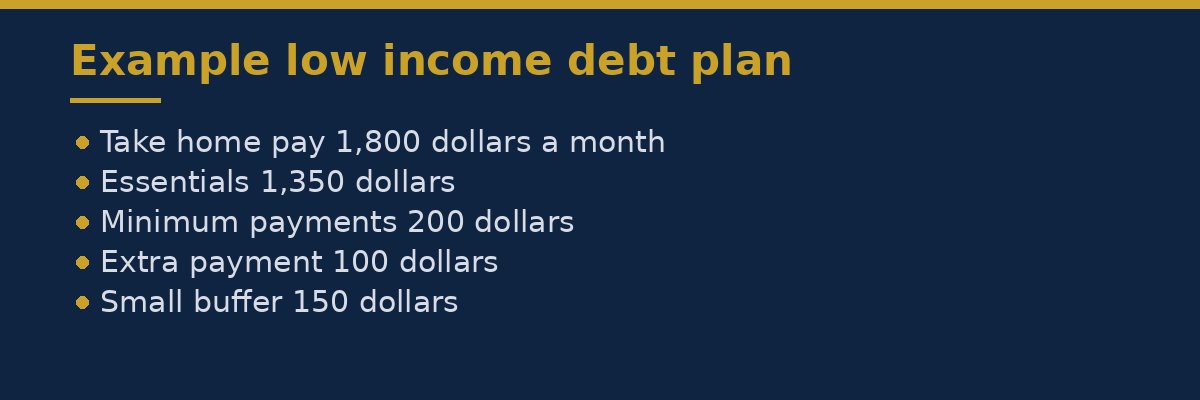
Imagine Maya takes home 1,800 dollars a month after tax. Her essential costs are: rent 700 dollars, food at home 300 dollars, utilities 150 dollars, transport to work 120 dollars, and phone 80 dollars. Add those together: 700 plus 300 is 1,000, plus 150 is 1,150, plus 120 is 1,270, plus 80 is 1,350 dollars for essentials.
Maya has three debts. The minimum payments are: store card 50 dollars, credit card 100 dollars, and personal loan 50 dollars. Add those together: 50 plus 100 plus 50 is 200 dollars in minimum payments. Essentials plus minimums are 1,350 plus 200, which is 1,550 dollars. Maya takes home 1,800 dollars, so 1,800 minus 1,550 is 250 dollars left.
Maya keeps 150 dollars as a small buffer for irregular costs, and she has 100 dollars left for extra debt payments. She picks the smallest debt, the store card, and sends the whole 100 dollars extra to that card, on top of its 50 dollar minimum. That means she pays 150 dollars to the store card that month, 100 dollars to the credit card, and 50 dollars to the personal loan.
If she keeps that up for six months, she will have sent 600 dollars in extra payments to the store card, plus the minimums, and that card will be much smaller or gone. When it is gone, its 50 dollar minimum becomes extra money too, so she will then have 150 dollars a month extra to send to the next debt.
Step 4: Call your creditors and ask about hardship help
Many people on a low income never call their creditors, because they feel ashamed or afraid. Calling is one of the most useful steps you can take, and it costs nothing.
Before you call, write down three facts: your take home pay, your essential costs, and what you can pay each month. Then call the number on your statement, and say, in plain words, that your income is low, you want to keep paying, and you need help to make the payment affordable.
Ask whether the monthly payment can be lowered for a few months, whether interest can be paused or lowered, whether a late fee can be removed, whether there is a hardship programme for low income customers, and whether the due date can be moved to match your payday.
Write down what the person says, including the date and any reference number. Ask them to send the new arrangement in writing before you rely on it. Do not agree to a payment you cannot keep.
Our guide to how to talk to a lender if you cannot pay has a simple script and a checklist for these calls.
If a creditor will not help, or you feel pressured, do not agree on the spot. Say you need time to check, and talk to a nonprofit credit counsellor first. You can read the official Consumer Financial Protection Bureau explanation of credit counselling and debt management plans here: What is credit counseling?.
Step 5: Find extra money when there is very little to spare
On a low income, extra money is usually small, and it comes from small changes, not from one big cut. Look for 25 dollars here and 50 dollars there, and send it to your one chosen debt the same week, before you can spend it.
Start with food: cook at home more often, plan meals for the week, and buy the cheaper version of the same food where you can. Start with transport: walk or take the bus for short trips if it is safe and practical. Start with subscriptions: cancel any subscription you have not used in the last month.
Sell things you no longer need. Clothes, books, electronics, furniture, and toys that are sitting unused can become 25 or 50 dollars of extra debt payment. Sell one item at a time, and send the money to your debt the same day.
Look for small extra income that fits your hours, such as a few hours of weekend work or a one off job for a neighbour. Only take on extra work if you can do it safely and without losing more money on transport or childcare than you earn.
Check whether you can claim any help you are entitled to. In the United States, the Earned Income Tax Credit is a tax credit for people on low to moderate incomes: Earned Income Tax Credit. This is general information only, not tax advice, so check the official IRS page for the current rules, or speak to a qualified tax adviser. Do not count on a tax refund, a bonus, or a gift to pay off debt.
Step 6: Get community help, and do not try to do this alone
A nonprofit credit counsellor can look at your full list of debts, income, and costs, and help you make a plan. A good counsellor will not charge a large fee, and will explain your options in plain words. Be careful of any service that charges a large upfront fee, promises to make your debt disappear, or tells you to stop paying your creditors without a clear plan. Those are warning signs. A local food bank, community centre, or charity can help with food, utilities, or a one off emergency cost, so that your debt plan does not break in a hard month. Using that help is not a failure. It is a way to protect your essentials and keep your minimum payments going. If you are behind on rent or utilities, talk to your landlord or utility company early, and ask about a payment plan or a local assistance programme. If you cannot pay a minimum, do not hide. Pay food, rent, and utilities first, then call the creditor before the due date and ask about a lower payment, a pause, or a hardship plan. Talk to a nonprofit credit counsellor the same week, and take your list of debts and costs with you. Do not take a payday loan or another high cost loan to pay a minimum, unless a qualified adviser has explained the full cost and risk to you. Keep a simple record of every payment you make, every call you make, and every arrangement you agree.
Common mistakes on a low income debt plan
The first mistake is cutting essentials to pay extra on a debt. Skipping meals, skipping medicine, or falling behind on rent to pay a credit card faster will cause a bigger problem than the debt itself. Protect essentials first, always. The second mistake is paying extra on one debt while missing a minimum on another. Pay every minimum first, then send extra to one debt. The third mistake is borrowing to pay debt without advice, and the fourth is quitting after one bad month. A bad month is normal. Pay what you can, call the creditor, and restart the plan next month. On payday, move your extra debt payment to your chosen debt the same day, before you spend it. Once a month, add up what you paid, check the new balance on your chosen debt, and write down the next month target. If your income changes, change the extra amount, not the method.
Frequently asked questions
How can I pay off debt fast with a low income?
Pay essentials and every minimum first, pick one debt to attack with extra money, call your creditors to ask about hardship help, and find small extra amounts each month, even 25 or 50 dollars, and send them to that one debt. Fast on a low income usually means steady and focused, not large and sudden.
Which debt should I pay first on a low income?
Pick one debt only. If you need a quick win, pick the smallest debt first. If you want to save the most interest over time, pick the debt with the highest interest rate first. Pay only the minimum on the others, and do not switch your chosen debt every month.
What if I cannot afford the minimum payment?
Pay food, rent, and utilities first, then call the creditor before the due date and ask about a lower payment, a pause, or a hardship programme. Talk to a nonprofit credit counsellor the same week, and take your full list of debts, income, and costs with you. Do not skip a payment in silence.
Conclusion
How to pay off debt fast with a low income comes down to a few clear steps, repeated every month. Protect food, rent, utilities, and transport. Pay every minimum on time. Pick one debt, and send every spare dollar to it. Call your creditors and ask about hardship help. Find small extra money, and use community help when you need it.
You do not need a large income to start. You need a real list of numbers, a clear order, and a plan you can keep in a bad month as well as a good month. Start today: write down your take home pay, your essentials, and your minimum payments, and pick the one debt you will attack first.
This article is for general information and education only. It is not legal or financial advice.
