

How to Make Extra Money: A Beginner’s Guide to Earning More, Online and Offline
Learning how to make extra money starts with one simple idea. Extra money comes from selling your time, your skills, or things you own. You can do it online from a computer, or offline in your own town. You can work a few hours a week, or build something bigger over time. This guide covers both sides, online and offline, so you can pick the way that fits your life.
This guide is a broad hub. It covers local jobs, gig work, selling things, freelancing, and part time work, in one place. If you only want work you can do from home, read our guide How Do I Make Extra Money From Home? instead. That post stays inside the home. This post goes wider, so you can compare every option and choose well.
Extra money takes real work, and the amount depends on your hours, your skills, and your area. There is no trick that pays well for no effort. But a few focused hours a week can add up to a useful amount.
How much extra money can you realistically make?
The amount you can make depends on three things: how many hours you can give, what skill you offer, and what people near you, or online, will pay for it. A simple way to think about it is pay per hour, times hours per week, times weeks per month.
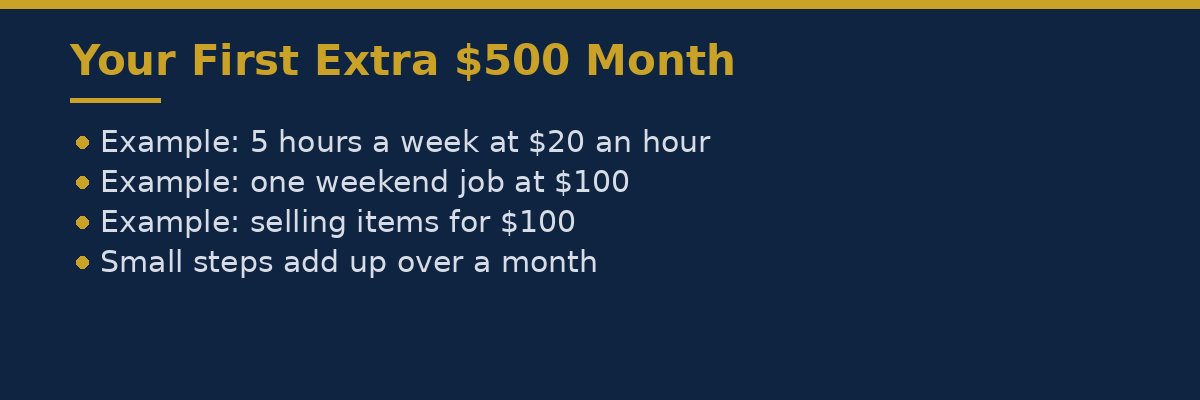
Here is example math, using round numbers that are only examples. If you earn 20 dollars an hour for 5 hours a week, that is 100 dollars a week. Over 4 weeks, that is 400 dollars a month. If you earn 15 dollars an hour for 10 hours a week, that is 150 dollars a week, or 600 dollars a month. Your own numbers will be different, and that is fine. The point is to do the math before you start, so you know what an option is really worth.
Some ways pay by the hour, like part time shop work or cleaning. Some pay by the task, like a delivery or a single design job. Some pay by the sale, like selling a used item. Hourly work is the most predictable. Task work can pay more per hour, but the work is less steady.
Do not trust any offer that promises a large income for almost no work. A real opportunity can tell you plainly how you get paid and what the work involves. If it cannot, walk away. Our guide on how to avoid side income scams explains the warning signs in detail.
Start here: pick one way that fits your life
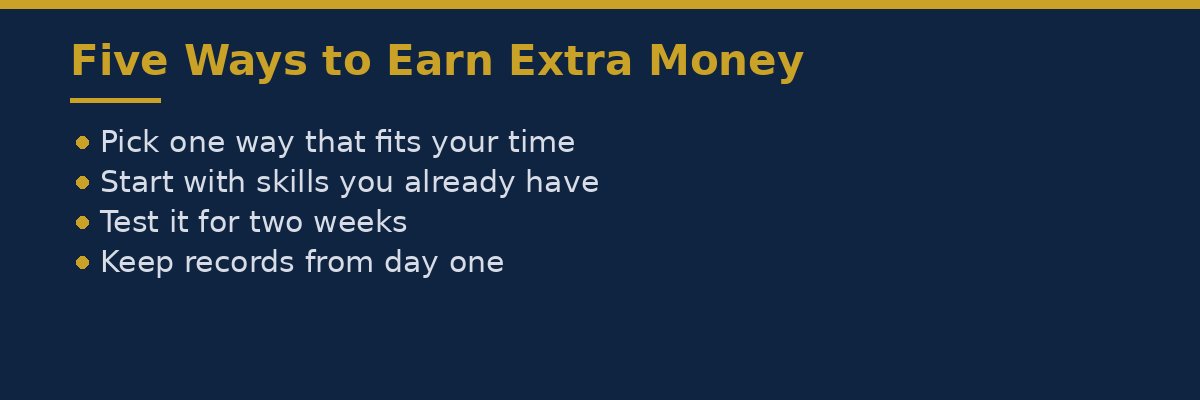
Do not try five ideas at once. Pick one, test it for two or three weeks, and then decide. Ask yourself three questions.
First, how many hours do you really have? Be honest. If you have 5 hours a week, pick something that works in short blocks, like deliveries or selling items. If you have 15 hours or more, a regular part time job or steady freelance work may fit better.
Second, what can you already do? You do not need a new skill to start. If you can clean, cook, drive, write, fix things, teach, or organise, someone will pay for that. Starting with a skill you already have is faster than learning a new one first.
Third, do you want to work online, offline, or both? Online work needs a computer and internet, and you can reach people far away. Offline work needs you to be in a place, and you get paid by people near you. Many beginners mix the two, for example a local weekend job plus selling items online.
Offline ways to make extra money
Offline work is work you do in person, in your town. It is often the fastest way to get paid, because you meet the person, do the work, and get paid the same day or the same week.
Local part time jobs
Shops, cafes, restaurants, warehouses, and offices often need evening and weekend help. These jobs usually pay by the hour and have a set schedule, which makes the income predictable. Ask in person, or check local job listings. A regular shift of 8 hours a week is a solid start. If you are starting with no money at all, read How Can I Start a Side Income With No Money?
Gig work in your area
Delivery driving, food delivery, rideshare driving, and task work through local apps let you choose your hours. You are usually paid per delivery or per task, plus tips in some cases. Before you start, check the costs. Fuel, car wear, and phone data come out of your pay, so track them.
Services for people near you
Many people will pay for help with cleaning, gardening, moving, babysitting, pet sitting, tutoring, or simple repairs. You can start by telling friends, family, and neighbours what you offer, and asking them to pass the word on. One happy customer often leads to the next. Set a clear price before you start, and write it down.
Selling things in person
Garage sales, local markets, and community buy and sell groups are good places to sell furniture, clothes, tools, and other items you no longer need. You get cash in hand, and you do not pay shipping.
Online ways to make extra money
Online work lets you reach people beyond your town. It usually takes longer to get the first payment, but it can fit around a job or family life.
Freelancing your skills
Freelancing means selling a skill to clients, one job at a time. Common beginner freelance skills are writing, graphic design, data entry, virtual assistance, social media help, and simple website work. Start with one service, one clear offer, and a simple price. For example, “I will write a 500 word blog post for 25 dollars” is clearer than “I do writing.”
Selling things online
You can sell used items on online marketplaces, or sell handmade goods or digital products. Used items are the easiest start, because you already own them. Take good photos, write an honest description, and price the item by checking what similar items sold for. Remember to count shipping and platform fees before you call it profit.
Tutoring and teaching online
If you know a school subject, a language, music, or a practical skill, you can teach it online in one to one sessions. You set your hours, and you are paid per lesson. Start with a subject you know well.
Content, surveys, and small tasks
Some sites pay for surveys, testing websites, or small online tasks. These pay the least per hour, and they are best treated as pocket money, not as a main income. Never pay to join a site that offers this kind of work.
Selling things you already own
Selling what you already own is the fastest way to make your first extra money, because there is nothing to learn first. Walk through your home and look for items in good condition that you have not used in a year: clothes, electronics, books, furniture, sports gear, and tools.
Price each item by checking what similar items actually sold for. Clean the item, take photos in good light, and write an honest description. Keep the money from selling separate from your spending money, at least for the first month, so you can see exactly how much you made.
Your first week: a simple start plan
Here is a plan you can follow in your first week, one small step a day.
Day 1: Write down your free hours and your skills. Pick one way to earn from the lists above. If you want more ideas first, see Side Income Ideas for Beginners.
Day 2: Check what it pays. Look at local job listings, marketplace prices, or freelance rates for your skill. Do the hourly math from earlier in this guide.
Day 3: Set up what you need. That may be a simple profile, a few photos of items to sell, or a short message telling people what you offer.
Day 4: Tell five people. Friends, family, neighbours, or an online group. Say what you do, what it costs, and when you are free.
Day 5: Do the first job, or list the first items. Do not wait for everything to be perfect.
Day 6: Write down what you earned, what you spent, and how long it took. This is your real hourly rate.
Day 7: Decide. If it worked, do more of it next week. If it did not, change one thing, the price, the hours, or the offer, and test again.
Worked example: your first extra 500 dollars a month
Here is a full example using round numbers, so you can see how small pieces add up. These are example figures only, to show the math.
Suppose you have 8 free hours a week, and you mix three ways of earning.
First, a weekend local job: 4 hours a week at 20 dollars an hour. That is 80 dollars a week.
Second, selling items online: you sell 4 items a month for 25 dollars each, after fees and shipping. That is 100 dollars a month.
Third, a small freelance task: one task a week at 25 dollars. That is 100 dollars a month.
Now add it up. The weekend job is 80 dollars a week times 4 weeks, which is 320 dollars a month. Add the 100 dollars from selling, and the 100 dollars from freelancing. The total is 520 dollars a month.
That is more than the 500 dollar goal, from 8 hours a week of part time work, plus a few items sold and one small task a week. Your mix will be different. The lesson is the same: combine a steady hourly base with one or two smaller streams, and the total grows faster than any single one alone.
Watch out for scams and hidden costs
Extra money attracts scams, because scammers know beginners are hopeful. Here are the main warning signs.
You are asked to pay to start, for a kit, a training course, or a background check that costs far more than a normal one. Real employers and real clients do not ask you to pay them first.
You are promised a large income for almost no work, or a guaranteed income. No honest work can guarantee that.
You are asked to cash cheques, move money for someone else, or share your bank login. Never do this. It is a common fraud, and it can cost you your bank account.
You are asked to work for free for a long trial, with a promise of pay later. A short sample is normal in some freelance work, but a long unpaid trial is not.
Also watch the hidden costs of real work: fuel, parking, phone data, supplies, platform fees, and taxes. Keep every receipt, and write down every cost.
Taxes on extra money, in simple terms
In most cases, money you earn outside a regular job still counts as income, and you may need to report it and pay tax on it. The rules depend on where you live and how much you earn, so check the rules for your own country and area.
Keep records from day one: what you earned, when, from whom, and what you spent to earn it. A simple notebook or spreadsheet is enough. Keep receipts for costs like fuel, supplies, and fees.
If you do gig or freelance work in the United States, the IRS has a Gig Economy Tax Center that explains the basics in plain language. This article is not tax advice. If your situation is complex, speak to a qualified tax professional.
Common mistakes to avoid
Do not spend money to start before you have earned anything. Start with free options, and only spend on tools or supplies after the income has started.
Do not quit your main job for a side income that has not paid you yet. Build the side income first, test it for a few months, and only then think about bigger changes.
Do not ignore your time. An option that pays 50 dollars but takes 10 hours is worse than an option that pays 40 dollars and takes 2 hours. Always check the hourly rate, after costs.
Do not mix your extra money with your spending money. Keep it in a separate place, even if that is just a separate envelope or account, so you can see what you really earned.
Frequently asked questions
How can I make extra money fast?
Selling things you already own is usually the fastest, because you can list items today and get paid within days. A local weekend job is the next fastest, because you get paid on a set schedule. Freelancing and online work take longer to start, because you need to find clients first.
What is the easiest way to make extra money?
The easiest way is usually the one that uses a skill you already have, or items you already own. For many people that means local services, like cleaning or pet sitting, or selling used items.
Can I make extra money with no money to start?
Yes. Selling items you own, offering local services, and applying for part time jobs all need no upfront money. Our guide on starting a side income with no money covers these options in detail.
How do I know if an extra money offer is a scam?
If it asks you to pay first, promises a guaranteed large income for little work, or asks you to move money or share bank details, treat it as a scam and walk away. Read our full guide on avoiding side income scams before you accept any offer.
Conclusion, and your first step today
Making extra money is a skill, and like any skill it starts small and grows with practice. Pick one way from this guide, one that fits your hours and your skills. Do the simple hourly math. Tell five people about it. Do the first job or list the first item this week.
Then track what happened. What did you earn, what did it cost, and how long did it take? That one page of numbers will tell you more than any list of ideas. Keep what works, change what does not, and add a second stream only when the first one is steady.
This article is for general information and education only. It is not legal or financial advice.
