
What Is a Roth 401(k), in Simple Terms?
A Roth 401(k) is a retirement account at work where you put in money after tax is taken out of your pay, and your qualified withdrawals in retirement, including the growth, come out free of federal income tax. You pay tax now, when the money goes in. You do not pay federal income tax later, when qualified money comes out. A traditional 401(k) works the other way round: you get a tax break now, and you pay tax later, when the money comes out.
If your employer offers a Roth 401(k) option, it sits inside the same workplace plan as a traditional 401(k). You choose, each pay period, how much goes to the Roth side and how much, if any, goes to the traditional side. A retirement account in simple terms is a place to hold savings for later life with tax rules set by law. A Roth 401(k) is one type of that account.
How a Roth 401(k) works
Money goes in after tax
When you choose the Roth option, your employer takes your chosen amount from your pay after income tax has been worked out. If you put in $200 per pay period, your take-home pay falls by the full $200. With a traditional 401(k), the same $200 would come out before income tax, so your take-home pay would fall by less than $200.
The money is kept separate
The IRS calls this a designated Roth account. Your employer must keep your Roth contributions, and the growth on them, separate from your traditional pre-tax contributions. Once you choose Roth for a contribution, you cannot later change that same contribution to a traditional one.
The money can grow over time
Your Roth money is usually invested in funds from the list your plan offers, such as target date funds or index funds. The value can go up and down with the market. There is no guaranteed return. Tax only becomes a question when you take money out, and for a qualified withdrawal, the answer is no federal income tax.
You take money out under the plan rules
You normally take money out in retirement, after you leave the job, or under the other conditions your plan allows. A qualified distribution must meet both tests at the same time, according to the IRS: at least five years have passed since the year of your first designated Roth contribution, counting the first year as part of the five, and the withdrawal is made on or after you reach age 59 and a half, or on account of disability, or after your death. Meet both tests and the whole qualified withdrawal, contributions and growth, is excluded from your gross income for federal tax purposes.
Roth 401(k) versus traditional 401(k)
Both have the same employee contribution limit. The difference is when tax is paid.
| Feature | Roth 401(k) | Traditional 401(k) |
|---|---|---|
| Tax when you contribute | You pay tax now. No tax break in that year. | You do not pay income tax on the contribution now. |
| Tax when you withdraw | No federal income tax on a qualified withdrawal, including growth. | You pay ordinary income tax on the withdrawal, including growth. |
| Take-home pay today | Falls by the full contribution amount. | Falls by less than the contribution amount. |
Neither side is better in every case. Paying tax now can help if your rate in retirement is higher than today. Paying tax later can help if your rate in retirement is lower. Many people split contributions between Roth and traditional.
A worked example with real math
All tax rates in this example are examples only, not your rate and not a prediction of future rates. Real tax is worked out in bands, not at one flat rate, so this is a simplified illustration. Meet Sara. Sara earns $60,000 a year in this example. She puts $6,000 a year into her 401(k), which is $500 a month. Her example income tax rate is 22 percent.
What the same $6,000 costs in take-home pay
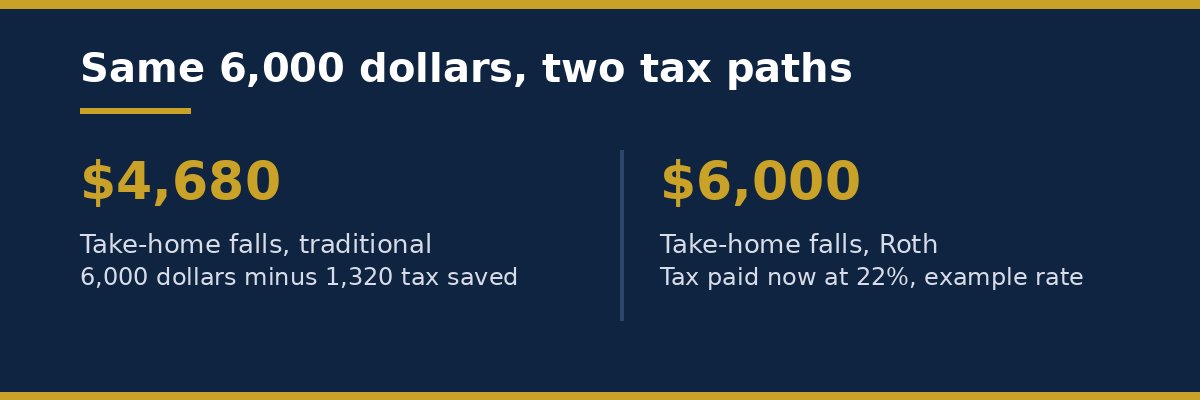
Traditional 401(k): tax saved now is $6,000 x 22 percent = $1,320. Fall in take-home pay is $6,000 minus $1,320 = $4,680.
Roth 401(k): tax saved now is $0. Tax paid now is $6,000 x 22 percent = $1,320. Fall in take-home pay is $6,000.
So the same $6,000 contribution costs Sara $4,680 in take-home pay with a traditional 401(k), and $6,000 with a Roth 401(k). The difference is $1,320 a year.
What the same money looks like at withdrawal
Now suppose, as a simple illustration only, that Sara’s $6,000 grows to $12,000 by the time she withdraws it. That doubling is an illustration, not a promise. Real growth depends on what the money is invested in, how long it stays invested, and how markets perform.
Qualified Roth withdrawal: withdrawal $12,000, federal income tax $0, Sara keeps $12,000.
Traditional withdrawal, at the same example 22 percent rate: tax is $12,000 x 22 percent = $2,640. Sara keeps $12,000 minus $2,640 = $9,360.
In this illustration, the Roth side leaves Sara with $2,640 more at withdrawal, because she already paid $1,320 in tax when the money went in. The traditional side saved her $1,320 at the start, then cost her $2,640 at the end, because the tax applied to the larger grown amount. If Sara’s rate at withdrawal were lower, the gap would be smaller. The example leaves out employer matching, fees, and state tax.
How much can you put in?
The IRS sets a limit on employee elective deferrals, which is the total you can put in from your own pay across your traditional and Roth 401(k) contributions combined. The limit is not per account type. If you split between Roth and traditional, the two sides together must stay within the limit.
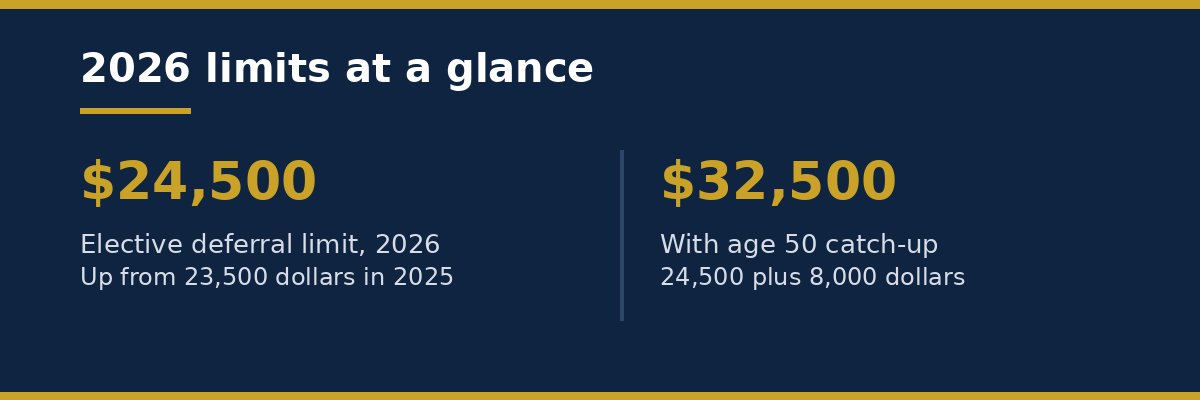
For 2026, the figures verified on irs.gov are: employee elective deferral limit $24,500; catch-up for age 50 and over $8,000, for a total of $32,500; higher catch-up for ages 60 to 63 $11,250, for a total of $35,750. The 2026 limit is up from $23,500 in 2025, according to IRS news release IR-2025-111. Limits change over time, so check the current IRS figure, and check your plan, because your plan may set a lower limit. If you are 50 or over, our guide on how to catch up on retirement savings at 50 explains the extra room in plain terms.
The five-year rule, in plain words
The clock starts on January 1 of the tax year in which you made your first designated Roth contribution to that employer’s plan. It ends after five consecutive tax years have passed. If your first Roth contribution was in October 2026, your five-year period began on January 1, 2026, and it ends on December 31, 2030. Age alone is not enough. If you are 62 and you only started three years ago, a withdrawal of the growth is not yet qualified. If you started ten years ago but you are only 55, it is not yet qualified either. Both tests must be met at the same time, and each employer’s plan has its own clock.
What happens if you withdraw early?
A nonqualified distribution is a withdrawal that does not meet both tests above. Your own contributions come out tax free, because you already paid tax on them. The growth part is generally taxed as ordinary income, and if you are under age 59 and a half, a 10 percent additional tax may also apply to the growth part, unless an exception applies. A Roth 401(k) does not let you take out only your contributions and leave the growth untouched. Each withdrawal is treated as part contributions and part growth. That differs from a Roth IRA, where you can generally withdraw your own contributions at any time without tax or penalty.
Employer matching and required withdrawals
Many employers match part of what you put in. Your employer can match your Roth contributions, but the matching money itself must go into a pre-tax account, not into your Roth account. That is the IRS rule. The match is taxed later, when you withdraw it. So you can end up with two tax buckets in one plan: a Roth bucket and a pre-tax bucket for the match.
A required minimum distribution, often called an RMD, is an amount the law says you must withdraw each year once you reach a set age. Beginning in 2024, designated Roth accounts in a 401(k) or 403(b) plan are not subject to required minimum distribution rules while the account owner is alive, under the SECURE 2.0 Act. Beneficiaries are still subject to RMD rules after the owner dies.
Roth 401(k) versus Roth IRA
A Roth 401(k) is offered through an employer plan. A Roth IRA is an individual account you open yourself, outside work. A Roth 401(k) has the higher 401(k) limit, $24,500 for 2026, and it can come with an employer match. A Roth IRA has a much lower limit and income limits on direct contributions. The withdrawal rules also differ. Do not carry a rule from one account across to the other without checking it.
Who might consider a Roth 401(k)?
It may suit you if you are early in your career and your tax rate is lower now than you expect later, or if you expect your income in retirement to be similar to, or higher than, now. You might lean towards a traditional 401(k) instead if your tax rate now is high and you expect it to be lower in retirement. Many people split contributions, half to Roth and half to traditional. If you work for yourself, a SEP IRA is one option to look at instead.
How to start in six steps
- Check if your employer offers it. Log in to your plan website or ask human resources.
- Read the plan documents. Note the contribution choices, the fees, the matching formula, and the withdrawal rules.
- Choose an amount you can keep up every pay period. If there is a match, many people aim to put in at least enough to get the full match.
- Choose your investments from the funds your plan offers. A target date fund is a common starting point. Check the fees.
- Check your first pay slip. Your take-home pay should fall by the full contribution amount.
- Review once a year. Check your rate, your investment mix, and your beneficiary details. For the wider picture, financial planning for retirement covers how a 401(k) fits with other savings, debt, and income in retirement.
Frequently asked questions
Is a Roth 401(k) the same as a Roth IRA?
No. A Roth 401(k) is part of an employer plan, with the higher 401(k) limit and possible employer matching. A Roth IRA is an individual account you open yourself, with a lower limit and income limits on direct contributions. The withdrawal rules differ too.
Do I pay tax on Roth 401(k) withdrawals in retirement?
Not on a qualified withdrawal. If you meet the five-year rule and the age 59 and a half, disability, or death test, the whole withdrawal, including growth, is free of federal income tax. On a nonqualified withdrawal, the growth part is generally taxed, and an extra 10 percent tax may apply if you are under 59 and a half.
What is the 2026 Roth 401(k) contribution limit?
For 2026, the limit is $24,500, covering Roth and traditional contributions combined. If you are 50 or over, you can add an $8,000 catch-up, for a total of $32,500. If you turn 60, 61, 62, or 63 in 2026, the higher catch-up is $11,250, for a total of $35,750.
Can I contribute to both a Roth and a traditional 401(k)?
Yes, if your plan offers both. You can split your contributions, but the total must stay within the annual limit.
Do I have to take required withdrawals from a Roth 401(k)?
Not while you are alive, beginning in 2024. Beneficiaries are still subject to RMD rules after the owner’s death.
What happens to my Roth 401(k) if I change jobs?
You can usually leave it with the old employer, roll it into your new employer’s plan, roll it into a Roth IRA, or take it out as cash. Taking it out as cash before retirement can trigger tax on the growth part and possibly an extra tax. Check how the five-year clock works before you move the money.
Conclusion
A Roth 401(k) is a simple idea with a few rules that matter. You pay tax now, you save in a separate Roth account inside your workplace plan, and qualified withdrawals later, including the growth, are free of federal income tax. The five-year rule and the age 59 and a half test must both be met. The 2026 limit is $24,500, with extra room at age 50 and over. Employer matching goes into the pre-tax side, and there are no required withdrawals from the Roth account during your lifetime, beginning in 2024. A Roth contribution costs more in take-home pay today, and a qualified Roth withdrawal costs nothing in federal income tax later. Which side suits you depends on your income now, your income in retirement, and how much certainty you want about tax later.
Sources:
- IRS, Retirement Topics, Designated Roth Account: https://www.irs.gov/retirement-plans/plan-participant-employee/retirement-topics-designated-roth-account
- IRS, Retirement Topics, 401(k) and Profit-Sharing Plan Contribution Limits: https://www.irs.gov/retirement-plans/plan-participant-employee/retirement-topics-401k-and-profit-sharing-plan-contribution-limits
- IRS, Roth Account in Your Retirement Plan: https://www.irs.gov/retirement-plans/roth-acct-in-your-retirement-plan
This article is for general information and education only. It is not legal or financial advice.
