

How Do I Save for a Car Without a Loan?
The Short Answer
Pick a clear target price, open a separate savings account just for the car, and move a set amount into it on every payday until you reach the target. Then pay for the car in full and drive away with no monthly loan payment.
Why Saving First Beats Borrowing
A loan lets you drive now and pay later. The later part is where the cost hides. With a loan, you pay back the price of the car plus extra money for borrowing. That extra money leaves your budget every month, for years, and buys you nothing extra.
When you save first, the price is the price. You pay it once, and you are done. There is no monthly payment and no extra borrowing cost. The money you would have spent on payments stays in your pocket after you buy the car.
Saving first also changes how you shop. When you borrow, it is easy to stretch for a more expensive car, because the monthly payment looks small. When you pay cash, the full price is right in front of you, so you judge it honestly. A car bought with cash is yours from day one.
How to Pick a Target Price You Can Reach
Pick a target price and write it down. A vague goal such as “save for a car” does not work, because you never know when you are done. A clear number does work, because every payday moves you closer to it.
Start with your budget, not with a car advert. Look at what you can save each month without cutting into rent, bills, food, and your emergency fund. Then look at how long you are willing to wait. Multiply the monthly amount by the number of months, and that gives a realistic target range. For example, if you can save 300 dollars a month for 24 months, that is 7,200 dollars in total, as an example. These are example numbers, not prices you must aim for.
Next, look at cars in your area, in your price range, that are safe, reliable, and cheap to run. Then add a buffer of about 10 percent for fees, taxes, registration, and insurance, as an example, so a car priced at 8,000 dollars would need a target of about 8,800 dollars, as an example. Check the actual costs in your area before you buy.
Write it down in one line: “My car target is X dollars by Y date.”
The Monthly Saving Math
Once you have a target, the math is simple. Divide the target by the number of months until you want to buy, and that gives you the monthly amount to save. For example, a target of 8,000 dollars divided by 24 months is about 333 dollars a month, as an example. A target of 6,000 dollars divided by 20 months is 300 dollars a month, as an example.
If the monthly amount is too high, you have three honest choices. You can wait longer, so the monthly amount drops. You can lower the target, so you buy a cheaper car. Or you can find extra money by cutting costs. Do not pretend the math works when it does not, because that leads to a half finished fund and a rushed loan at the end.
Try the math both ways: pick a date and see the monthly amount, then pick a monthly amount and see how long it takes. Pick the version that fits your life. Round the amount up slightly if you can.
Where to Keep the Car Fund
Keep the car fund in a separate savings account, away from your everyday spending money. This is the most important practical step in the whole guide. If the car money sits in the same account as your spending money, it will get spent in small amounts, and after a few months the fund will be much smaller than it should be.
A separate account fixes that. The money is out of sight, and moving it back takes a deliberate step. Open a savings account just for the car, give it a clear name such as “Car Fund”, and set up an automatic transfer on payday. Our guide How Do I Automate Saving and Investing? shows how to set up that kind of automatic move.
Should you use a high yield account or a normal savings account? A normal account is simple and easy to access. A higher yield account may pay a little more, but check terms such as withdrawal limits before you choose. Our guide When Should I Use a High-Yield Account vs a Normal Savings Account? walks through the choice. A money market account is another option for a short term goal fund, and our guide What Is a Money Market Account? explains how it works.
Do not keep the car fund in cash at home, and do not invest it for a short term goal. Cash at home is easy to spend, and investing is for long term goals, because the value can fall just when you need the money.
Cutting Costs to Reach the Target Faster
If your monthly saving amount is not enough, look for money you are already spending. Start with subscriptions. List every regular payment, and cancel the ones you have not used in the last month. Even a small monthly saving adds up over two years.
Next, look at food. Cook at home a few more times a week, and keep a small fun food budget. Check transport costs too, and sell things you no longer use.
Keep a small amount for fun in your budget. If you cut everything fun, the plan will fail. Every time you save money by cutting a cost, move that amount to the car fund within a day.
Checking a Used Car Before You Buy
Most people saving without a loan buy a used car, because a used car often fits a cash budget better than a new one. A used car can be a great buy, but only if you check it carefully before you pay. Once you hand over the cash, a hidden problem becomes your problem.
Start with the paperwork. Ask for the service history, the ownership documents, and the title. Check that the seller’s name matches the documents. If the seller cannot show clear documents, walk away.
Check the car in daylight, never at night or in the rain, because both hide damage. Look for uneven paint, rust, dents, and gaps between panels. Check the tyres, open the bonnet for leaks and worn belts, and look under the car for drips.
Sit inside and test the lights, indicators, wipers, heater, windows, locks, and radio. Then take a test drive, turn left and right, brake gently and firmly, and listen. If the car pulls to one side, shakes, or makes a grinding or knocking sound, get a professional check before you buy, or walk away.
If you can afford it, pay an independent mechanic to inspect the car before you buy it. Never rush a purchase. If the seller pressures you to decide today, take that as a warning sign. Your cash gives you power: you can walk away and wait for the right car.
What to Do If the Car Breaks Down While You Are Saving
This is the worry that stops many people from saving first: what if my current car breaks down before I have saved enough for the next one? First, do not panic, and do not raid the car fund for a repair without thinking. That is what your emergency fund is for. Our guide How Do I Build an Emergency Fund From Zero? explains how to start one, even with a small amount.
If you do not have an emergency fund yet, start one now, alongside the car fund. Our guide How Do I Save for a Goal and an Emergency Fund at the Same Time? shows how to split your saving. Even a small fund, such as 500 dollars as a first target, covers many common repairs.
If the repair is small, pay for it from the emergency fund and keep saving as normal. If the repair is large, get a second opinion. If the car cannot be fixed at a sensible cost, use the money saved so far toward a cheaper car now, or use public transport for a short time while you finish saving.
Keep the Emergency Fund Separate From the Car Fund
Your emergency fund and your car fund are two different jobs, and they need two different accounts. The emergency fund is for surprises you cannot plan for: a broken boiler, a medical bill, a week without work, or a car repair. The car fund is for a planned purchase on a date you chose. If you keep them in one pot, every surprise eats into the car plan.
Open two separate savings accounts if you can, one named “Emergency Fund” and one named “Car Fund”. If your bank makes that hard, use one account with clear tracking, and write down the split every month.
Decide the split before each payday. For example, you might put 200 dollars to the emergency fund and 300 dollars to the car fund each month, as an example, until the emergency fund reaches your first target. Our guide How Do I Choose a Bank Account as a Beginner? explains what to look for in an account.
A Worked Example: Saving for an 8,000 Dollar Used Car
Here is a full example, with every number clearly labelled as an example. Suppose you want to buy a used car priced at 8,000 dollars, as an example, and you want to buy it in about 27 months.
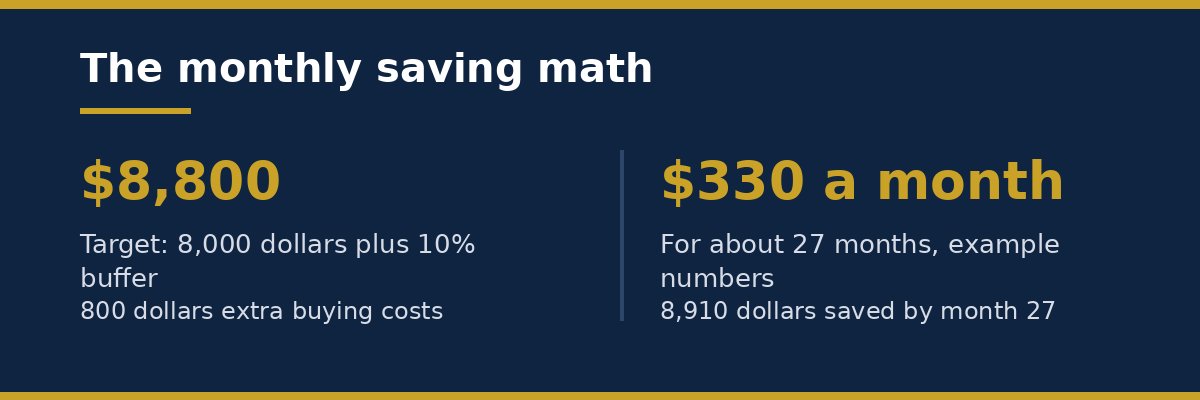
First, add a buffer for the extra buying costs. Using a buffer of 10 percent as an example, 10 percent of 8,000 dollars is 800 dollars. Add that to the price: 8,000 plus 800 is 8,800 dollars. That is your target, as an example.
Next, work out the monthly amount: 8,800 divided by 27 is about 326 dollars a month, as an example. Round it up to 330 dollars a month, as an example. After 12 months, you have 3,960 dollars, as an example. After 27 months, you have 8,910 dollars, as an example, which covers the target.
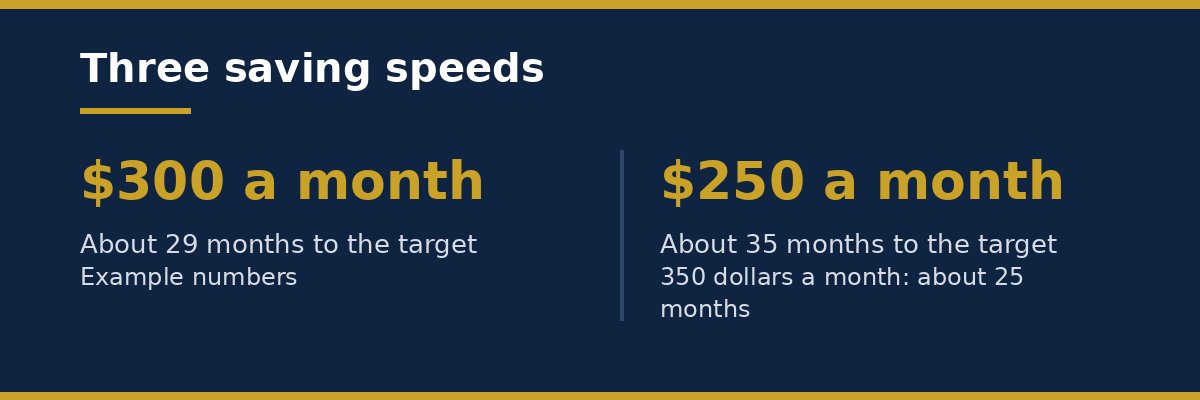
What if 330 dollars a month is too much? Saving 300 dollars a month, as an example, takes about 29 months. Saving 250 dollars a month, as an example, takes about 35 months. Saving 350 dollars a month, as an example, takes about 25 months.
Here is the same example as a simple monthly budget, with example numbers. Suppose your take home pay is 2,500 dollars a month, as an example: rent and bills 1,100 dollars, food 350 dollars, transport 150 dollars, fun 150 dollars, emergency fund 200 dollars, car fund 300 dollars, and other saving 250 dollars. That adds up to 2,500 dollars, and the car fund gets its share on payday.
These are example numbers, not a promise. Use the same method with your own numbers.
FAQ
How long does it take to save for a car without a loan?
Divide the target by the monthly amount. For example, saving 300 dollars a month toward an 8,000 dollar car, as an example, takes about 27 months.
How much should I save each month for a car?
Look at your income, subtract rent, bills, food, transport, and emergency saving, and see what is left. If it is too small, wait longer, lower the target, or cut costs.
Is it better to buy a used car with cash?
For many beginners, yes, because the price often fits a saving plan better than a new car. Check it carefully first, including paperwork, a daylight inspection, a test drive, and a mechanic inspection if you can.
Where should I keep my car savings?
In a separate savings account, away from everyday spending money, with an automatic transfer on payday. Do not keep it in cash at home, and do not invest it for a short term goal.
What if I need a car urgently and cannot wait to save?
Look at what reliable car fits the amount you have already saved, or use public transport for a short time while you finish saving. If you are considering borrowing, understand the full cost first, and talk it through with someone you trust.
Should I stop saving for emergencies while I save for a car?
No. Keep both funds growing, even if the amounts are small. The emergency fund protects the car plan from surprises, such as a repair on your current car.
Conclusion
Saving for a car without a loan is simple, even if it takes time. Pick a target price you can reach, divide it by the number of months you are willing to wait, and save that amount every payday into a separate account. Cut a few costs to reach the target faster, keep your emergency fund separate, and check any used car carefully before you pay.
The reward is a car you own outright, with no monthly payment. Start this week: write down your target price and your monthly amount, open the separate account, and set up the automatic transfer.
Further reading
This article is for general information and education only. It is not legal or financial advice.
