

How Do I Build a Complete Beginner Money System in 90 Days?
The Short Answer
A complete beginner money system has four parts: a budget that tells your money where to go, an emergency fund for surprises, a plan for debt, and automatic saving for the future. You can build all four in 90 days if you take one small step each week instead of trying to fix everything at once.
The system is not a strict diet or a perfect spreadsheet. It is a routine: money comes in, a set amount moves to savings before you can spend it, bills are paid on time, and you check the numbers once a week for fifteen minutes. After 90 days, the routine runs on its own, and your money stops leaking away unnoticed.
The Four Parts of the System
1. A Budget You Can Actually Follow
A budget is a plan for your money before the month starts. It does not need to be complicated. List your income, then your fixed costs such as rent and bills, then your flexible spending such as food and transport, and then your saving. If saving is the last item, it never happens, so put it first, even if it is small.
Our guide How Do I Create a Monthly Budget That Actually Works? walks through the first budget step by step.
2. An Emergency Fund
An emergency fund is money set aside for surprises: a car repair, a broken phone, or a week without work. Without it, every surprise becomes debt. With it, a surprise is an annoyance, not a crisis.
Start with a small target, such as 500 dollars, then build toward one month of basic costs, and later three to six months. Our guide How Do I Build an Emergency Fund From Zero? explains the steps.
3. A Debt Plan
If you have high interest debt, such as credit card debt, it needs a plan. List every debt with its balance, interest rate, and minimum payment. Pay the minimum on all of them, then put any extra money toward one debt at a time, either the smallest balance first or the highest interest first.
Our guide How Do I Make a Debt Payoff Plan I Can Stick To? covers both methods.
4. Automatic Saving
Saving works best when it happens without a decision. Set up an automatic transfer on payday, so a set amount moves to savings before you see it in your spending account. Even a small amount counts, because the habit matters more than the size. Our guide How Do I Automate Saving and Investing? shows how to set this up.
The 90 Day Plan, Week by Week
Days 1 to 14: See Where Your Money Goes
Write down everything you spend for two weeks. No judgment, just the numbers. Check your bank statements too, because small regular payments, such as subscriptions, are easy to miss. At the end of two weeks, sort your spending into needs, wants, and surprises.
Days 15 to 30: Build Your First Budget
Use what you learned to write a simple budget for the next month. Give every dollar a job: bills, food, transport, fun, debt, and saving. Keep the fun money in the plan, because a budget with no fun fails fast. Open a separate savings account for your emergency fund if you do not have one. Our guide Is a High-Yield Savings Account Safe? explains what to look for.
Days 31 to 60: Automate and Attack One Debt
Set up the automatic transfer on payday, even if it is only 25 dollars. Then list your debts and pick your target: the smallest balance or the highest interest rate. Put every spare dollar toward that one debt, while paying the minimum on the rest.
Days 61 to 90: Review, Fix, and Lock It In
Check your numbers once a week. Did the budget hold? Did the automatic transfer happen? Is the debt balance falling? Fix what is not working, keep what is, and write the routine down: payday, transfer, bills, weekly check. That written routine is your system.
A Worked Example: 2,000 Dollars a Month
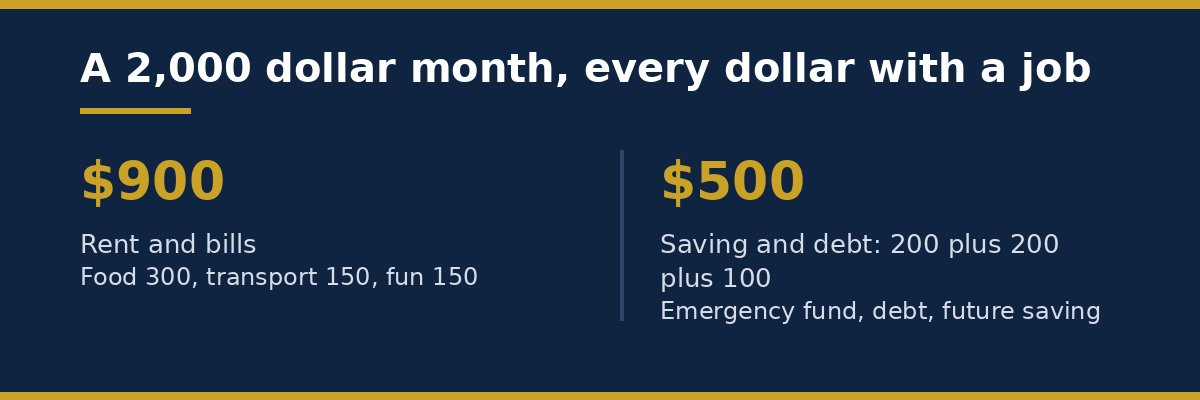
Here is a simple example with round numbers. Suppose your take home pay is 2,000 dollars a month.
- Rent and bills: 900 dollars
- Food: 300 dollars
- Transport: 150 dollars
- Fun and personal: 150 dollars
- Emergency fund: 200 dollars
- Extra debt payment: 200 dollars
- Future saving: 100 dollars
Add it up: 900 plus 300 is 1,200, plus 150 is 1,350, plus 150 is 1,500, plus 200 is 1,700, plus 200 is 1,900, plus 100 is 2,000. Every dollar has a job.
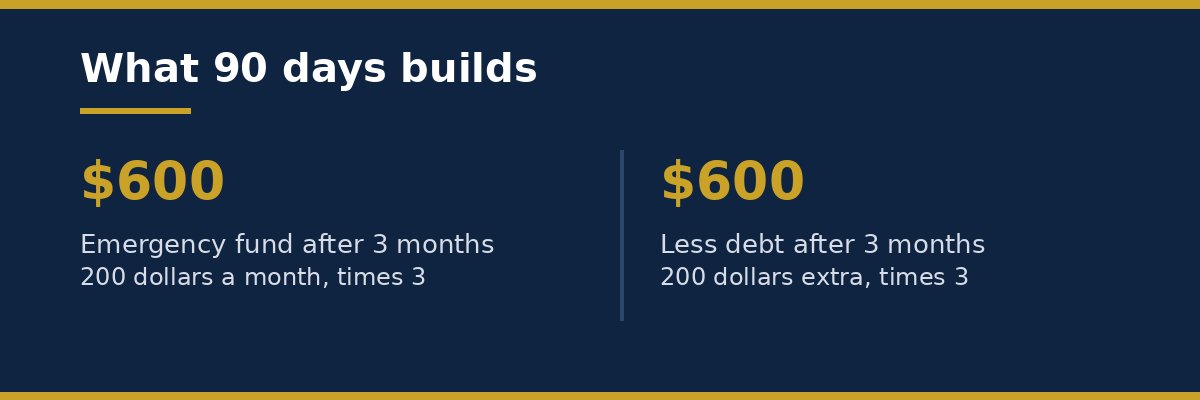
Over 90 days, about three months, the emergency fund grows by 200 dollars times 3, which is 600 dollars. The extra debt payment totals 200 dollars times 3, which is 600 dollars toward one debt. Future saving totals 100 dollars times 3, which is 300 dollars. In three months, without earning more, you have 600 dollars of safety, 600 dollars less debt, and 300 dollars saved for the future.
These are example numbers, not a promise. Your own numbers will differ, but the method is the same: split your income by purpose, automate the saving, and review weekly.
The Weekly 15 Minute Check
Once a week, sit down for fifteen minutes and check three things. First, did the automatic transfer happen? Second, is your spending on track for the week? Third, is there any surprise payment or fee you did not expect?
That is the whole check. If something is off, fix it now, while it is small. A weekly check catches problems when they cost 20 dollars, not when they cost 200.
Tools You Need, and Tools You Do Not Need
You need a bank account, a savings account, and a way to write the budget down. That can be a notebook, a simple spreadsheet, or a free budgeting app. You do not need a paid app, a complicated system, or five accounts to start. One spending account and one savings account are enough for the first 90 days.
If you like apps, pick one and use it for a month before judging it. The best tool is the one you will actually open each week.
Common Mistakes Beginners Make
Trying to Fix Everything in Week One
A system built in a rush falls apart in a rush. One step per week is fast enough. Ninety days is short, and steady beats intense.
Cutting All Fun Spending
A budget with no fun money fails, because you will break it and then give up. Keep a small fun amount in the plan, and spend it without guilt.
Saving What Is Left Over
If saving is what is left at the end of the month, there is usually nothing left. Move saving to payday, before spending starts, even if the amount is small.
Checking Daily and Panicking
Daily checking makes normal ups and downs feel like failure. A weekly check is often enough, and a monthly review shows the real trend.
Giving Up After One Bad Week
One bad week does not break a system. A system is what you return to after a bad week. Note what went wrong, fix one thing, and continue.
What Day 91 Looks Like
On day 91, you have a budget you understand, an emergency fund that is growing, a debt balance that is falling, and saving that happens on its own. You also have a habit: a fifteen minute weekly check that keeps the system honest.
From here, the system grows with you. Raise the saving amount when your income rises. Add investing once the emergency fund and high interest debt are handled. The system stays the same shape, only the numbers change.
FAQ
Do I need a lot of money to start a money system?
No. The system is a routine, not an amount. It works with a small income, because the steps are the same: plan, save a little, handle debt, and check weekly. Start with what you have.
What if my income changes every month?
Base the budget on your lowest recent month, not your best month. In a good month, put the extra toward the emergency fund or debt. In a bad month, the budget still holds, because it was built for a low month.
How much should my emergency fund be?
Start with 500 dollars as a first target. Then build toward one month of basic costs, and later three to six months. The first 500 dollars matters most, because it covers the most common surprises.
Should I pay debt or save first?
Do both, in order. Keep a small emergency fund first, so surprises do not become new debt. Then attack high interest debt while saving a small amount at the same time. Once the expensive debt is gone, raise the saving.
What if I miss a week of checking?
Just do the next one. A missed check is not a failed system. Catch up in fifteen minutes, note anything unusual, and carry on.
Can I build this system in less than 90 days?
You can set up the parts faster, but 90 days is about the time it takes for the routine to feel normal. Speed is less important than sticking with it. If you finish early, use the extra time to review and improve.
Conclusion
A complete money system is not complicated. It is a budget, an emergency fund, a debt plan, and automatic saving, checked once a week. Build it one step at a time over 90 days, and by the end you will have money that goes where you meant it to go, instead of disappearing.
Start this week with step one: write down what you spend. The rest follows from that single honest list.
Further reading
This article is for general information and education only. It is not legal or financial advice.
