

What Is a 403(b), in Simple Terms?
What Is a 403(b), in Simple Terms?
A 403(b) is a retirement savings plan offered through your job. You put part of your pay into the plan, and that money is set aside to help pay for life after you stop working.
The name comes from section 403(b) of the tax code. You do not need to remember that. What matters is simple. A 403(b) is a way to save for retirement a little at a time, straight from your paycheck, before you have a chance to spend it.
If you work for a public school, a nonprofit organization, or certain churches and church related groups, a 403(b) may be the retirement plan your employer offers. If you work for a regular private company, you are more likely to be offered a 401(k) instead.
Think of a 403(b) as a savings bucket with tax benefits. The government gives you a tax break for using it, because it wants to encourage people to save for retirement. Your money can then grow inside the plan over many years.
Who Can Open a 403(b)?
Not everyone can open a 403(b). Your employer has to offer one, and in general these workers can use one:
- Employees of public schools, colleges, and universities
- Employees of nonprofit organizations, such as hospitals, charities, and foundations
- Employees of some churches and religious organizations
- Some employees of public health organizations
If your employer is a private company that is run for profit, you will usually not be offered a 403(b). Instead, you may be offered a 401(k). If you are self employed, a 403(b) is not the right plan for you either. You would look at other retirement accounts instead, such as an IRA. If you are not sure whether your employer offers a 403(b), ask your human resources department or check your employee benefits booklet.
How a 403(b) Works
A 403(b) works in three simple steps. Money goes in, it grows, and you take it out later in retirement.
Your Money Goes In From Your Paycheck
When you join a 403(b), you choose how much of each paycheck to save. Your employer takes that amount out of your pay and puts it into your 403(b) account. You do not have to remember to make a transfer. It happens on its own, every payday.
Most people save a percentage of their pay, such as 5 percent or 10 percent. Others save a fixed dollar amount, such as 100 dollars per paycheck. You can usually change your amount later if your budget changes.
With a traditional 403(b), your contributions go in before income tax is taken out. That means your taxable pay for the year is lower, so you pay less income tax now. You will pay tax later, when you take the money out in retirement.
Some plans also offer a Roth 403(b) option. With a Roth 403(b), your contributions go in after tax, so you get no tax break now, but withdrawals in retirement may be tax free if you meet the rules. Not every employer offers a Roth option.
Your Employer May Add Money Too
Many employers add money to your 403(b) as well. This is called an employer match. For example, your employer might add 50 cents for every dollar you save, up to a certain limit. An employer match is part of your pay, in a way, so a good first goal is to save at least enough to get the full match.
Be aware that some employer contributions take time to become fully yours. This is called vesting. Your own contributions are always yours, but employer money may follow a vesting schedule, so ask your plan for its rules.
Your Money Is Invested and Can Grow
The money in your 403(b) does not just sit in a savings account. You choose how to invest it from the options your plan offers. Common choices include mutual funds, which are baskets of many stocks and bonds, and annuities, which are insurance contracts that some 403(b) plans still offer.
Your investments can grow over time as the funds earn returns. Growth is not guaranteed, and the value of your account can go down as well as up. Inside a 403(b), your investment growth is not taxed each year. Tax is normally due only when you take money out.
403(b) vs 401(k): What Is the Difference?
A 403(b) and a 401(k) are close cousins. Both are retirement plans offered through work. Both let you save from your paycheck before tax, or after tax with a Roth option. Both offer tax deferred growth.
The main difference is who offers them. A 403(b) is for employees of public schools, nonprofits, and some churches. A 401(k) is for employees of private, for profit companies.
There are a few smaller differences. Some 403(b) plans offer annuities as an investment choice, which 401(k) plans rarely do, and a 403(b) has a special extra catch up rule for people with many years of service at the same employer.
For most people, the practical choice is simple. You take the plan your employer offers. If you have a 403(b), you use the 403(b). If you have a 401(k), you use the 401(k). If you want a fuller comparison, read our guide on what is a 401(k) in simple terms and our comparison of an IRA vs a 401(k).
How Much Can You Put In?
The IRS sets a limit on how much you can contribute to a 403(b) each year. That limit changes over time, so check the current IRS figures for this year before you decide your amount. The IRS publishes the current limits on its 403(b) pages at irs.gov.
Two extra points are worth knowing. First, if you are age 50 or older, the IRS usually allows you to contribute an extra catch up amount above the normal limit. Second, some plans allow an additional catch up for employees who have worked for the same employer for 15 years or more. Your plan can tell you whether these rules apply to you.
You do not have to contribute the maximum. Many people start small, for example 3 percent or 5 percent of pay, and raise the amount a little each year. What matters most is starting, and then increasing the amount when you get a raise or pay off a bill.
A Worked Example: What $300 a Month Could Become
Let us work through a clear example so you can see how a 403(b) can grow. This is an example only. It uses a plain assumed growth rate, and it is not a promise or a prediction. Real investment returns go up and down, and no one can know them in advance.
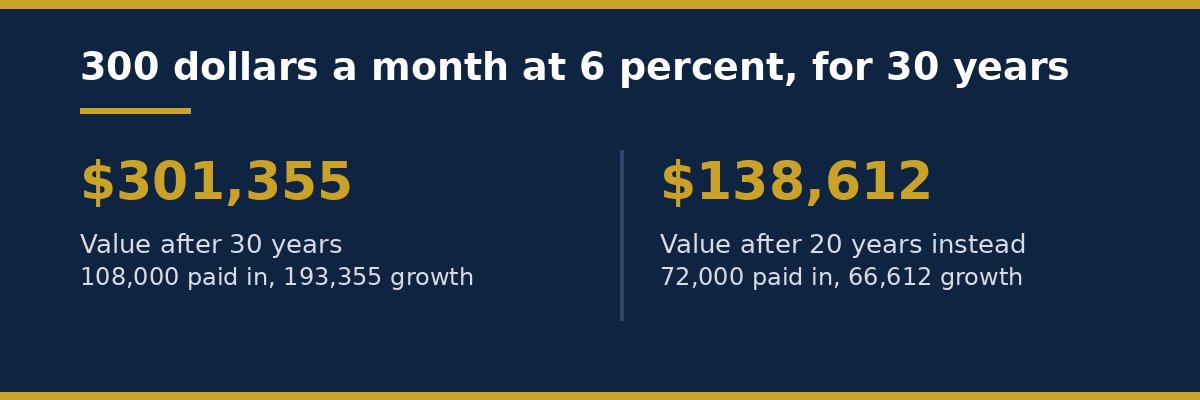
Here is the setup. You contribute 300 dollars every month to your 403(b) for 30 years. We assume your investments grow at 6 percent a year, compounded monthly. We ignore fees, taxes, and any employer match, just to keep the math clear.
First, your total contributions. You put in 300 dollars a month for 360 months. That is 300 times 360, which equals 108,000 dollars.
Next, the growth. With monthly compounding at 6 percent a year, the future value formula gives a total of about 301,355 dollars after 30 years. Here is how that number is built:
- Total contributions: 108,000 dollars
- Growth on those contributions: 193,355 dollars
- Total after 30 years: 301,355 dollars
Check the addition: 108,000 plus 193,355 equals 301,355. The growth is larger than the contributions. That is the effect of time and compounding. Your money earns returns, and then those returns earn returns of their own.
Now compare a shorter period. If you saved the same 300 dollars a month for only 20 years at the same assumed 6 percent growth, your total would be about 138,612 dollars. Your contributions would be 72,000 dollars, and growth would be about 66,612 dollars. Ten extra years of saving adds a great deal, because compounding needs time to work.
The lesson is simple. Starting earlier usually matters more than saving a perfect amount. Even a modest monthly contribution can grow into a meaningful sum over a long working life. If you want help thinking about how much to aim for, read our guide on how much you should save for retirement.
What Happens to Your Money When You Leave Your Job?
Your 403(b) belongs to you, and it does not disappear when you change jobs. Your own contributions are always yours. You usually have four choices when you leave an employer:
- Leave the money in your old plan, if the plan allows it.
- Move it to your new employer’s retirement plan, such as a new 403(b) or 401(k).
- Move it to an individual retirement account, or IRA. This is called a rollover.
- Take the money out as cash. This is usually the worst choice, because you may owe income tax and an extra penalty if you are under age 59 and a half.
A direct rollover, where the money moves from one retirement account to another without passing through your hands, is the usual way to avoid tax problems when you move it.
When Can You Take Money Out?
In general, you can take money out without an extra penalty once you reach age 59 and a half. If you take money out before that age, you may owe income tax on the withdrawal plus an extra 10 percent penalty, unless an exception applies. There are some exceptions, such as for disability or certain medical costs, but they are narrow. Your plan document lists them.
Once you reach your early 70s, the IRS generally requires you to start taking a minimum amount out each year. These are called required minimum distributions. The exact starting age has changed over the years, so check the current IRS rules for your birth year.
If you need money before retirement, some plans allow a loan from your 403(b) or a hardship withdrawal for a serious financial need. Both have strict rules and downsides, so treat them as last resorts.
How to Start a 403(b) in 5 Steps
Starting a 403(b) is simpler than most people expect. Here are five steps.
Step 1: Confirm Your Employer Offers One
Ask your human resources team or check your benefits portal. If a 403(b) is listed, ask for the enrollment form or the online enrollment link.
Step 2: Pick Your Contribution Amount
Choose an amount you can afford every payday. If your employer offers a match, aim to save at least enough to get the full match. You can start at 5 percent of pay and raise it later.
Step 3: Choose Your Investments
Your plan will offer a list of funds. If you are unsure, look for a target date fund, which adjusts its mix of stocks and bonds as you get closer to retirement. It is a common choice for beginners because it handles the mix for you.
Step 4: Name Your Beneficiary
A beneficiary is the person who would receive your account if something happened to you. Pick someone, and keep this choice up to date after big life events such as marriage or the birth of a child.
Step 5: Review Your Account Once a Year
Check your balance, your contribution rate, and your investment choices once a year. Raise your contribution a little when you get a pay rise. That is all the regular care a 403(b) usually needs.
If you are 50 or older and worried about lost time, our guide on how to catch up on retirement savings at 50 walks through the extra steps that can help.
Common Mistakes to Avoid
A 403(b) is a helpful tool, but a few mistakes can reduce what it does for you.
- Not joining at all. Every year you wait is a year of growth you do not get back.
- Saving less than the full employer match. If a match is offered, try to get all of it.
- Taking money out early. Taxes and penalties can take a large bite out of a withdrawal.
- Paying too much in fees. Some 403(b) plans, especially older annuity based ones, charge high fees. Ask your plan for its fee list, and compare the funds it offers.
- Forgetting old accounts. If you change jobs, keep track of every old 403(b) so no account is left behind. Fees also deserve a look. Even a small difference in yearly fees can add up over 30 years, so ask your plan for a plain list of what each fund option costs.
FAQ
Is a 403(b) the same as a pension?
No. A pension is a promise from your employer to pay you a set amount in retirement. A 403(b) is an account that you and sometimes your employer pay into, and its final value depends on how much was saved and how the investments did.
Do I have to pay tax on a 403(b)?
With a traditional 403(b), you pay no income tax on the money when it goes in, and your growth is not taxed each year. You pay income tax when you take money out in retirement. With a Roth 403(b), you pay tax when the money goes in, and withdrawals in retirement may be tax free if you meet the rules.
Can I have both a 403(b) and an IRA?
Yes. Having a 403(b) through work does not stop you from opening an IRA of your own. Many people use both, and each account has its own yearly limits and rules.
Is my money safe in a 403(b)?
Your money is held in your own account, separate from your employer’s money. But it is invested, so its value can go up and down with the markets. A 403(b) is not a bank savings account, and it does not guarantee a fixed return.
Conclusion
A 403(b) is a simple idea. You save a little from each paycheck, your employer may add money, and your savings get time to grow with a tax break along the way. It is the main retirement plan for teachers, nurses at nonprofit hospitals, charity workers, and others who work for public schools and nonprofits.
You do not need to save the maximum, and you do not need to understand every rule before you start. Join the plan, save enough to get any full employer match, pick a simple investment choice, and raise your amount a little over time.
If you are thinking about the bigger picture, read our guide on when you can retire to see how your savings fit into your retirement date. The best time to start was years ago. The next best time is now.
This article is for general information and education only. It is not legal or financial advice.
