

What Is the Envelope Budgeting System, and How Do I Start It?
What Is the Envelope Budgeting System?
The envelope budgeting system is a simple way to control spending by giving every dollar a job before the month begins. You divide your take-home pay into spending categories, put a set amount of cash in a labelled envelope for each category, and spend only what is in that envelope. When an envelope is empty, you stop spending in that category until the next month, unless you move money from another envelope on purpose. There is no app to learn and no spreadsheet to update every day. The envelope is the limit.
The system is old. People used it long before budgeting apps existed. It still works because it solves the most common budgeting problem. Most people do not overspend because they lack a plan. They overspend because the plan is invisible at the moment they spend. An envelope makes the plan visible.
How the Envelope System Works
Each envelope holds cash for one category only. Groceries money stays in the groceries envelope. Fun money stays in the fun envelope. You do not borrow from one envelope without deciding to do it on purpose.
That rule sounds strict, and it is meant to be. Without a hard limit, a budget is only a wish. With a hard limit, you learn quickly which categories run out first and why.
Paying with a card can feel painless, since the balance changes somewhere you cannot see. Paying with cash is different. You open the envelope, count the notes, and hand them over. You see what is left, and that small moment of friction is often enough to make you pause before an impulse buy.
You can run the system with real paper envelopes and real cash. That is the classic version, and it works best for most beginners because it is the most visible. You can also run it digitally, with separate bank pots or a budgeting app that uses virtual envelopes. The idea is the same. Each category has its own balance, and you spend only from that balance. Many people use both: fixed bills from the bank, and cash envelopes for the variable spending they find hardest to control.
Who the Envelope System Helps Most
It helps people who overspend in the same categories every month, who find apps and spreadsheets hard to keep up with, and couples and families who share spending, since each person can see what is left in the shared groceries envelope. It also helps people saving for a goal: when you put a fixed amount in a savings envelope first, saving becomes a planned step, not whatever is left at the end of the month.
It is less useful for bills that cannot be paid in cash, such as rent or a mortgage paid by bank transfer. Those bills still belong in your budget, but they do not need a physical envelope. Keep them in the bank and mark them as paid in your plan.
How to Start the Envelope System in 7 Steps
Step 1: Work out your take-home pay
Start with the money you actually receive, not your salary before tax. Take-home pay is the amount that lands in your bank account after tax and other deductions. If your pay changes from month to month, use your lowest recent month, so you plan for a tight month rather than a good one. If your income is irregular, read our guide on how to budget on an irregular income for a method that fits variable pay.
Step 2: List your spending categories
Write down every category you spend money on in a normal month. Ten to twelve categories is enough for most people. Too many envelopes become hard to track. Too few hide the spending you need to see.
A typical list looks like this: rent or mortgage, utilities, groceries, transport, dining out, fun, clothing, personal care, phone, savings, and a small miscellaneous category for surprises. Group small, similar costs together. For example, put shampoo, toothpaste, and haircuts in one personal care envelope.
Step 3: Set an amount for each envelope
Give each category a monthly amount based on what you actually spent in the last two or three months, not what you wish you spent. If you spent 450 dollars on groceries last month, do not set the envelope at 200 dollars. Set it close to reality, then trim it a little each month.
The total of all your envelopes, including savings, must not be more than your take-home pay. If the total is higher, cut something. Start with flexible categories, such as dining out and fun, before you touch rent, utilities, or groceries.
If you want a simple starting split, the 50/30/20 idea can help. It suggests about 50 percent for needs, 30 percent for wants, and 20 percent for savings and extra debt payments. Our guide on the 50/30/20 budget rule explains that split in plain terms.
Step 4: Get your envelopes and your cash
Buy a set of paper envelopes, or use a small wallet with dividers. Label each one clearly with the category name and the monthly amount. On payday, withdraw the cash for your variable envelopes and fill them. Leave fixed bills in your bank account. Keep the savings money in a separate savings account if you can, rather than in cash at home, so it is harder to spend by accident.
Step 5: Spend only from the matching envelope
When you buy groceries, pay from the groceries envelope. When you go out for dinner, pay from the dining out envelope. If you use a card for a purchase that belongs in an envelope category, take the same amount of cash out of that envelope as soon as you can and put it back in your bank account. If you do not do this, the envelope will look full while the money is already gone.
Step 6: Check your envelopes once a week
Pick one day each week to check every envelope. Count what is left, compare it with how many days are left in the month, and note any category that is running low too fast. A weekly check takes about ten minutes. If you want a method that does not need a spreadsheet, read our guide on how to track spending without a spreadsheet.
Step 7: Close the month and reset
At the end of the month, empty every envelope and count what is left. Roll it forward into the same envelope next month, move it to savings, or move it to a category that ran out, but only if you can explain why that category needed more. Do not let leftover cash sit in envelopes with no plan. Give it a job, even if the job is simply to stay in savings. Then start again, and adjust any amount that was too high or too low. The second month is usually easier than the first because your amounts are based on real spending, not guesses.
Worked Example: A 3,200 Dollar Month Split Into Envelopes
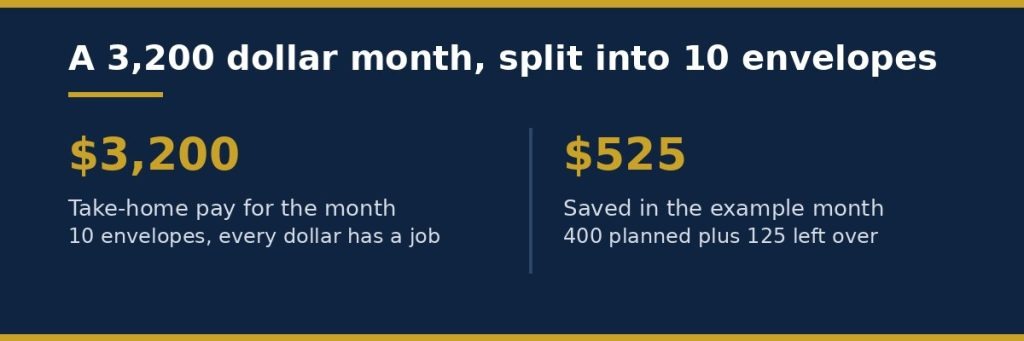
Maya takes home 3,200 dollars a month after tax. She rents a small flat, cooks most meals at home, takes the bus to work, and wants to save every month.
Her envelopes are:
- Rent: 1,100 dollars
- Groceries: 450 dollars
- Transport: 250 dollars
- Utilities: 200 dollars
- Dining out: 150 dollars
- Fun: 150 dollars
- Clothing: 100 dollars
- Personal care: 100 dollars
- Savings: 400 dollars
- Miscellaneous: 300 dollars
Now check the addition step by step:
1,100 plus 450 equals 1,550.
1,550 plus 250 equals 1,800.
1,800 plus 200 equals 2,000.
2,000 plus 150 equals 2,150.
2,150 plus 150 equals 2,300.
2,300 plus 100 equals 2,400.
2,400 plus 100 equals 2,500.
2,500 plus 400 equals 2,900.
2,900 plus 300 equals 3,200.
The total is 3,200 dollars, which matches her take-home pay exactly. Nothing is missing, and nothing is double counted. Every dollar has a job.
Rent and utilities are fixed bills, so Maya leaves that money in her bank account. She withdraws cash for the rest: groceries 450, transport 250, dining out 150, fun 150, clothing 100, personal care 100, and miscellaneous 300. That is 1,500 dollars in cash envelopes. Savings of 400 dollars goes straight to a savings account on payday.
In week two, Maya checks her envelopes. Groceries has 220 dollars left, which is about right for half the month. Dining out has only 40 dollars left because she ate out three times, so she decides to cook at home for the rest of the month.
At the end of the month, groceries has 15 dollars left, transport has 30 dollars left, fun has 0 dollars left, clothing has 100 dollars left because she bought nothing, and miscellaneous has 80 dollars left. She moves the 100 dollars from clothing into next month’s clothing envelope, since she may need new shoes soon. She moves the other leftovers, 15 plus 30 plus 80, which is 125 dollars, into savings. Her total saved that month is 400 dollars plus 125 dollars, which equals 525 dollars.
Common Mistakes and How to Avoid Them
The most common mistake is setting an envelope far below real spending. If you spend 500 dollars on groceries and set the envelope at 300 dollars, you will run out in week three and feel like the system failed. It did not fail. The amount was wrong. Use your last three months of real spending as the starting point, and cut by 5 to 10 percent at a time, not by 40 percent at once.
Moving money between envelopes is allowed, but only as a clear decision. If you move 50 dollars from fun to groceries, write it down and change both envelope balances. Silent borrowing hides the problem. You can move money between envelopes, but do not move money out of savings to cover everyday spending without stopping and asking why.
Some costs do not appear every month. Car repairs, gifts, annual subscriptions, and medical bills can break a monthly plan. Put a small amount each month in a separate irregular costs envelope. For example, 50 dollars a month gives you 300 dollars after six months, ready for when the cost arrives.
Do not keep a full month of cash at home if that feels risky. Keep one week of cash in the envelopes and refill them each week from the bank.
The first month is a test, not a final result. Most people get at least one amount wrong. That is normal. If an envelope runs out early, ask what happened. Was the amount too low? Did an unusual cost appear? Did you spend without checking? Then adjust the amount or the habit and try again next month.
Envelope Budgeting and Zero-Based Budgeting
The envelope system and zero-based budgeting share the same core idea. Every dollar gets a job, and income minus planned spending equals zero. Zero-based budgeting is the planning method, and envelope budgeting is a way to carry it out with cash limits. If you want a fuller planning method around the envelopes, read our guide on what a zero-based budget is.
Build Your First Monthly Budget First
If you do not have a monthly budget yet, build one first, then turn it into envelopes. A budget is the plan. Envelopes are the way you follow it day by day. Our step-by-step guide on how to create a monthly budget walks through that process in plain language.
Once the budget exists, turn each variable category into an envelope, turn each fixed bill into a line you mark as paid from the bank, and turn savings into a transfer you make on payday, before spending starts. That order matters. If you start with envelopes and no budget, you are guessing the amounts.
How to Keep the System Going After Month One
Keep the weekly check short and at the same time each week. Ten minutes on a Sunday evening is enough. Keep the envelope count low: if you have more than twelve, merge the smallest ones. Review your amounts every three months, since prices and your life change. Have a plan for a bad month: use the miscellaneous envelope first, then move money from a flexible category, then note the change. A bad month is data, not failure.
Frequently Asked Questions
How much cash should I put in each envelope?
Start with what you actually spent in the last two or three months. Add up the spending in each category, divide by the number of months, and use that average as your starting amount.
Can I use the envelope system without cash?
Yes. You can use separate bank pots, sub-accounts, or a budgeting app with virtual envelopes. The idea stays the same. Each category has its own balance, and you spend only from that balance.
What do I do when an envelope runs out early?
Stop spending in that category until next month, or move money from another envelope with a clear written decision. Do not use a credit card to top it up silently. If the same envelope runs out early every month, the amount is probably too low, so raise it next month and cut a flexible category by the same amount.
Should I include savings as an envelope?
Yes. Treat savings as a category with its own amount, just like groceries or rent. Move the savings amount out of your spending money on payday, before you start spending. If you wait until the end of the month to save what is left, there is often nothing left.
How many envelopes should I have?
Most people do well with eight to twelve envelopes. Fewer than five hides too much spending in one place. More than twelve becomes hard to fill and check each week.
What if I get paid weekly instead of monthly?
You can still use envelopes. Fill them each payday with one week of spending money. The steps stay the same. Only the refill timing changes.
Conclusion
The envelope budgeting system is simple on purpose. You divide your pay into categories, put a set amount in each envelope, and spend only what is in that envelope. When an envelope is empty, you stop or you move money on purpose.
Start small. Pick your take-home pay, list ten or so categories, set honest amounts based on real spending, and fill three cash envelopes for the categories you find hardest to control. Check them once a week. You do not need a perfect first month, only one that shows you where your money goes.
This article is for general information and education only. It is not legal or financial advice.
