

What Is a Certificate of Deposit?
Short answer: a certificate of deposit, or CD, is a savings account where you agree to leave your money untouched for a set time, from a few months to a few years, and the bank pays you a fixed interest rate in return. The rate is usually higher than a normal savings account, because the bank knows it can keep the money for the full term. If you take the money out early, you pay a penalty, usually some of the interest you earned. A CD suits money you will not need until a known date. This guide explains how CDs work, what they pay, and how to use them well. It is educational only, not financial advice.
How a CD works
You open a CD at a bank or credit union, put in a lump sum, and pick a term. Common terms are 3 months, 6 months, 1 year, 2 years, 3 years, and 5 years. Some banks ask for a minimum deposit, often 500 or 1,000 dollars, though some offer no-minimum CDs.
The bank pays a fixed rate for the whole term. That rate is set when you open the CD, and it does not change, even if rates elsewhere fall. The interest is usually added to the CD, so the balance grows a little each month, and the final amount is the deposit plus all the interest.
When the term ends, the CD matures. At that point you can take the money out, move it to another account, or roll it into a new CD. Many banks renew a CD automatically into a new CD of the same term if you do nothing, so check the maturity date and decide before it arrives.
The key rule is simple: the money is locked for the term. You can take it out early, but the penalty cuts into your interest, and in some cases it can eat into the deposit itself. A CD is for money with a known date, not for money you might need next month.
A worked example: 5,000 dollars at 4 percent
Here is a real example with simple numbers. You put 5,000 dollars into a 1-year CD paying 4 percent APY, which is the yearly rate including compounding.
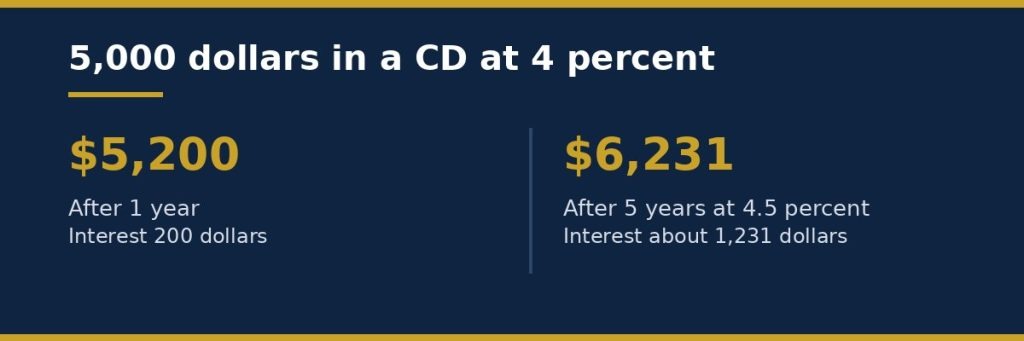
After one year, the CD is worth 5,200 dollars. The interest is 200 dollars: 5,000 times 4 percent.
Put the same 5,000 dollars into a 2-year CD at 4 percent, and leave the interest in. After two years it is worth 5,408 dollars. The first year earns 200 dollars, and the second year earns 208 dollars, because the interest from the first year also earns interest. That is compounding, the same force that grows long-term investments, working here on a small, safe scale.
Now try a longer term and a higher rate. Put 5,000 dollars into a 5-year CD at 4.5 percent, and it grows to about 6,231 dollars. The interest is about 1,231 dollars over five years. The extra rate and the extra years both help, but the money is locked for the full five years.
Try a bigger deposit. Put 10,000 dollars into a 1-year CD at 4 percent, and it grows to 10,400 dollars. The interest is 400 dollars, double the 5,000 dollar example, because the deposit is double. CDs reward bigger deposits, but only put in money you will not need before the term ends.
Now the cost of breaking the deal. Take the 5,000 dollar, 1-year CD out early, after six months, and the bank charges a penalty of 90 days of interest. Ninety days of interest at 4 percent on 5,000 dollars is about 49 dollars. You keep the interest you earned minus that penalty. The penalty is small here, but on a longer CD it can be several months of interest, so always ask the penalty before you open the account.
These figures use round rates to show the math. Real CD rates change over time and differ by bank, so check current rates when you shop, and compare the APY, not just the headline rate.
To understand APY properly, read: What Is APY, and Why Is It Different From Interest Rate?
CD vs high-yield savings vs money market
A CD, a high-yield savings account, and a money market account all keep your money safe, but they work differently.
A high-yield savings account pays interest and lets you take money out whenever you need it. The rate moves up and down with the market, and it is usually lower than a CD of the same length, because the bank cannot count on keeping the money. It is the right home for an emergency fund and for money you might need soon.
To check whether one is safe, read: Is a High-Yield Savings Account Safe?
A money market account is similar to a high-yield savings account, but it may come with a debit card or cheques, and it may pay a slightly different rate. It suits money you want to keep safe but reach easily, like a fund for a bill due next month.
To learn how one works, read: What Is a Money Market Account?
A CD pays a fixed rate for a fixed term, and the money is locked. It usually pays more than the other two, because the bank has your money for the full term. It suits money with a known date: a house deposit in a year, a car in two years, or a tax bill in six months. The trade is clear. You give up access, and the bank pays you more for it.
The rule for choosing is the date. If you need the money soon, or you do not know when you will need it, use a savings account. If you know the date, and it is months or years away, a CD is worth comparing.
Is your money safe in a CD?
In the United States, CDs at FDIC-insured banks are covered by federal deposit insurance, up to 250,000 dollars per depositor, per bank, for each ownership category. CDs at federally insured credit unions have similar cover through the NCUA. That means the deposit is protected even if the bank fails, up to the limit.
The insurance covers the deposit and the interest earned, up to the limit. It does not cover market risk, because a CD has no market risk: the rate is fixed, and the value does not fall when markets fall. The main risk is not loss, but being locked in. If rates rise after you open a CD, your money earns the old, lower rate until the term ends.
Check that the bank is insured before you open a CD, and keep your total deposits at one bank below the insurance limit if you hold large amounts. The US Federal Deposit Insurance Corporation explains the cover here: https://www.fdic.gov/resources/deposit-insurance
How to use a CD ladder
A CD ladder is a simple way to keep some money free each year while still earning CD rates. Instead of putting all your money into one CD, you split it across several CDs with different terms.
Here is a worked example. You have 6,000 dollars for a goal that is a few years away, and you want some of it free each year. Put 2,000 dollars into a 1-year CD, 2,000 dollars into a 2-year CD, and 2,000 dollars into a 3-year CD, all at 4 percent.
After one year, the first CD matures at about 2,080 dollars. You can take it out if you need it, or roll it into a new 3-year CD. After two years, the second CD matures, and you do the same. After three years, all three CDs have matured in turn, and each year one of them becomes free. If you keep rolling each matured CD into a new 3-year CD, you end up with a ladder where one CD matures every year, all earning the 3-year rate.
A ladder suits money you may need in stages, like a house deposit you are building over years, or a fund for yearly costs. It is less useful for money with a single fixed date, where one CD of the right term is simpler.
How to open a CD, step by step
Step 1: Pick the date first. Decide when you will need the money. A bill in six months needs a 6-month CD. A house deposit in two years needs a 2-year CD. Never pick a term longer than the time until you need the money.
Step 2: Compare rates. Check at least three banks or credit unions, including online banks, which often pay more than high-street banks. Compare the APY, the minimum deposit, and the early withdrawal penalty. The highest rate is not always the best deal if the penalty is harsh.
Step 3: Check the insurance. Confirm the bank is FDIC-insured, or the credit union is federally insured, and keep the deposit within the insurance limit.
Step 4: Open the CD and fund it. Most banks let you open a CD online in minutes, and fund it from your savings account. Note the maturity date and the penalty terms, and set a reminder for a week before the CD matures.
Step 5: Leave it alone. Do not touch the money until the term ends, unless a real emergency forces you to. Each early withdrawal costs interest and breaks the plan.
Step 6: Decide before maturity. A week before the CD matures, decide: take the money out, move it to savings, or roll it into a new CD. If you do nothing, the bank may renew it automatically, possibly at a different rate.
To pick the right account for the money around it, read: How Do I Choose a Bank Account as a Beginner?
Five mistakes that waste a CD
Mistake 1: Locking away emergency money. A CD is not an emergency fund. If the car breaks down and your money is locked in a 2-year CD, you will pay a penalty or borrow at a high rate to cover it. Keep the emergency fund in a savings account you can reach at once.
To keep the two apart, read: Should I Keep My Emergency Fund Separate From My Spending Money?
Mistake 2: Picking a term longer than your plan. A 5-year CD pays more, but if you need the money in two years, the penalty wipes out the extra interest. Match the term to the date, not to the rate.
Mistake 3: Ignoring the penalty. Penalties differ a lot between banks. One bank may charge 90 days of interest, another may charge a full year. Ask the penalty before you open the account, and factor it into the choice.
Mistake 4: Putting everything into one CD. One big CD means one maturity date and one penalty if you need money early. A ladder, or two CDs with different terms, gives you more options for the same money.
Mistake 5: Forgetting the maturity date. If you do nothing, the bank may renew the CD automatically, possibly at a lower rate, and lock the money away again. Set a reminder a week before maturity, and make the decision yourself.
FAQ
How much money do I need to open a CD?
It depends on the bank. Many banks ask for 500 or 1,000 dollars as a minimum, and some offer CDs with no minimum at all. Online banks often have lower minimums. Check the minimum before you compare rates, so you compare CDs you can actually open.
Can I lose money in a CD?
The deposit is protected by federal insurance up to the limit, and the rate is fixed, so the balance does not fall with the market. You can lose interest if you withdraw early, because the penalty cuts into what you earned. You can also lose buying power if inflation runs higher than the CD rate, which is why CDs suit short and medium terms, not decades.
What happens when a CD matures?
You can take the money out, move it to another account, or roll it into a new CD. Many banks renew the CD automatically into a new CD of the same term if you do nothing, so decide before the maturity date arrives.
Is a CD better than a savings account?
It depends on the date. A CD usually pays more, but the money is locked. A savings account pays less, but the money is free whenever you need it. For money with a known date months away, a CD is often better. For money you might need soon, a savings account is better.
Do I pay tax on CD interest?
Yes, in most cases. The interest a CD earns is usually taxable income in the year it is earned, even if it stays in the CD. The bank sends a tax form showing the interest. Keep it with your tax records, and set money aside if the interest is large.
Can I add money to a CD after opening it?
Usually no. A standard CD takes one deposit when it opens, and you cannot add to it later. If you get more money later, you can open a second CD. Some banks offer add-on CDs that allow extra deposits, but they often pay a lower rate.
Conclusion
A certificate of deposit is a simple deal: you lend the bank your money for a set time, and it pays you a fixed rate. The worked example shows the return: 5,000 dollars at 4 percent grows to 5,200 dollars in one year, 5,408 dollars in two years, and about 6,231 dollars in five years at 4.5 percent. The rate is usually higher than a savings account, and the deposit is insured up to the limit, but the money is locked, and an early withdrawal costs interest. Pick the term by the date you need the money, compare the APY and the penalty at three banks, check the insurance, and set a reminder before the maturity date. For money with a known date, a CD turns waiting into earning.
This article is for general information and education only. It is not legal or financial advice.
