

What Is a Sinking Fund?
Short answer: A sinking fund is money you set aside a little at a time for a cost you know is coming. You pick the cost, work out how much it will be and when you will need it, then save a small fixed amount every month until the money is there. When the bill arrives, you pay it from the fund instead of from that month’s pay or a credit card. It is not an emergency fund. An emergency fund covers surprises you cannot predict. A sinking fund covers costs you can see coming, like car insurance, a holiday, new tyres, or a yearly bill. This guide explains how it works, how to start one, and the exact math, with a worked example you can copy. It is educational only, not financial advice.
Why a sinking fund stops the same bill hurting twice a year
Most budgets break on costs that are not really surprises. Car insurance comes every six months. A birthday comes every year. The car needs new tyres every few years. These costs are easy to forget in a monthly budget because they do not arrive every month, so the month they land feels like a crisis. The money has to come from somewhere, so it comes from savings, or it goes on a card and costs more later.
A sinking fund fixes this by spreading the cost across the months before it. If car insurance is 900 dollars every six months, you save 150 dollars a month for six months. When the bill arrives, the money is already there. The bill still costs 900 dollars, but it no longer wrecks a single month. That is the whole idea. You are not spending less. You are spending at a time you choose, in pieces you can handle.
It also makes planning honest. A monthly budget that ignores a 900 dollar bill due in June is not a real plan for June. A sinking fund puts that bill into every month in small pieces, so the budget tells the truth all year round.
For a budget that holds together month after month, read: How Do I Create a Monthly Budget That Actually Works?
Sinking fund vs emergency fund: they do different jobs
People mix these two up, and the mix causes trouble. Keep them separate.
An emergency fund is for costs you cannot predict and cannot plan for: a broken boiler, a sudden car repair, a gap between jobs. You build it once, keep it untouched, and only use it for real emergencies. The usual beginner target is 1,000 dollars first, then one month of costs, then three to six months over time.
A sinking fund is for costs you can predict. You know the cost, or you can guess it closely, and you know roughly when it will arrive. You build it up, spend it on purpose, then start building it again. It is meant to be spent. That is the point.
The two funds protect each other. Without a sinking fund, a known bill lands on the emergency fund and drains it. Without an emergency fund, a real surprise lands on the sinking fund and the holiday money disappears. Keep them in separate accounts, or at least in separate pots, so you always know which is which.
To build the emergency side first, read: How Do I Build an Emergency Fund From Zero?
What to save for: the usual sinking funds
Start with costs you already know about. Most people need only three to five sinking funds. More than that gets hard to track, and small funds get forgotten.
Common ones:
Car insurance, paid every six or twelve months. Car tax and yearly checks. New tyres, which most drivers need every few years. Car repairs that are not emergencies, like a service or a worn part you know is coming.
Home costs: a yearly insurance payment, a service for the boiler, or a repair you are planning, like a roof fix or new appliances.
Family costs: birthdays, holidays, school costs, and Christmas. These arrive on the same dates every year, so they are the easiest sinking funds to plan.
Personal costs: a holiday, a new phone, a yearly subscription, or a course you want to take.
One-off plans: a wedding, a house deposit top-up, or a big purchase you want to pay for in cash.
Pick the ones that apply to you. Write the cost and the date next to each one. If you do not know the exact cost, use last year’s figure, or a rough quote, and adjust later. A close guess is far better than no plan at all.
How to start a sinking fund in four steps
Step 1: List the costs you know are coming. Go through the last twelve months of bank statements and mark every cost that arrived once or twice a year. Those are your sinking fund candidates. Note the amount and the month it is due.
Step 2: Work out the monthly amount. Take the cost and divide it by the number of months until you need it. A 900 dollar insurance bill due in six months needs 150 dollars a month. A 600 dollar holiday in ten months needs 60 dollars a month. Write each monthly amount down.
Step 3: Give each fund its own place. The simplest way is a separate savings account for sinking funds, with a note of how much belongs to each one. Some banks let you create pots or spaces inside one account. A spreadsheet with one row per fund also works. The rule is simple: you must be able to see, at a glance, how much is in each fund. If the money is mixed together in one pot, it will get spent on the wrong thing.
Step 4: Move the money on payday, not at the end of the month. The day your pay arrives, move the monthly amounts into the sinking fund. What is left is what you can spend. If you wait until the end of the month, there will be nothing left to move. This is the same rule that makes any saving work: pay the fund first.
To keep the fund apart from everyday money, read: Should I Keep My Emergency Fund Separate From My Spending Money?
A worked example: three funds, one monthly number
Here is a real example with simple numbers. Meet Sara. She earns 3,000 dollars a month after tax. She has three costs coming:
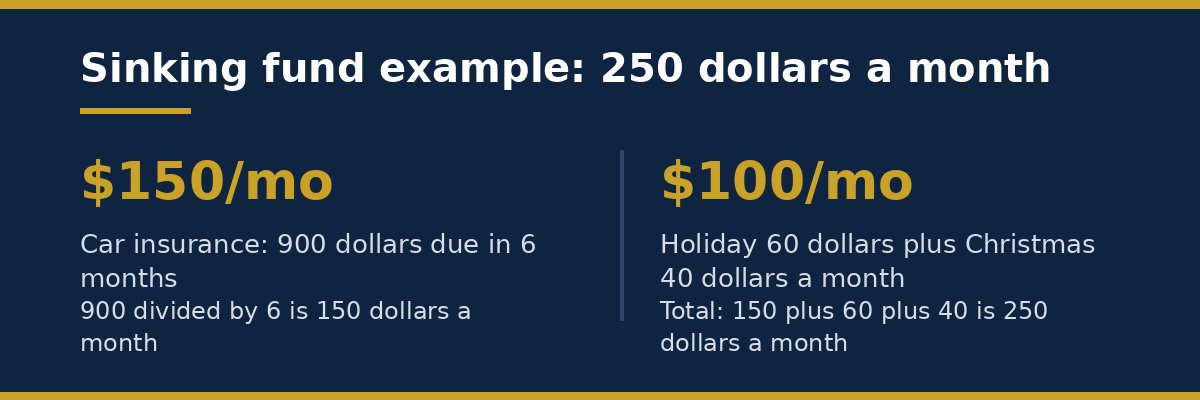
Car insurance: 900 dollars, due in 6 months. 900 divided by 6 is 150 dollars a month.
Holiday: 600 dollars, due in 10 months. 600 divided by 10 is 60 dollars a month.
Christmas: 480 dollars, due in 12 months. 480 divided by 12 is 40 dollars a month.
Her total sinking fund amount is 150 plus 60 plus 40, which is 250 dollars a month. On payday, she moves 250 dollars into her sinking fund account. Her spending money for the month is 2,750 dollars, and she plans her month on that number, not on 3,000.
After six months, she has 900 dollars for the insurance, plus 360 dollars toward the holiday and 240 dollars toward Christmas. She pays the insurance from the fund. The next month, she keeps saving 60 dollars for the holiday and 40 dollars for Christmas, and she can start a new fund with the freed 150 dollars, for example new tyres at 600 dollars in 12 months, which is 50 dollars a month.
The math is simple division. The discipline is moving the money on payday, every month, without fail. After a year, Sara has paid for insurance, a holiday, and Christmas without touching a card and without a single month feeling tight.
If the monthly total feels too high, you have three honest choices: push a date back, shrink a cost, or start with fewer funds. What you should not do is skip the saving and hope the bill is small. The bill will not be small.
To fit the monthly amount into a simple plan, read: What Is the 50/30/20 Budget Rule, and Does It Work?
Where to keep the money
A sinking fund should be easy to reach but not easy to spend by accident. A separate savings account works best for most people. It keeps the money out of the spending account, so it does not get spent on groceries or a night out, but it is there when the bill arrives.
A high-yield savings account is a good fit if the fund will sit for several months, because it earns a little interest while you wait. The interest is small on a few hundred dollars, but the separation is what matters. Do not put sinking fund money into investments. The money is needed on a fixed date, and investments can fall in value at the wrong time.
Cash envelopes work too, if you prefer cash. One envelope per fund, labelled with the cost and the date. The risk is the same as with any cash at home: it can be lost or spent. A bank account is safer for most people.
For the safety of a savings account, read: Is a High-Yield Savings Account Safe?
Five mistakes that break a sinking fund
Mistake 1: Raiding the fund for everyday spending. The fund is not spare money. If you take 100 dollars from the holiday fund for a takeaway, the holiday is 100 dollars short. Treat the fund like a bill you owe to your future self.
Mistake 2: Having too many funds. Ten small funds are hard to track and easy to abandon. Start with two or three. Add more only when the first ones are running smoothly.
Mistake 3: Forgetting to restart a fund after spending it. When the insurance is paid, the fund is empty. The next insurance bill is already six months away. Restart the monthly saving the very next payday, or the same problem returns.
Mistake 4: Guessing the cost too low. If you guess 500 dollars for a holiday that costs 700, you will be 200 short. Use last year’s real figure where you can. Add a small buffer, around 10 percent, to costs you are unsure about.
Mistake 5: Mixing it with the emergency fund. One pot for both means neither job gets done properly. Keep them apart, in separate accounts or clearly labelled pots, so you always know what each pile of money is for.
If a month goes wrong and spending runs over, read: What Should I Do When I Overspend in One Category?
How much should you put in each month?
There is no single right number. The monthly amount comes from your own costs and dates, not from a rule. But a useful check is this: add up all your monthly sinking fund amounts. If the total is more than about 10 to 15 percent of your take-home pay, look closely. Either some costs can be cut, some dates can move, or some funds can wait until others are done. If the total is under 5 percent, check you have not missed a yearly cost. Most people are surprised by how much their yearly costs add up to once they are written down.
Review the funds once a month, at the same time as you review the budget. Check three things: is each fund on track for its date, has any cost changed, and is there a new yearly cost to add? A five minute check keeps the plan honest.
To build the monthly review habit, read: How Do I Review My Budget at the End of the Month?
FAQ
Is a sinking fund the same as saving?
It is a type of saving, but with a job and a date attached. General saving is money set aside without a fixed purpose. A sinking fund is money set aside for one named cost, due on one named date. That label is what stops it being spent on something else.
How many sinking funds should I have?
Start with two or three: the biggest yearly cost, the next one, and one fun one like a holiday. Most people settle at three to five. More than that is fine only if you can track each one without effort.
Can I use a sinking fund for a car repair?
Yes, if the repair is planned, like a service or tyres you know are wearing out. If the car breaks down without warning, that is an emergency fund job, not a sinking fund job.
What if I cannot afford the monthly amount?
Split the cost differently. Push the date back, choose a cheaper option, or start with a smaller fund and add to it when you can. Saving half the monthly amount is far better than saving nothing, because it cuts the shock in half when the bill arrives.
Should a sinking fund earn interest?
It can, in a savings account, but interest is not the point. The point is that the money is there on the date you need it. Keep it safe and easy to reach, not invested.
Do I need a sinking fund if I already have an emergency fund?
Yes, because they cover different costs. The emergency fund covers surprises. The sinking fund covers known costs. Without a sinking fund, known bills eat the emergency fund, and then a real surprise has nothing left to cover it.
Conclusion
A sinking fund is one of the simplest money habits there is. Name the cost, find the date, divide the cost by the months left, and move that amount on payday. Do it for two or three costs to start, keep the money in its own place, and restart each fund as soon as you spend it. The reward is quiet: bills that used to feel like emergencies become routine payments, and the months they land in feel like any other month. Start with your biggest yearly bill, work out its monthly number today, and set up the first transfer on your next payday.
This article is for general information and education only. It is not legal or financial advice.
