

How Do I Save Money on Groceries?
Short answer: you save money on groceries by planning before you shop, buying fewer things you throw away, and comparing prices the same way every week. You do not need coupons, a special app, or a strict diet. A short list, a weekly meal plan, store brands, and a clear look at what you waste will cut most grocery bills by 10 to 20 percent, and the savings repeat every month.
This guide walks through the steps in order, with a worked example that shows the math. It is educational only, not financial advice.
Start with a number, not a feeling
Most people guess what they spend on groceries, and the guess is usually low. Before you change anything, find your real number.
Look at the last three months of bank or card statements and add up every grocery store, supermarket, and food market charge. Leave out restaurants and takeaway, since those are a different budget line. Divide the three month total by three. That is your monthly grocery spending.
If the number surprises you, that is normal. Food is one of the few budget lines that grows quietly, a few dollars at a time, with no single big purchase to notice. Write the number down next to a monthly grocery target. A simple first target is 10 percent below your current spending.
New to setting a food budget inside a full monthly plan? Start here: How Do I Create a Monthly Budget That Actually Works?
Plan the week before you shop
The single biggest grocery saving comes from deciding what to eat before you walk into the store. Shopping without a plan is how extra items, duplicate items, and forgotten items all end up in the same cart.
Pick five dinners, not seven
Plan five main meals for the week and leave two nights flexible. Flexible nights use leftovers, a simple pantry meal, or food already in the freezer. A seven night plan looks neat on paper, but real weeks have late work days and changed plans, and the extra meals you planned but never cooked are the ones that go to waste.
Shop your kitchen first
Before you write the list, open the fridge, the freezer, and the pantry. Note what is already there and build at least one meal around it. A bag of rice, a tin of beans, or chicken already in the freezer is a meal you have already paid for. Buying a second bag of the same thing because you forgot the first one is one of the most common grocery leaks.
Write the list from the plan, and keep it short
Write every item your five meals need, plus breakfast and lunch basics. Group the list by store section, such as produce, dairy, meat, and pantry, so you walk the store once instead of wandering. A short, grouped list takes ten minutes to write and can save thirty minutes and twenty dollars in the store.
If your income changes from month to month, the same planning habit still works, you just set the weekly food amount first and plan meals to fit it. See: How Do I Budget on an Irregular Income?
Shop with a system, not with willpower
Willpower fades halfway down aisle three. A system does not.
Compare unit prices, not shelf prices
The shelf price tells you what the pack costs. The unit price tells you what the food costs, per ounce, per pound, or per 100 grams. The bigger pack is often cheaper per unit, but not always, and the smaller pack is sometimes the better deal when a large pack is on a special display. Check the small unit price on the shelf label every time you buy a staple such as rice, oats, coffee, or cooking oil. It takes five seconds and it is the most reliable price check in the store.
Try the store brand for one item a week
Store brands are usually made in the same factories as name brands, and the price gap is often 20 to 30 percent. You do not have to switch everything at once. Try one store brand each week, starting with basics such as canned tomatoes, oats, rice, or frozen vegetables. Keep the ones your family likes, and go back to the name brand only for the few items where the taste really matters to you.
Buy seasonal produce and frozen vegetables
Fruit and vegetables in season cost less and taste better. Frozen vegetables are picked and frozen at harvest, they keep for months, and they cost less per serving than fresh vegetables that wilt in the fridge. Keep two or three bags on hand for nights when fresh produce runs out.
Shop once a week, not every day
Every extra trip is another chance to buy things that were not on the list. One weekly shop, plus one small top up for milk or bread if you need it, is enough for most households.
A simple framework helps here too. If you use the 50/30/20 rule, groceries sit inside the 50 percent needs group, so cutting the grocery bill frees money inside needs without touching fun money first. See: What Is the 50/30/20 Budget Rule, and Does It Work?
Cut waste, because waste is money in the bin
The United States Department of Agriculture estimates that food waste is between 30 and 40 percent of the food supply, based on its Economic Research Service estimate of 31 percent food loss at the retail and consumer levels, about 133 billion pounds and 161 billion dollars worth of food in 2010. A large share of that waste happens at home, in ordinary kitchens, from food bought with good intentions and then forgotten.
You do not need to fix the whole food system. You only need to fix your own fridge.
Learn the date labels
“Best before” and “best by” are about quality, not safety. “Use by” is the one to take seriously, and it appears mainly on meat, dairy, and ready meals. Food past its best before date is often still fine to eat if it looks, smells, and tastes normal.
Store food so you can see it
Put new food behind old food, so the older item gets used first. Keep leftovers in clear containers at eye level, not hidden behind jars at the back. A fridge you can see into is a fridge that wastes less. A quick five minute fridge check before shopping, as described above, is part of the same habit.
Freeze what you will not eat in time
Bread, meat, cooked rice, and most leftovers freeze well. If you buy a large pack of chicken on sale, cook half and freeze half. If a meal makes too much, freeze the extra in single portions for a busy night. The freezer is a pause button, and it turns food that would have been wasted into a free meal later.
Use the scraps
Stale bread becomes breadcrumbs or croutons. Wilted vegetables go into soup or a stir fry. Leftover roast chicken becomes sandwiches or a pasta topping the next day. None of this needs a new skill, only the habit of asking “what can this become” before it goes in the bin.
For the wider picture on food costs, see the companion guide on cutting food spending without cutting meals: How Do I Cut Food Spending Without Cutting Meals?
A worked example: a household that saves 140 dollars a month
The numbers below are an example household, so you can see the math clearly. Replace them with your own numbers to get your own result.
A household of four spends 800 dollars a month on groceries. They decide to plan meals, use a list, and switch five staple items to store brands. That cuts their spending by 10 percent.
800 dollars x 10 percent = 80 dollars saved per month.
Next, they look at waste. They find they throw away about 15 percent of the food they buy, which is 120 dollars of food each month.
800 dollars x 15 percent = 120 dollars wasted per month.
They cut that waste in half by planning five meals instead of seven, freezing leftovers, and checking the fridge before shopping. Half of 120 dollars is 60 dollars saved per month.
80 dollars from smarter shopping + 60 dollars from less waste = 140 dollars saved per month.
140 dollars x 12 months = 1,680 dollars saved per year.
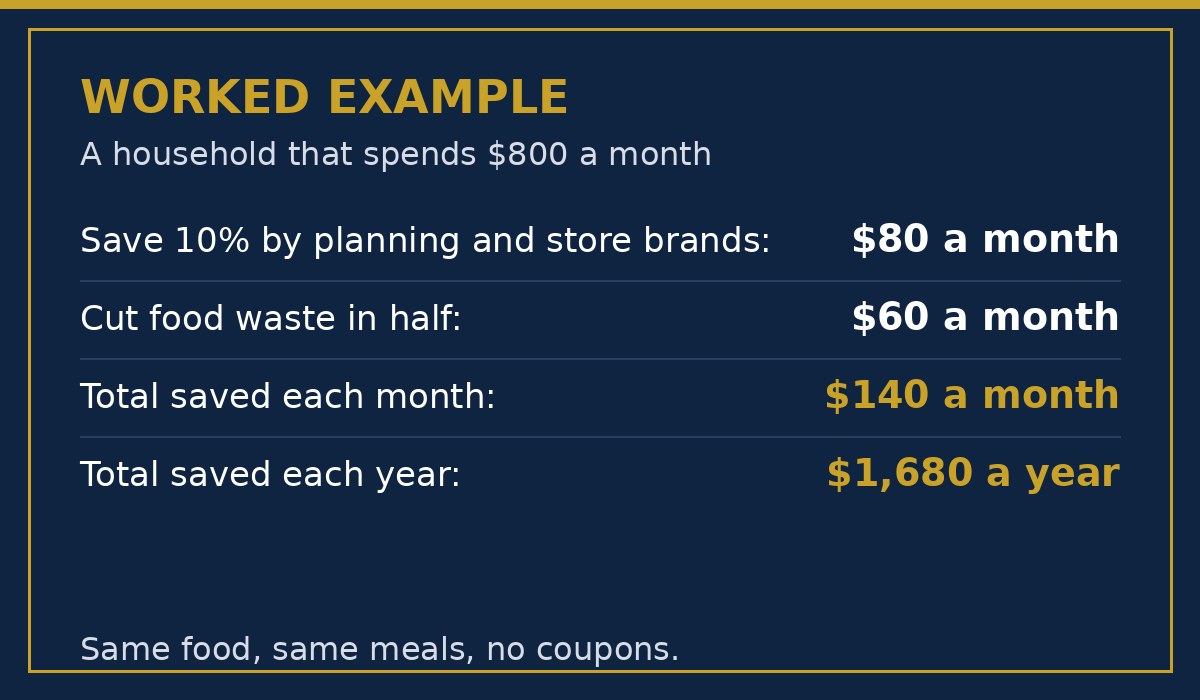
That is 1,680 dollars a year from the same food, the same meals, and no coupons. The first month is the hardest, because the habits are new. By the third month, the list, the five meal plan, and the fridge check take less than thirty minutes a week.
What not to do
Some grocery tips sound smart and cost more than they save.
Do not buy in bulk unless you will use it
A bulk pack is only a bargain if you finish it before it goes off. A large bag of salad that wilts, a big pack of bread that goes stale, or a bulk buy of a snack nobody likes is not a saving, it is a larger waste. Buy in bulk only for foods that keep well, such as rice, oats, pasta, frozen food, and tinned goods, and only if you have somewhere dry and cool to store them.
Do not chase every coupon and deal
A coupon saves money only if you would have bought the item anyway. A coupon for a snack you do not need is not a saving, it is a purchase you would not have made. The same applies to buy one get one free offers. Two of something you use is a saving. Two of something that goes off is a waste.
Do not shop hungry, and do not pay for convenience every time
Shopping on an empty stomach adds snacks, treats, and ready meals to the cart, and those are the most expensive items per serving in the store. Eat before you shop, or shop straight after a meal. Pre-cut vegetables, grated cheese, and ready meals also cost two to three times as much per serving as the whole food they came from. They have a place on a busy night, but if every meal uses them, the convenience charge quietly becomes a large part of the bill.
A simple weekly routine that makes it stick
Here is the whole system in one short routine, about thirty minutes a week.
- Sunday, ten minutes: check the fridge, freezer, and pantry. Pick five dinners. Write the list, grouped by store section.
- Shopping day, one trip: follow the list, check unit prices on staples, try one new store brand.
- After shopping, ten minutes: put new food behind old food, freeze anything you will not use in the next three days, and put leftovers in clear containers at eye level.
- Midweek, two minutes: check what is left and move one flexible night to use it up.
- Month end, ten minutes: add up the month’s grocery spending and compare it with your target. If you are under target, move the extra into your emergency fund or your next goal, so the saving has a home.
A worksheet makes the monthly check easier to keep up. See: Budgeting Worksheets for Beginners: How to Choose One and Track It Week to Week
Reviewing the month also shows which habits are working and which are not. If the bill is still high, look first at waste and extra trips, not at the price of single items. See: How Do I Review My Budget at the End of the Month?
FAQ
How much should a family spend on groceries each month?
There is no single right number, because it depends on where you live, how many people you feed, and what you eat. Start from your own spending over the last three months, then set a first target 10 percent below it.
What is the fastest way to cut a grocery bill?
Plan five meals, shop from a list once a week, and stop throwing food away. Those three habits usually cut more than coupons or switching stores, and they cost nothing to start. Store brands on staples come next.
Are store brands really as good as name brands?
For most basic foods, yes. Store brand rice, oats, canned tomatoes, frozen vegetables, and flour are usually made to the same standard as name brands, and the price gap is often 20 to 30 percent. Try one item a week and keep the ones your family likes.
Is buying in bulk always cheaper?
No. Bulk is cheaper only when the unit price is lower and you finish the food before it goes off. Compare the unit price, not the pack size, and buy in bulk only for foods that keep well, such as rice, pasta, oats, and frozen food.
How do I stop food going to waste in the fridge?
Plan five meals, shop once a week, store new food behind old food, keep leftovers in clear containers at eye level, and freeze anything you will not eat within three days.
Does meal planning take a lot of time?
About ten minutes a week once the habit is set. That is less time than one extra trip to the store, and it replaces the daily question of what to cook with a short list you already made.
Conclusion
Saving money on groceries is not about eating less or buying worse food. It is about planning the week, shopping from a list, comparing unit prices, trying store brands, and wasting less of what you already bought. Start with your real monthly number, set a target 10 percent below it, and run the simple weekly routine for a month. In the worked example above, a household spending 800 dollars a month saved 140 dollars a month, or 1,680 dollars a year, and most of that came from habits, not from coupons. A good first home for the saving is an emergency fund, even a small one. See: How Much Should I Keep in an Emergency Fund?
Sources
- U.S. Department of Agriculture, “Food Loss and Waste” FAQs. Food waste estimated at 30-40 percent of the food supply, based on USDA Economic Research Service estimate of 31 percent food loss at retail and consumer levels, 133 billion pounds and 161 billion dollars in 2010.
- U.S. Department of Agriculture, Economic Research Service, “The Estimated Amount, Value, and Calories of Postharvest Food Losses at the Retail and Consumer Levels in the United States“, February 2014.
This article is for general information and education only. It is not legal or financial advice.
