
Direct answer
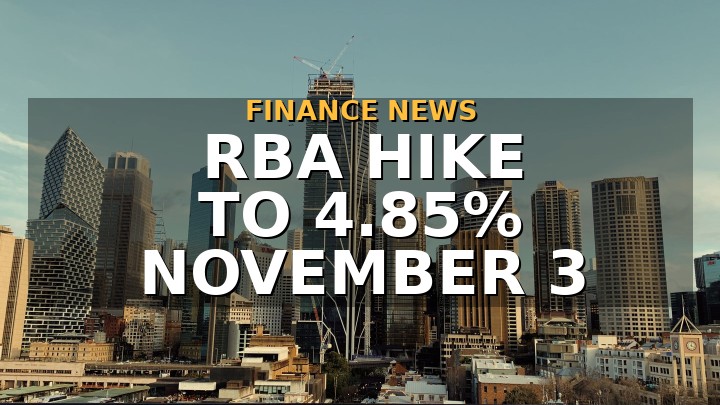
Australia’s big four banks all expect the Reserve Bank of Australia to raise its cash rate by 25 basis points to 4.85% on November 3, 2026. That would be the fifth rise this year, and it would take the cash rate to its highest level since 2008. This is an expectation, not yet a decision. The Reserve Bank will announce its actual decision on November 3.
What happened
Bond markets and most economists have swung behind a rate rise on Tuesday, November 3, after hot inflation figures and hawkish comments from Reserve Bank Governor Michele Bullock in the previous week, according to AAP reporting on November 1, 2026.
The Reserve Bank’s preferred measure of inflation, the quarterly trimmed mean, came in at 1.0% in the September quarter, above the bank’s forecast of 0.8%. In annualised terms, AAP reports the trimmed mean at 3.7%. That is the 20th consecutive quarter in which underlying inflation has been above the midpoint of the Reserve Bank’s 2% to 3% target band.
Headline consumer price inflation also rose. It reached 4.3% in the 12 months to September, up from 4.0% in August, as reported in our earlier post on Australian inflation. That sharper than expected increase helped push market pricing for a November rise from about 69% before the data to about 79% in the hours after it, according to The Bull’s November 1 report.
Australia’s four major banks, Commonwealth Bank, National Australia Bank, ANZ, and Westpac, now all expect a 25 basis point rise to 4.85% on November 3, The Bull reported on November 1, 2026. National Australia Bank shifted its forecast to a hike, joining ANZ and Westpac, which had already expected a rise, while Commonwealth Bank had already been flagging a November move.
The cash rate currently sits at 4.60%, after a rise on September 29, 2026, the fourth rise of 2026. A further 25 basis point rise on November 3 would therefore take it to 4.85%.
AAP also reports the household impact in simple terms. A household with a $600,000 mortgage would pay an extra $456 in monthly interest repayments compared with the start of the year, according to financial comparison site Canstar, if the cash rate reaches 4.85%.
HSBC chief economist Paul Bloxham said the Reserve Bank is increasingly worried about how persistent inflation has been. He said that although the jobs market is showing clearer signs of weakening, and falling housing prices are starting to feed through to stalling growth, the bank is likely to prioritise the high inflation challenge and hike in November.
Home values fell 1.1% in September, AAP reported, and the housing downturn is on track to be the deepest on record. Property data firm Cotality was due to provide another snapshot on Monday, November 2.
Why it matters for beginners
A cash rate is the Reserve Bank’s main tool for influencing borrowing costs across the economy. It is not the exact rate any one person pays on a mortgage or a loan, but banks often move their own lending rates in the same direction when the cash rate changes.
When inflation stays high, a central bank may raise rates to slow spending and cool price rises. That can help bring inflation down, but it also makes borrowing more expensive for households and businesses. That is the trade-off in this story.
For beginners, three points matter most. First, higher rates do not only affect new borrowers. Existing variable rate borrowers can see repayments rise. Second, savers may benefit from higher interest on savings, but that does not cancel out higher borrowing costs for people with large loans. Third, a rate rise is not a guarantee that inflation will fall quickly. It is a step the bank takes to try to bring inflation back toward its target over time.
For a simple explanation of how interest rates affect borrowing costs, see our guide on how credit card interest charges work: https://investclaritypath.com/how-do-credit-card-interest-charges-work/
For the inflation data behind this expectation, see our earlier post on Australia inflation rising to 4.3% in September: https://investclaritypath.com/australia-inflation-rises-4-3-percent-september-2026/
What to watch next
First, watch the actual Reserve Bank decision on November 3. An expectation is not a decision, and the bank could still hold, even though the big four banks and bond markets expect a rise.
Second, watch the bank’s updated forecasts, due alongside the November decision. Commonwealth Bank expects those forecasts to show higher inflation projections, driven by elevated fuel prices and capacity pressures.
Third, watch what the bank says about what comes after November. Both Commonwealth Bank and Westpac are working from a base case of a single hike followed by an extended hold, with the bank expected to stay on hold at its December and February meetings while it waits for clearer evidence on growth and prices.
Fourth, watch housing and spending data. If house prices keep falling and spending cools, that could strengthen the case for a pause after November. If inflation stays high, pressure for further rises could return.
Frequently asked questions
What is the question: Has the Reserve Bank already raised rates to 4.85%? Answer: No. As of November 1, 2026, the cash rate is 4.60%. A rise to 4.85% is what the big four banks expect on November 3, not a decision that has already happened.
What is the question: Why do banks expect a rise now? Answer: Because September inflation came in hotter than expected. Headline inflation rose to 4.3% in the year to September, and the quarterly trimmed mean rose 1.0%, above the bank’s 0.8% forecast.
What is the question: What is a basis point? Answer: One basis point is one hundredth of a percentage point. A 25 basis point rise is therefore a rise of 0.25 percentage points, for example from 4.60% to 4.85%.
What is the question: What does the cash rate mean for a normal household? Answer: It influences borrowing costs. AAP, citing Canstar, reports that a $600,000 mortgage holder would pay an extra $456 a month compared with the start of the year if the cash rate reaches 4.85%. The exact impact depends on the loan, the lender, and whether the rate is fixed or variable.
What is the question: Is this financial advice? Answer: No. This post explains a rate expectation in simple terms. It is educational only, and it does not recommend any investment, loan, or financial decision.
Sources
AAP, Nation readies itself for rates that stop inflation, November 1, 2026: https://aapnews.aap.com.au/news/nation-readies-itself-for-rates-that-stop-inflation
The Bull, Big Four Expecting Rate Hike At November RBA Meet: But What Follows?, November 1, 2026: https://thebull.com.au/news/big-four-expecting-rate-hike-at-november-rba-meet-but-what-follows/
This article is for general information and education only. It is not legal or financial advice.