
How Do I Handle Multiple Debts at Once?
The short answer
List every debt in one place, pay the minimum on all of them, and put every spare dollar toward one target debt at a time. When that debt is gone, roll the whole payment onto the next one. That is the whole method. The order you pick matters less than sticking to it, and the list matters more than anything else, because debts you forget about keep charging interest in the background.
Most people with several debts feel stuck because the problem looks like one big number. It is not one problem. It is three or four small problems with different interest rates, different minimums, and different due dates. Once you split them up and attack them in order, the plan becomes simple: one target, one payment, one win at a time.
This guide walks through the five steps: list the debts, pick an order, run the numbers, decide about consolidation, and know what to do if the minimums alone are too much.
Step 1: List every debt in one place
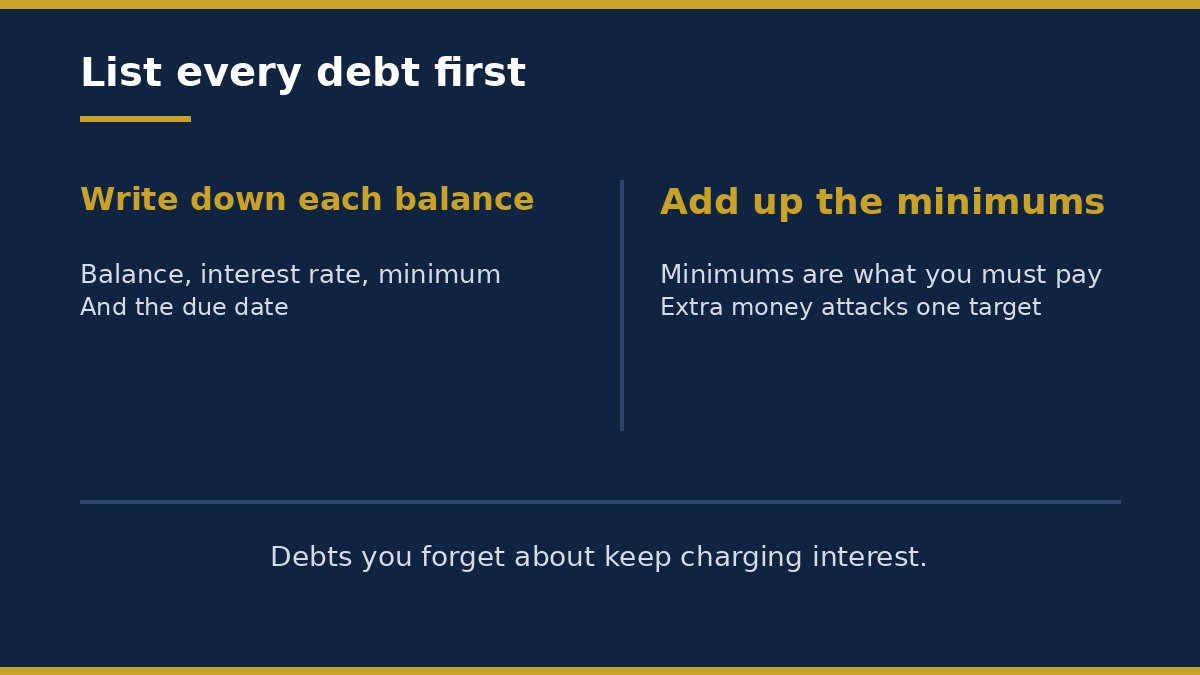
Before you pay anything extra, write down every debt you owe. Check your statements and your credit reports, because a store card or an old medical bill is easy to forget. For each debt, note four things: the balance, the interest rate (APR), the minimum monthly payment, and the due date.
A typical list might look like this: a store card with an $800 balance at 26 percent, a credit card with a $2,400 balance at 19 percent, and a personal loan with a $4,500 balance at 10 percent. The total is $7,700, but the three debts behave very differently. The store card is small and expensive. The loan is big and cheap. That difference decides your order.
Add up the minimum payments too. If the minimums are $25, $60, and $150, you must pay $235 every month just to stay current. Anything above $235 is the extra money that actually shrinks your debts. If you can find $400 a month in total for debt, then $165 of it is extra, and that $165 is what you aim at one target debt.
Put the list somewhere you will see it. A simple sheet of paper on the fridge works as well as any app. Update it once a month, when you make your payments. Watching the balances fall is what keeps the plan going.
Step 2: Pick your payoff order
There are two proven orders, and both work. Pick the one you will actually follow.
The snowball method pays the smallest balance first, whatever its interest rate. You clear a debt fast, feel the win, and roll that payment onto the next smallest. It works best if you need motivation, because early wins keep you going. Our guide on the debt snowball method explains the steps in full.
The avalanche method pays the highest interest rate first, whatever its balance. You pay less interest overall, because the most expensive debt shrinks first. It works best if you can stay patient, because the first win may take longer. Our guide on the debt avalanche method explains the steps in full.
Which one saves more money? The avalanche, usually, but often by less than people expect. On a few thousand dollars of debt, the difference between the two methods is often a few hundred dollars. The method you quit after two months saves nothing, so honesty about your own habits matters more than the maths. If small wins keep you going, pick the snowball. If saving every dollar of interest keeps you going, pick the avalanche. Our guide on which debt to pay first, the smallest or the highest interest compares the two side by side.
One rule applies to both: pay at least the minimum on every debt, every month, without exception. Missing a payment adds a late fee, can raise your interest rate, and hurts your credit record. The target debt gets the extra money. The others get their minimums, on time, every time.
Step 3: A worked example: $4,800 across two debts
Numbers make this concrete, so here is a simple example worked out in full.
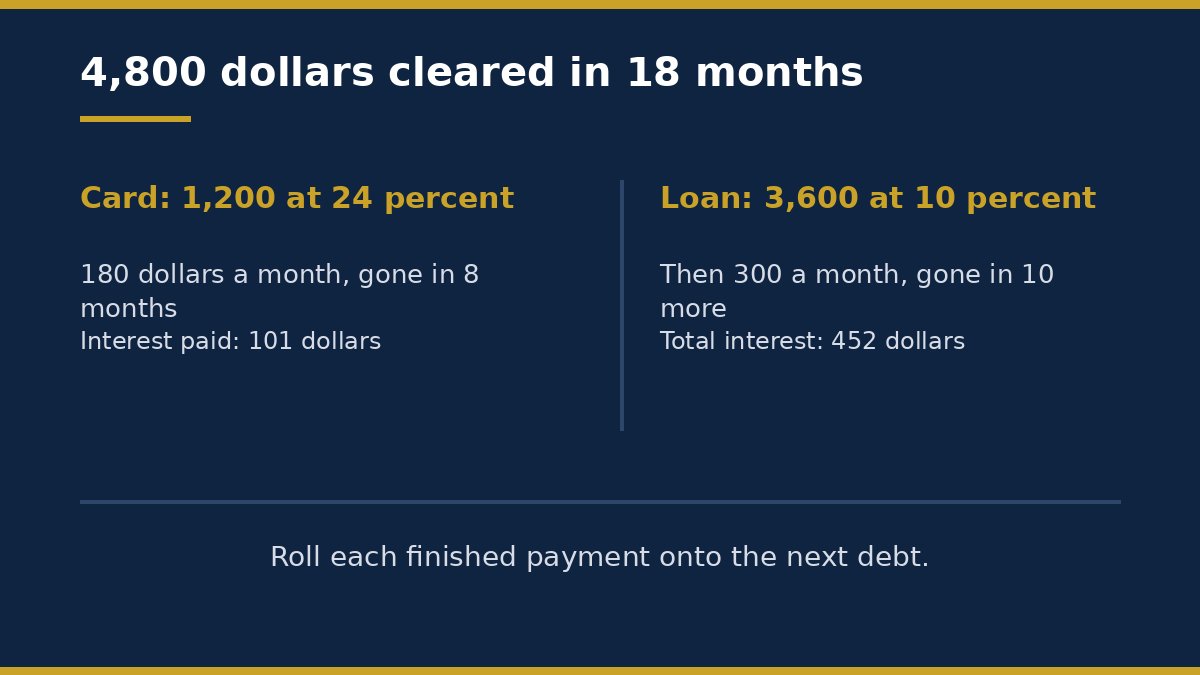
Say you owe $4,800 in total, across two debts. The first is a credit card with a $1,200 balance at 24 percent APR and a $30 minimum payment. The second is a personal loan with a $3,600 balance at 10 percent APR and a $120 fixed monthly payment. Your debt budget is $300 a month.
The minimums add up to $150, so you have $150 extra each month. Both methods point at the same target here: the card is the smallest balance and the highest rate. So the card gets $180 a month ($30 minimum plus $150 extra), and the loan gets its $120.
The card clears in 8 months, and you pay $101 in interest on it. Compare that with paying only the $30 minimum: the card alone would take 82 months, almost seven years, and cost $1,238 in interest. The extra $150 a month saves about $1,137 in interest and more than six years.
Meanwhile the loan keeps shrinking on its $120 payments. After 8 months, its balance is $2,859, and you have paid $219 in interest on it. Now the card is gone, so the full $300 a month goes to the loan. At $300 a month, the loan clears in 10 more months, with $132 of further interest.
The whole plan takes 18 months. Total interest is $452, and total paid is $5,252. That is the power of rolling payments: the same $300 a month clears two debts in a year and a half, because every dollar freed from the first debt attacks the second.
If your numbers are bigger, the same steps still work. List the debts, find your monthly total, pick the order, and roll each finished payment forward. Our guide on how to make a debt payoff plan you can stick to helps you turn these steps into a dated plan, and our guide on how long it will take to pay off your debt shows how to estimate your own finish date.
Step 4: Should you consolidate multiple debts?
Consolidation means replacing several debts with one new loan, usually at a lower rate, so you have one payment instead of many. It can help, but only in the right situation. It helps when your credit is good enough to get a clearly lower rate, when the new loan has no large fee, and when the monthly payment fits your budget. It does not help when the new rate is barely lower, when fees eat the saving, or when you run the old cards back up again after clearing them.
A balance transfer card is one form of consolidation: you move card balances onto one card with a low rate for a set period, often 12 to 18 months. It works only if you can clear the moved balance before the low rate ends. If you cannot, the rate jumps, and you are back where you started.
A personal loan is the other common form. One fixed payment, one end date, and no card to run back up. Before you take one, check the full cost: the interest rate, any origination fee, and the total you will pay over the life of the loan. Our guide on whether you should consolidate your debt walks through the checks to make before you sign.
The Consumer Financial Protection Bureau explains how consolidation works and what to watch for, and a nonprofit credit counsellor can look at your exact debts and tell you whether consolidation or a payment plan fits better. The National Foundation for Credit Counseling lists nonprofit agencies that offer that help. If you go this route, use a nonprofit agency, not a company that charges large upfront fees.
Step 5: When the minimums alone are too much
Sometimes the minimums on all your debts add up to more than you can pay. That is a different problem, and it needs a different first step: talk to someone before you miss payments.
Start with your lenders. Call each one, explain the situation, and ask what help is available. Many lenders offer a hardship plan: a lower rate, a smaller payment, or a pause for a few months. They would rather help you keep paying than chase a missed payment. Our guide on how to talk to a lender if you cannot pay gives you the words to use on that call.
Next, consider a nonprofit credit counsellor. A counsellor reviews your income, your spending, and all your debts, then helps you build a plan. Some agencies run a debt management plan, where you make one monthly payment to the agency and it pays your creditors, often at lower rates they negotiate for you. There is usually a small monthly fee, and the plan takes three to five years, but it stops the fees and the collection calls.
Know your rights if a collector contacts you. A collector must tell you the amount you owe and who you owe it to, and you can ask for that in writing. The Consumer Financial Protection Bureau has a plain guide to dealing with debt collection. You do not have to take the first offer a collector makes, and you should never give bank details to a caller you did not expect.
What you should not do is borrow from one card to pay another, take a payday loan to cover a minimum, or empty your emergency fund to pay a debt in full. Borrowing to pay borrowing just moves the problem, and an empty emergency fund means the next surprise goes straight back onto a card. Our guide on whether to use savings to pay off debt explains where that line sits.
Mistakes to avoid with multiple debts
The most common mistake is paying only the minimums and hoping the balances fall. They barely move. A $1,200 card at 24 percent, paid at the $30 minimum, takes 82 months and costs $1,238 in interest, more than the original balance. Minimums keep you current. They do not get you out of debt. Our guide on what happens if you only pay the minimum on a credit card shows the maths on a typical card.
The second mistake is paying the wrong debt first. Extra money aimed at a low-rate loan while a 26 percent store card keeps growing is wasted effort. Always aim the extra at the target debt your order picked, even when another lender is louder.
The third mistake is closing cards as soon as they are paid off. An open card with a zero balance helps your credit record, because it shows available credit you are not using. Keep the paid-off card open, use it rarely if at all, and pay it in full if you do use it.
The fourth mistake is stopping the plan after the first debt clears. That freed payment is the engine of the whole method. The month a debt is gone, the next debt should get the bigger payment, not your spending. Roll it forward the same week.
The fifth mistake is hiding a debt from the list. A small forgotten balance at a high rate can cost more in interest than a big loan at a low rate. Check your statements and your credit reports once a year, and add anything you find.
Frequently asked questions
Should I pay off all my debts at the same time?
No. Pay the minimum on all of them, and aim all extra money at one target debt. Splitting the extra across every debt means none of them clears quickly, and you pay more interest overall. One target at a time is faster and simpler.
Is it better to pay the smallest debt or the highest interest debt first?
Both work. The smallest first, the snowball, gives you quick wins and keeps you motivated. The highest interest first, the avalanche, saves the most interest. The difference is often a few hundred dollars, so pick the one you will stick with for the whole plan.
Does consolidating multiple debts hurt my credit?
It can dip your score for a short time, because a new loan means a hard check and a new account. Over time, one loan paid on time usually helps, because your card balances fall and your payments are steady. The bigger risk is running the old cards back up after consolidating, which leaves you with the loan and the cards.
What if I can only afford the minimums right now?
Pay the minimums on time, every month, and do not add new debt. Then look for even $25 extra a month, from a small spending cut, and aim it at your target debt. If even the minimums are too much, call your lenders about a hardship plan and speak to a nonprofit credit counsellor before you miss a payment.
Should I use my emergency fund to pay off a debt?
Usually not in full. Keep at least a small cushion, enough to cover a car repair or a short gap in pay, so the next surprise does not go back on a card. A small emergency fund and a steady payoff plan beat an empty fund and a cleared card.
How long will it take to clear several debts?
It depends on the total balance, the rates, and how much extra you can pay each month. In the worked example above, $4,800 clears in 18 months on $300 a month. The honest way to find your own date is to list your debts, fix your monthly total, and work the order month by month, as shown above.
Conclusion
Handling several debts at once comes down to five steps: list every debt, pick one order, pay the minimums on all of them, aim every spare dollar at one target, and roll each finished payment onto the next debt. The worked example shows what that looks like: $4,800 across two debts, cleared in 18 months, with $452 of interest, because the freed card payment attacked the loan.
Consolidation can help when the rate is clearly lower and the payment fits, and a nonprofit counsellor can help when the minimums alone are too much. Either way, the plan only works if you keep paying it. Start with the list today, pick your order, and make the first extra payment this month.
This article is for general information and education only. It is not legal or financial advice.
