

Should I Keep My Savings in One Account or Several?
Should I Keep My Savings in One Account or Several?
The short answer
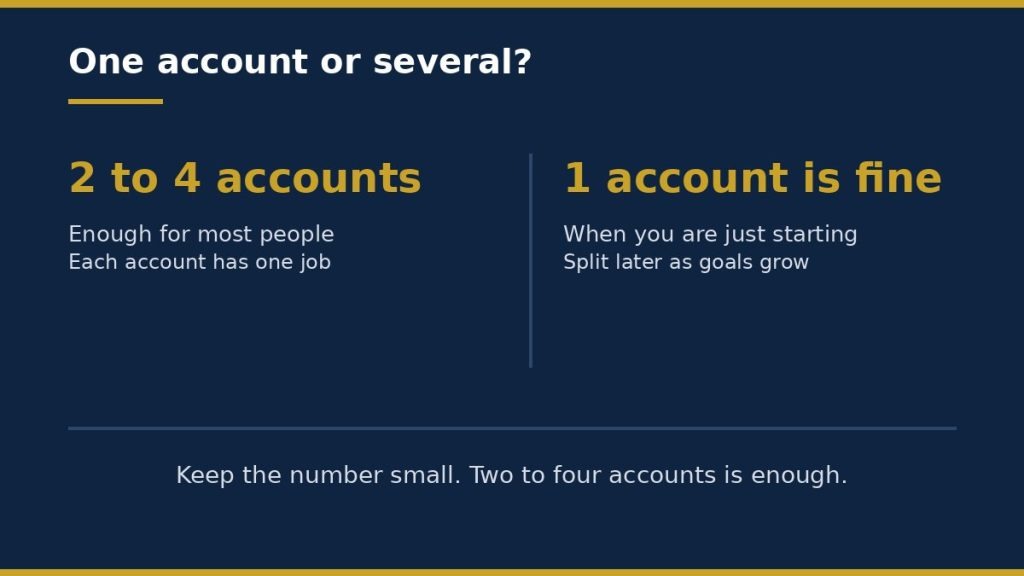
For most people, several savings accounts work better than one, as long as you keep the number small. Two to four accounts is a good range for most beginners. One account for emergencies, one for a short-term goal such as a vacation or a car repair, and maybe one more for a bigger goal such as a house deposit is enough. More than five accounts usually adds clutter without adding benefit.
The reason is simple. Each account has one job, so you always know what the money is for. When all your savings sit in one pot, it is easy to spend the emergency fund on a holiday, or to dip into the holiday fund for a takeaway. Separate accounts make that mistake harder, because you have to move the money on purpose.
That said, one account is not wrong. If you are just starting to save, one account is fine. You can split it later, once you have more than one goal and enough saved to make splitting useful. This guide explains when to split, how many accounts to keep, and how to set them up without creating a mess.
Why people split their savings
Splitting savings is a way of giving every dollar a job before you spend it. Psychologists call this mental accounting. It is the habit of treating money differently depending on what it is for. Separate accounts turn that habit into a system.
Here are the main reasons people split:
- Clear goals. An account named “Emergency fund” is harder to raid for a sale than a pot called “Savings”.
- No accidental spending. When the vacation money sits in its own account, you cannot spend it by mistake on a normal week.
- Automatic saving. You can set up a transfer that moves money into each account on payday, so every goal gets fed without you thinking about it.
- Safety limits. In the United States, the FDIC insures deposits up to 250,000 dollars per depositor, per bank. If your savings ever grow past that limit at one bank, a second bank keeps the extra insured.
- Better rates. Sometimes a different bank pays a higher rate on savings. A second account lets you earn the better rate on part of your money.
None of these reasons requires many accounts. Two or three accounts capture almost all of the benefit. The gain from a fourth or fifth account is small, and the extra admin can cost you time and attention.
One account or several?
There is no single right answer, because it depends on how much you save and how many goals you have. Here is a simple way to decide.
One account is enough when
- You are just starting, and your total savings are under 1,000 dollars.
- You have one goal only, such as building a first emergency fund.
- You check your accounts rarely, and you want the simplest setup possible.
- You are saving for one thing at a time and finishing it before starting the next.
If that sounds like you, keep one account for now. Put your energy into saving regularly, not into opening accounts. You can split later when it helps.
Several accounts help when
- You have two or more goals at the same time, such as an emergency fund and a vacation.
- You keep spending money that was meant for something else.
- You want each goal to grow on its own, with its own automatic transfer.
- Your savings are large enough that the FDIC insurance limit matters.
- You and a partner share some goals and keep others separate.
If two or more of those apply, open a second account for the next goal. Add a third only when a new goal truly needs its own home. Our guide to keeping saving when money is tight (https://investclaritypath.com/how-do-i-keep-saving-when-money-is-tight/) has practical ideas for finding money to save in the first place.
How many savings accounts should you have?
A good rule for most people is two to four accounts. Here is a setup that works for many households:
- Emergency fund. Three to six months of essential spending, in a high-yield savings account you can reach quickly. This is the account you protect most.
- Short-term goal. A vacation, a car repair, or Christmas, with a clear target and a clear date.
- Bigger goal. A house deposit, a car replacement, or a course, saved over one to three years.
- Optional extras. A separate account for a shared goal with a partner, or for a business, if you have one.
More than four accounts is rarely needed for personal saving. Each extra account means another balance to check, another statement to read, and another transfer to set up. It also spreads your money thin, so each account grows slowly, which can feel discouraging.
A useful test: if you cannot name the job of each account in one short sentence, you have too many. “Emergency fund”, “Vacation in July”, and “House deposit” are clear jobs. “Savings 4” is not a job, it is clutter.
A worked example: splitting 6,000 dollars three ways
Let us work through real numbers. Imagine you have saved 6,000 dollars and your monthly essential spending is 2,000 dollars. You have three goals: an emergency fund, a vacation, and a car repair fund.
Here is one way to split it:
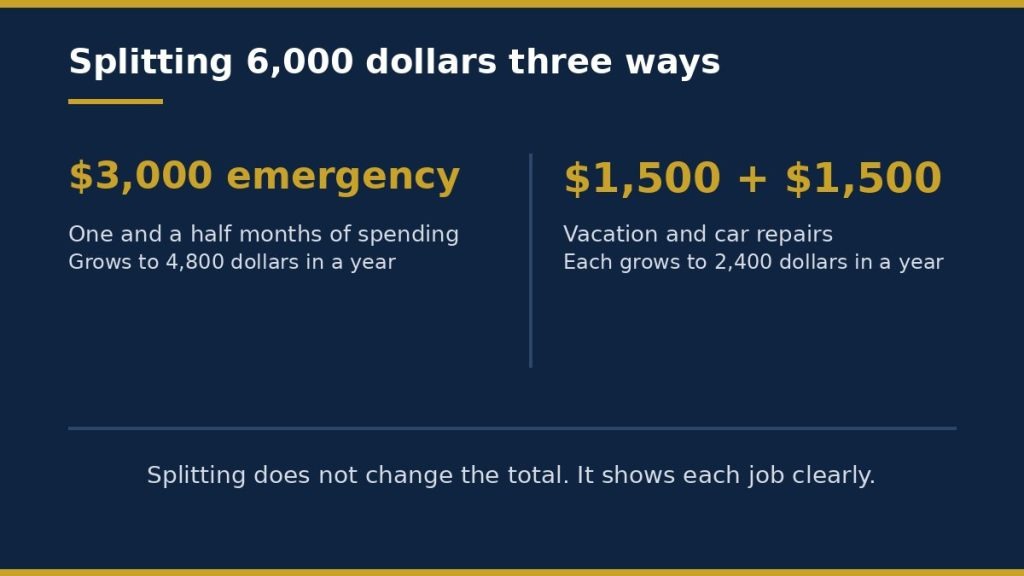
- Emergency fund: 3,000 dollars. That covers one and a half months of essential spending, a solid start toward the usual three to six month target.
- Vacation: 1,500 dollars. That is your full holiday budget for the summer.
- Car repairs: 1,500 dollars. That covers a new set of tyres and a service, with money left over.
Now add monthly saving. Suppose you can save 300 dollars a month. You split the transfer on payday:
- 150 dollars a month to the emergency fund. After 12 months, that is 1,800 dollars, so the fund grows from 3,000 to 4,800 dollars.
- 75 dollars a month to the vacation account. After 12 months, that is 900 dollars, so the account grows from 1,500 to 2,400 dollars.
- 75 dollars a month to the car repair account. After 12 months, that is 900 dollars, so the account grows from 1,500 to 2,400 dollars.
After one year, your total is 6,000 dollars plus 3,600 dollars of new saving, which is 9,600 dollars. The total is the same as if you had kept it all in one account. Splitting does not change how much you have. It changes how clearly you can see what each part is for, and that clarity is the whole point.
If all three accounts pay the same interest rate, the interest earned is the same too. Splitting does not cost you interest, as long as each account pays a similar rate. That is worth checking, because some accounts pay more than others. Our guide to how compound interest works (https://investclaritypath.com/how-does-compound-interest-work/) explains how interest builds up over time.
The downsides of too many accounts
Splitting helps, but only up to a point. Too many accounts create their own problems.
First, minimum balances. Some savings accounts require a minimum balance to avoid a fee or to earn the advertised rate. If you spread 2,000 dollars across five accounts, each one may sit below the minimum, and you may pay fees or earn a lower rate.
Second, lost track. With six or seven accounts, it is easy to forget one, miss a fee, or leave money sitting in an account that pays almost no interest.
Third, slow progress. When each goal gets only 25 dollars a month, none of them seems to grow. Saving feels pointless, and people give up. Fewer accounts mean each one grows faster, which keeps you motivated.
Fourth, admin time. Every account needs a password, a statement check, and a place in your records. That is fine for three accounts. It is a chore for eight.
If you already have too many, close the extras. Move the money into the accounts that remain, keep the ones with the best rates, and set a date each year to review the list.
How to set up your accounts step by step
Setting this up takes less than an hour, and most of it is a one-time job.
Step 1: List your goals and pick two or three
Write down every savings goal you have, with the amount and the date you need it. Then pick the two or three that matter most right now. The rest can wait until one of these is done.
Step 2: Choose the bank or banks
You can keep all your accounts at one bank, or spread them across two. One bank is simpler. Two banks can help if the second pays a better rate, or if your total savings are near the FDIC insurance limit of 250,000 dollars per depositor per bank. The FDIC explains deposit insurance in plain words on its deposit insurance (https://www.fdic.gov/resources/deposit-insurance/) page.
If you are comparing banks and credit unions, our guide to choosing between a credit union and a bank (https://investclaritypath.com/how-do-i-choose-between-a-credit-union-and-a-bank/) walks through the differences in costs, access, and service.
Step 3: Open the accounts and name them
Most banks let you open a savings account online in minutes, and let you give each account a nickname. Name each account after its job, such as “Emergency fund”, “Holiday July”, or “New car”. A clear name is the whole trick. It is what stops you spending the wrong pot.
Step 4: Set up automatic transfers on payday
Set a transfer from your main account into each savings account on the day your pay arrives. Even 25 dollars a month to a goal is a start. Automatic transfers work because they happen before you have a chance to spend the money. If your income changes, adjust the amounts, but keep the habit going.
Step 5: Check in once a month
Once a month, look at each balance and compare it with the goal. Are you on track for the holiday? Is the emergency fund growing? If a goal is done, close that account or give it a new job. A short monthly check keeps the system honest.
Savings accounts vs investing
Splitting savings accounts is about money you need soon. Investing is about money you will not need for many years. The two jobs are different, and they belong in different places.
Money you need within the next year or two, such as an emergency fund or a holiday, belongs in savings, where its value does not fall. Money you will not need for 10 years or more can go into investments, where it has time to grow and to ride out falls in price.
Do not put your emergency fund into the stock market to chase a higher return. A fall in prices at the same time as a lost job or a broken car is the worst moment to need the money. Our guide to the difference between saving and investing (https://investclaritypath.com/what-is-the-difference-between-saving-and-investing/) explains the two roles in more detail.
Frequently asked questions
How many savings accounts is too many?
For most people, more than five is too many. Each extra account adds admin and splits your money into small, slow-growing pots. Two to four accounts cover almost every personal goal. If you cannot name the job of each account in one sentence, you have too many.
Does having several savings accounts hurt my credit score?
No. Savings accounts do not appear on your credit report, and opening one does not affect your credit score. Banks may run a soft check when you open an account, but that does not lower your score. What matters for your credit score is borrowing and repaying on time, not how many savings accounts you hold.
Should my emergency fund be in its own account?
Yes, if you can. Your emergency fund is the account you must not spend by accident. Keeping it separate, with its own name and its own automatic transfer, protects it from everyday spending. It also lets you see at a glance whether you have three to six months of spending saved.
Is it better to keep all savings at one bank?
For most people, yes, because it is simpler. You see all your balances in one place, and transfers between your own accounts are instant. The main reason to use a second bank is a better interest rate, or total savings above the FDIC insurance limit of 250,000 dollars per depositor at one bank.
What should I do with a savings account I no longer need?
Move the money to the account that needs it most, then close the empty account. Closing an old savings account does not hurt your credit score. Keep a note of the closure, and check that no automatic transfer still points to the closed account.
Conclusion
One account is fine when you are starting out. Several accounts work better once you have more than one goal, because each account has one job and you can see your progress clearly. Two to four accounts is the sweet spot for most people: an emergency fund, a short-term goal, and a bigger goal, each with its own name and its own automatic transfer on payday.
The total you save matters more than how many accounts hold it. Splitting 6,000 dollars three ways does not make it grow faster. What it does is stop you spending the emergency fund on a holiday, and that is worth more than a slightly higher interest rate. Keep the number small, name each account after its job, check in once a month, and let the system do the work.
If you are saving for a holiday, our guide to saving for a vacation without debt (https://investclaritypath.com/how-to-save-for-a-vacation/) shows how to plan the trip step by step. For a plain official guide to bank accounts and how they work, the Consumer Financial Protection Bureau has a clear bank accounts (https://www.consumerfinance.gov/consumer-tools/bank-accounts/) page.
This article is for general information and education only. It is not legal or financial advice.
