
How Do I Sell Digital Products as a Side Income?
How Do I Sell Digital Products as a Side Income?
The short answer
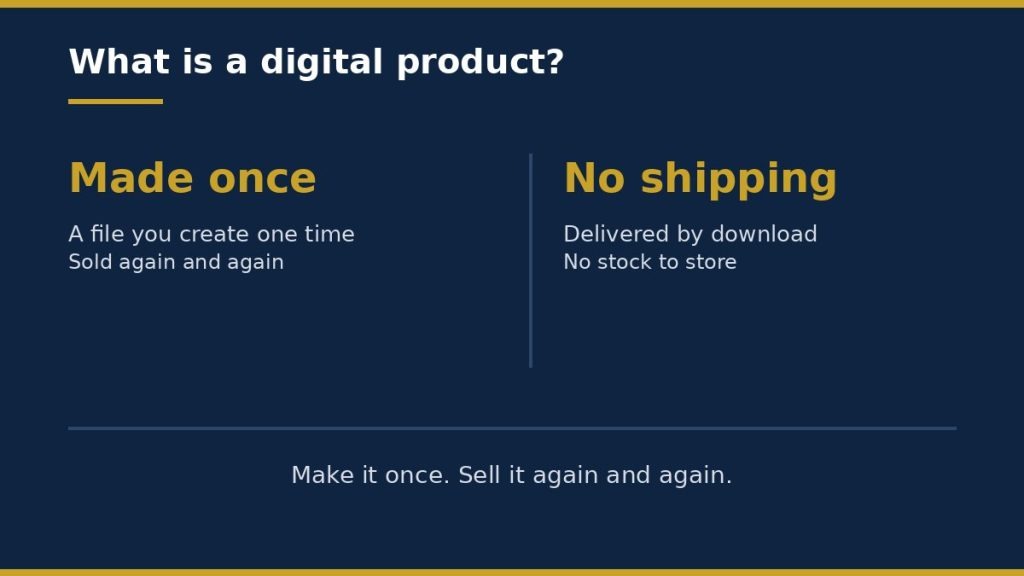
You sell digital products as a side income by making one useful file once, putting it on a platform that handles payment and delivery, and telling the right people about it. A digital product is a file a customer can download or use online, such as a printable planner, a template, a short ebook, a set of presets, or a short video course. You make it once, and you can sell the same file again and again without making a new one each time.
That is the main appeal. A service earns money only when you do the work. A digital product earns money from work you already did. It is not free money, and it is not fast money. You still have to make something good, set a fair price, and find buyers. But the work is front loaded, which suits a side income built around a day job.
This guide walks through the whole process in plain steps: pick a product, make it, price it, list it, find buyers, and handle the tax basics.
What is a digital product?
A digital product is something you create on a computer and deliver over the internet. The buyer gets a file or access to a page, not a box in the post. Common examples include:
- Printable planners, trackers, and checklists, such as a budget planner or a habit tracker.
- Templates, such as a resume template, a budget spreadsheet, or a social media template.
- Short ebooks and guides, such as a 20 page guide to a skill you know well.
- Stock photos, fonts, icons, and design assets.
- Presets and filters for photo editing apps.
- Short video courses or audio lessons on one clear topic.
- Printables for teachers, such as worksheets and classroom posters.
What these have in common is that they solve one small problem for one kind of buyer. A budget planner helps someone who wants to track spending. A resume template helps someone applying for jobs. The more specific the problem, the easier the product is to sell.
Is selling digital products a good side income for beginners?
For many beginners, yes, with honest expectations. Here is a fair look at the good and the hard parts.
The good parts: the start-up cost is very low, often nothing but your time and a free design tool. There is no stock to store and no shipping. You can work on it in the evenings and weekends. One product can keep selling for months or years after you finish it.
The hard parts: you earn nothing until someone buys, and the first sales are the slowest. You have to learn basic marketing, because a good product on a quiet shop page does not sell itself. Some platforms take a fee from every sale. And you need to keep your product up to date if the tool or topic changes.
A realistic goal for a first product is not to replace your salary. It is to make your first 10 sales, learn what buyers ask for, and then improve. If you are still deciding between a service and a product, our guide to the simplest side income for beginners (https://investclaritypath.com/what-is-the-simplest-side-income-for-beginners/) can help you compare.
Step 1: Pick one product for one kind of buyer
Most beginners fail by trying to sell to everyone. Pick one buyer and one problem instead.
Start with what you already know. Think of things people already ask you for help with. Do colleagues ask you to fix their spreadsheets? Do friends ask how you plan your meals? Do people admire your resume? Each of those is a possible product: a spreadsheet template, a meal planning printable, a resume template.
Then check that people actually want it. Search the marketplaces for your idea and look at what already sells. If ten similar products exist and each has many sales and good reviews, that is a good sign. It means buyers exist. If nothing like it exists at all, be careful. It may mean nobody wants it.
Also check the size of the job. Your first product should be something you can finish in a few weekends, not a 200 page course. A one page printable or a five page guide is a fine first product.
Step 2: Make the product well
A digital product only sells twice if the first buyer is happy. Make it carefully, even if it is small.
Use tools you already know. Free tools such as Canva or Google Sheets are enough for most first products. You do not need expensive software. What matters is that the file is clean, easy to read, and works as promised. Our guide to starting a side income with no money (https://investclaritypath.com/how-can-i-start-a-side-income-with-no-money/) covers the free ways to begin.
Test it yourself, then ask one or two people to test it. Give them the file and watch where they get stuck. Do they understand the instructions? Does the spreadsheet calculate correctly? Does the printable fit on a normal page? Fix every problem they find before you list it.
If your product is based on a skill you already sell as a service, you have a head start. Our guide to turning a skill into side income (https://investclaritypath.com/how-do-i-turn-a-skill-into-side-income/) explains how to package what you know.
Step 3: Price it simply
Pricing confuses most beginners. Keep it simple with three rules.
First, look at what similar products sell for. If most budget planners sell for 5 to 15 dollars, a price of 29 dollars for your first planner is hard to justify, unless yours does clearly more. Price near the normal range for your first product, and let your reviews and sales build before you charge more.
Second, remember the platform fee. Most marketplaces take a percentage of each sale, plus sometimes a fixed fee. A 5 percent fee on a 10 dollar sale is 50 cents. A 15 percent fee on the same sale is 1.50 dollars. Read the fee page before you set your price, so a sale still leaves you with a fair amount.
Third, do not race to the bottom. A price of 1 dollar attracts bargain hunters who may not value the product, and it leaves you almost nothing after fees. A fair price for a useful file is usually between 5 and 50 dollars, depending on how much it does for the buyer.
Step 4: Choose where to sell it
You have three main options, and each suits a different beginner.
Marketplaces such as Etsy or Gumroad bring buyers to you, but they charge fees and you follow their rules. Etsy suits printables, templates, and design files, and it has a large audience already searching. Gumroad suits ebooks, courses, and files of all kinds, and it is simple to set up.
Your own website gives you full control and no marketplace fee, but you have to bring every buyer yourself. That is a lot of work for a first product.
Social media shops, such as selling through a link on your profile, sit in between. You still bring the buyers, but the setup is fast.
For a first product, a marketplace is usually the simplest choice. You get a shop page, payment handling, and file delivery without building anything. Pick one marketplace, list one product, and learn how it works before you add a second shop.
When you set up your shop, write a clear title and description. The title should say what the product is and who it is for. The description should say what the buyer gets, how many pages or files, what size, and how to use it. Add a preview image that shows the product clearly.
Step 5: Find your first buyers
A listed product with no visitors will not sell. You need to tell people about it, in places where your buyers already spend time.
Start with people you know. Tell friends, colleagues, and online groups that you made something. Do not spam them. Share it once, explain who it helps, and let interested people come to you.
Write one short post or pin for each place your buyers gather. A budget planner belongs in budgeting groups and money forums. A teacher worksheet belongs in teacher groups. A resume template belongs where job seekers gather. One honest post in the right group beats ten posts in the wrong one.
Ask your first buyers for a review. Reviews are the main way strangers decide to trust a new shop. A polite message after delivery, asking if the file worked well and if they would leave a short review, is enough. Do not pay for reviews or invent them.
Keep a simple record of where each sale came from. If a post in one group brings five sales and a post elsewhere brings none, spend more time in the group that works. Finding buyers is a skill of its own, and our guide to finding your first freelance client (https://investclaritypath.com/how-do-i-find-my-first-freelance-client/) covers how to turn a first conversation into paid work.
A worked example: 60 sales at 29 dollars
Let us work through real numbers so you can see what a small product can earn.
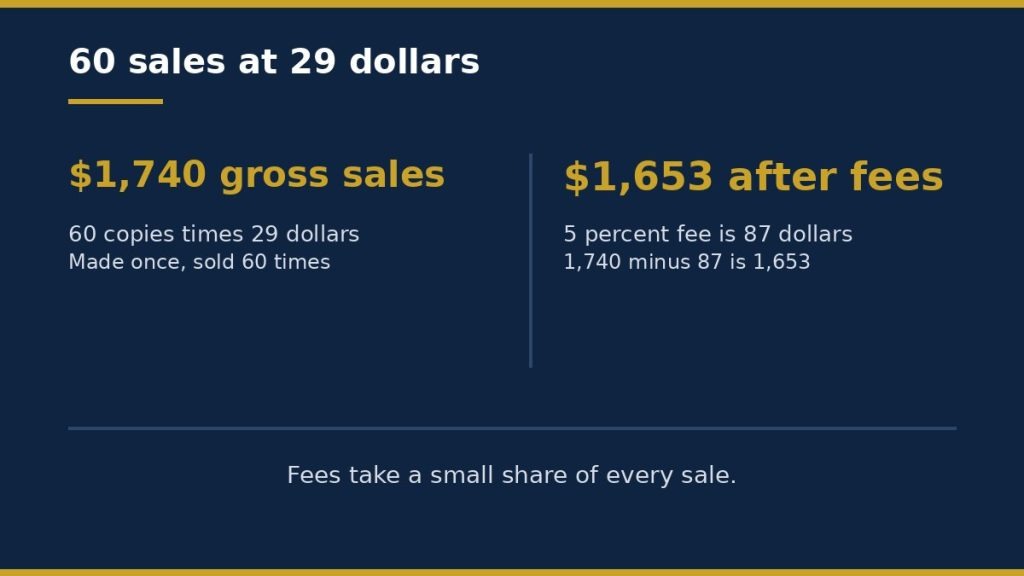
Imagine you make a printable budget planner and price it at 29 dollars. In your first month, you sell 60 copies. Here is the math:
- Gross sales: 60 copies times 29 dollars is 1,740 dollars.
- Platform fee: suppose the marketplace takes 5 percent. 5 percent of 1,740 dollars is 87 dollars.
- Net income: 1,740 dollars minus 87 dollars is 1,653 dollars.
That is 1,653 dollars from a file you made once. Now look at the time. Suppose you spent 20 hours making the planner, testing it, and listing it. That is 1,653 dollars divided by 20 hours, which is about 82.65 dollars per hour of work. But that only counts the first month. If the same file sells 20 more copies the next month with no extra work, the hourly value keeps rising.
Be honest about the other side too. If you sell only 5 copies in the first month, the math is very different: 5 times 29 dollars is 145 dollars, minus a 5 percent fee of 7.25 dollars, which leaves 137.75 dollars. That is still real money for a first try, and the lessons from those 5 sales are worth more than the cash. Most sellers start small and grow.
Tax basics for digital product sellers
Money from digital products is usually taxable income, even if it feels like a hobby. The rules depend on where you live, but in the United States the basics are:
- Keep a record of every sale and every fee, from the start. A simple spreadsheet with the date, the product, the sale price, and the fee is enough.
- Set aside money for tax as you earn it. A common habit is to move 20 to 30 percent of each payout into a separate savings account, so the tax bill does not surprise you later.
- Check whether you need to pay estimated tax during the year. The IRS explains the rules for self-employed people on its self-employed tax center (https://www.irs.gov/businesses/small-businesses-self-employed/self-employed-individuals-tax-center) page, and its estimated tax (https://www.irs.gov/businesses/small-businesses-self-employed/estimated-taxes) page explains when quarterly payments apply.
- Keep receipts for costs, such as design tools or marketplace fees.
This is general information, not tax advice. If your sales grow, or the rules confuse you, a local tax professional can answer for your situation.
Mistakes to avoid
A few common mistakes cost beginners time and sales.
First, making a product nobody asked for. Always check that buyers exist before you spend weekends building something.
Second, copying someone else’s product. Copying text, designs, or files from another seller breaks marketplace rules and can get your shop closed. Make your own version, in your own words and style.
Third, a messy listing. A vague title, no preview image, and a one line description will not sell, even if the product is good. Spend time on the listing, because that is what the buyer sees.
Fourth, falling for a scam. Some messages promise to promote your shop for a fee, or ask you to pay to unlock sales. Real marketplaces do not work that way. Our guide to avoiding side income scams (https://investclaritypath.com/how-do-i-avoid-side-income-scams/) lists the warning signs to check before you pay anyone.
Frequently asked questions
How much money do I need to start selling digital products?
Very little. Most beginners start with free tools and a marketplace account, which costs nothing to open. You pay fees only when you sell. Your main cost is your time, which is why picking a product you can finish in a few weekends matters more than spending money on tools.
Do I need a business or a website to sell digital products?
No, not to start. A marketplace account is enough for your first sales. You can add a website later if sales grow and you want more control. Some sellers never build a website and do fine on a marketplace alone.
How long does it take to make a first sale?
It varies a lot. Some sellers make a sale in the first week because they shared the product in the right group. Others wait a month or more. What speeds it up is a clear listing, a fair price, and telling the right people.
Can I sell the same product on more than one marketplace?
Usually yes, as long as each marketplace allows it, and most do. Many sellers list the same file on two marketplaces to reach more buyers. Check the rules of each marketplace first, and keep the price and the file the same in both places so buyers are not confused.
Do I have to pay tax on digital product sales?
In the United States, income from digital products is generally taxable, even in small amounts. Keep records from the first sale, set aside money for tax, and check the IRS self-employed pages linked above. If you are unsure, ask a local tax professional.
Conclusion
Selling digital products as a side income comes down to a simple chain: one useful file, one kind of buyer, a fair price, one marketplace, and steady, honest promotion. You make the product once, and it can sell again and again while you focus on your day job or your next product.
Start small. Pick one product you can finish in a few weekends. Price it near what similar products sell for. List it on one marketplace. Tell the right people, in the right places, that it exists. Then learn from your first sales and make the next product better.
This article is for general information and education only. It is not legal or financial advice.
