

How Do I Make Money Online for Beginners?
Making money online means earning money through work you do on the internet. It can be freelance writing, tutoring over a video call, selling a handmade item, or helping a small business with its social media. You do it from home, on hours you choose, and you are paid by a client or a platform.
To make money online as a beginner, pick one skill you already have, choose one simple way to sell it, set a clear price, and find your first buyer through people you know or a freelance platform. Start with a service, because a service needs no stock and no upfront cost. The worked example below shows how freelance writing at $25 an hour, 5 hours a week, adds up to $500 a month.
What Does Making Money Online Actually Mean?
Making money online is not one job. It is a way of working. The internet connects you with buyers, clients, and students who need something you can do. You offer a skill or a product, the buyer pays you through a bank transfer, a payment app, or a platform.
It is different from a regular job in three ways: you choose the work and the hours, you find your own buyers, and your income can be uneven at the start, because you earn only when you complete work and get paid for it.
There are two broad types of online income. Active income comes from work you do, like writing an article or tutoring a student. Passive-style income, like selling a digital guide, still needs real work upfront, and sales are never guaranteed. Beginners should start with active income, because it pays sooner.
You do not need a big idea, a loan, or a website to start. Most beginners start with a service, because it needs no stock and no upfront cost. Our guide on how to start a side income with no money explains why.
Six Beginner Ways to Make Money Online
Not every way of earning online suits every beginner. Here are six common ways, from the most beginner friendly to the slowest to grow.
1. Freelance Services
Freelance work means doing paid jobs for clients, one job at a time: writing, design, bookkeeping, data entry, virtual assistant work, and social media help. You set a price, agree the work in writing, deliver it, and get paid. This is the best first choice for most beginners, because you can start with a skill you already have. Our guide on how to turn a skill into side income shows how to test whether your skill can sell.
2. Tutoring and Teaching Online
If you know a school subject, a language, or a practical skill, you can teach it over a video call, one to one, at an hourly rate you set. Tutoring suits people who are patient and good at explaining things simply. Start with a short trial lesson, so the student and their family can see how you teach.
3. Selling Things You Own or Make
You can sell items you no longer need through an online marketplace, or sell things you make, like crafts or digital planners. Selling used items is a quick way to earn your first money online. Selling handmade or digital products takes longer, because you must make the product and find buyers. Keep it simple: one product, one marketplace, and a clear price.
4. Content Creation
Content creation means making videos, posts, or articles that an audience enjoys, and earning from adverts, sponsors, or product sales later. It is the slowest of these six ways to pay, and most creators earn nothing for months while they build an audience. Treat it as a long term project, not your first income.
5. Virtual Assistant Work
A virtual assistant helps a busy person or a small business with admin tasks: answering emails, booking appointments, updating spreadsheets, or managing a calendar. The work is done online, usually from home, and the hours are flexible. This suits organised people who like clear tasks and steady routines.
6. Surveys and Small Tasks
Some websites pay small amounts for surveys, testing apps, or completing simple tasks. The pay is very low, often a few dollars an hour at best, and the work is not steady. Surveys can earn a little extra pocket money, but they are not a real income. If a survey site asks you to pay to join, or promises hundreds of dollars a day, walk away.
How to Pick the Right Way for You
The best way to make money online is the one that fits your skill, your time, and your patience. Work through these four questions before you commit to one path.
First, what can you already do? Write down three skills, then ask of each one: would someone pay for this? If friends or co-workers have already asked you to do it, the answer is probably yes. Our guide on how to choose a side income that fits your skills helps you compare your options.
Second, how much time do you really have? Five hours a week is a realistic start for most people with a full-time job or studies. Pick a way that fits those hours.
Third, how soon do you need the money? Freelance services and tutoring can pay within a few weeks. Content creation and digital products can take months. Match your choice to your timeline.
Fourth, what do you enjoy enough to keep doing? Online work is slow at first, and you will keep going only if the work itself is tolerable.
Your First Week, Step by Step
You can go from idea to first message in one week.
Day 1 and 2: Pick your skill and your buyer. Finish this sentence: "I help [type of person] with [one problem]." For example: I help small shops with product photos. I help busy parents with weekly meal plans.
Day 3: Package it as one simple offer. An offer has four parts: what you do, who it is for, what they get, and what it costs. Keep it short enough to say in two sentences. For example: "I write five product descriptions a week for small online shops, 100 words each, delivered by Friday, for $125 a week."
Day 4: Set your price. Pick an hourly rate, then multiply it by the hours the job takes. In this guide, we use $25 an hour as a starting rate, so a 5-hour job costs $125. You can charge by the hour or by the job. Charging by the job is often easier for buyers, because they know the total cost upfront.
Day 5 to 7: Tell 30 people. Make a list of 30 people: friends, family, former co-workers, neighbours, local shop owners, and people in groups you belong to. Send each of them a short, personal message saying what you do, who it helps, and what it costs, and end with one question, such as "Do you know anyone who needs this?" Send about ten messages a day for three days. Expect most people to say nothing, and one or two to say yes. That is normal. One yes is all you need to start. Our guide on how to find your first freelance client has more ideas for where to look and what to say.
Worked Example: Freelance Writing at $25 an Hour
Here is a worked example using freelance writing. The same math works for any hourly service, so change the rate and hours to match your own skill.
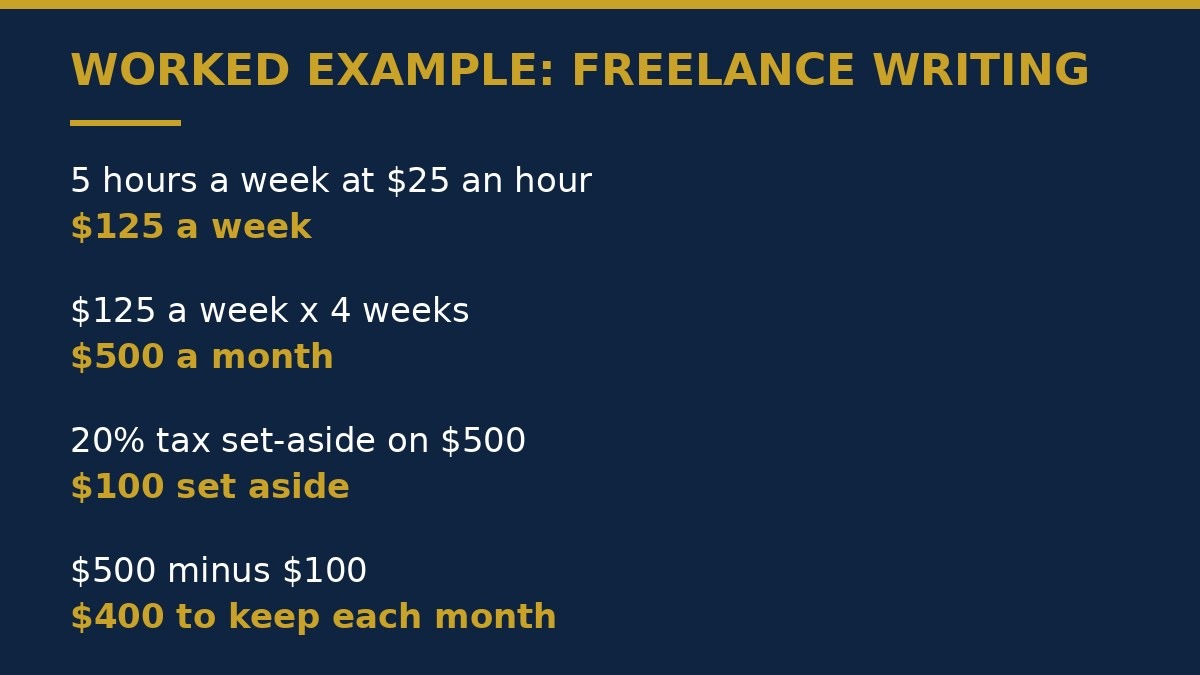
The offer: five product descriptions a week for an online shop, at $25 an hour, taking 5 hours a week.
- Hours per week: 5
- Hourly rate: $25
- Weekly earnings: 5 times $25 equals $125.
- Monthly earnings, using 4 weeks: $125 times 4 equals $500.
- Yearly earnings, using 52 weeks: $125 times 52 equals $6,500.
Now set money aside for tax. Set aside 20 percent of every payment when you earn it. On $500 a month, 20 percent is $100, which leaves $400 a month to keep.
- Monthly earnings: $500
- Tax set-aside, 20 percent: $500 times 0.20 equals $100.
- Money to keep each month: $500 minus $100 equals $400.
Start-up cost is $0, because the writer already owns a laptop and an internet connection.
Now look at growth. After a few months, the writer raises the rate to $30 an hour and works 10 hours a week, with two regular clients.
- Hours per week: 10
- Hourly rate: $30
- Weekly earnings: 10 times $30 equals $300.
- Monthly earnings: $300 times 4 equals $1,200.
- Yearly earnings: $300 times 52 equals $15,600.
- Tax set-aside, 20 percent: $1,200 times 0.20 equals $240.
- Money to keep each month: $1,200 minus $240 equals $960.
That growth needed no new skill, just one more client, five more hours a week, and a small rate rise.
How to Avoid Online Money Scams
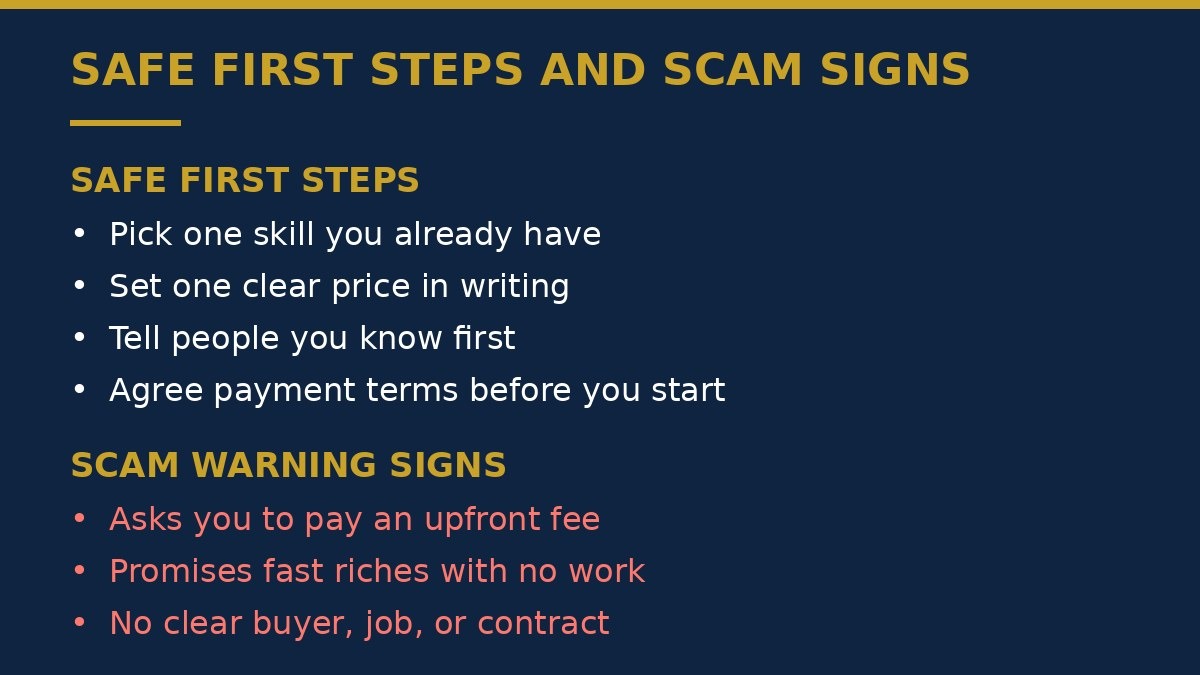
The internet has real ways to earn money, and it also has many scams. A scam usually asks you to pay money first, or promises large earnings for almost no work.
Never pay an upfront fee to get a job. A real client pays you for work, not the other way round. If someone asks for a training fee, a registration fee, or a deposit before you can start, walk away. The same rule applies to any "opportunity" that asks you to buy a starter kit.
Avoid get-rich-quick promises. Claims like "earn $500 a day from your phone with no skills" are not real jobs. Real online income starts small, grows slowly, and pays for real work. If an offer sounds too good to be true, it almost certainly is.
Check who you are dealing with before you agree to anything. A real buyer has a clear job, a clear deadline, and a way to pay you. Ask for the work in writing, agree the price and the delivery date, and never share your bank login details, passwords, or one-time codes with anyone. A client needs your bank account number or payment app handle to pay you, never your password.
Our guide on how to avoid side income scams lists the most common scam types and the red flags to check before you say yes.
What About Tax on Online Income?
Online income is usually taxable, so plan for it from the first dollar. Set aside 20 percent of every payment in a separate savings account, and do not spend it. In the worked example, that is $100 a month on $500 of earnings.
In the United States, people who work for themselves generally pay self-employment tax on top of income tax. The IRS page on self-employment tax explains that the tax is 15.3 percent, made up of 12.4 percent for Social Security and 2.9 percent for Medicare. That is one reason a 20 percent set-aside is a sensible habit: it covers the self-employment tax and leaves room for income tax too.
Keep simple records from day one: client name, date, what you delivered, and how much you were paid. A notebook or a simple spreadsheet is enough.
As your online income grows, it helps to write a short plan. The U.S. Small Business Administration has a free guide to writing a business plan that covers what you offer, who your customers are, and how the money works. Tax rules change by country and state, so talk to a qualified tax professional about your own case.
Mistakes to Avoid When You Make Money Online
- Trying five ideas at once. One skill and one offer finds a client faster.
- Paying to get started. Never pay an upfront fee for a job or an opportunity.
- Believing get-rich-quick promises. Real online income starts small and grows slowly.
- Having no price in writing. Agree the price and the delivery date before you start.
- Waiting until it feels perfect. Your first offer needs to be clear and sent to real people.
- Forgetting tax. Set aside 20 percent of every payment from the first dollar.
- Ignoring your day job rules. Check your contract first, and keep online work hours outside work hours.
- Giving up after one quiet week. Send more messages before you decide the idea does not work.
Frequently Asked Questions
How do I make money online for beginners with no experience?
Start with a service based on a skill you already have, like writing, tutoring, or admin help. You need one skill a buyer will pay for, not experience in online work. Pick one offer, set a price, and tell 30 people about it.
How much money can a beginner make online?
It depends on your rate, your hours, and your clients. In the worked example, 5 hours a week at $25 an hour earns $500 a month, or $6,500 a year, and 10 hours a week at $30 an hour earns $1,200 a month, or $15,600 a year. The math is the same for you: hours times rate, minus a tax set-aside, equals what you keep.
How long does it take to earn my first dollar online?
For most beginners, two to four weeks from the first messages to getting paid. The first client often says yes in week 2 or 3. Content creation and digital products take much longer, often months.
Do I need money to start making money online?
For a service, you can start with $0. You already have a phone, a laptop, and an internet connection, and your first clients come from personal messages.
Is making money online safe?
It can be safe if you follow basic rules: never pay an upfront fee, never share passwords or bank login details, and agree every job in writing. Avoid any offer that promises fast riches with no work.
Can I make money online while working full time?
Yes, and most people do. Keep online work hours outside your day job hours, and check your contract for rules about side work. Start with 5 hours a week, and grow the hours only when the income is steady.
Conclusion
Making money online as a beginner comes down to four steps: pick one skill you already have, choose one simple way to sell it, set a clear price, and find your first buyer through people you know or a freelance platform. Start with a service, because it needs no stock and no upfront cost. In the worked example, freelance writing at $25 an hour, 5 hours a week, earns $500 a month, with $100 set aside for tax and $400 to keep. Start this week, and let your first client teach you what to do next. And remember the golden rule: never pay to get a job, and walk away from any promise of fast riches.
This article is for general information and education only. It is not legal or financial advice.
