
How Do I Invest in Bonds in Simple Terms?
A bond is a loan you make to a government or a company. They borrow your money, pay you interest, and return your money on a set date. When you buy a stock, you own a small piece of a business. When you buy a bond, you are the lender.
To invest in bonds, pick one of three simple ways: buy a single bond through a broker, buy a bond fund or bond ETF that holds many bonds at once, or buy US government bonds directly from TreasuryDirect. The worked example below shows how a $1,000 bond paying 4 percent a year gives you $40 a year.
What Is a Bond, in Simple Terms?
Imagine a city needs money for a new bridge, or a company for a new factory. Instead of borrowing from one bank, they borrow small amounts from thousands of ordinary people. Each loan is split into bonds, and each bond is one small piece of that loan.
When you buy a bond, you lend your money to the borrower. In return, the borrower promises to pay you interest on a regular schedule and to return your full loan on a fixed date, called the maturity date.
Bonds are often called fixed income, because the interest payments are set in advance. You know how much interest you will get and when, as long as the borrower keeps its promise. Many beginners use bonds for the steady part of a plan, while stocks do the growing part. Our guide on how stocks, bonds, and funds work together explains how the three parts fit into one simple plan.
How Does a Bond Work?
Every bond has three numbers that matter most: the face value, the coupon rate, and the maturity date.
Face Value
The face value, also called par value, is the amount the borrower promises to pay back at maturity. Most bonds have a face value of $1,000, so you get $1,000 back on the maturity date if the borrower does not default.
Coupon Rate
The coupon rate is the interest rate the bond pays each year, as a percent of the face value. A $1,000 bond with a 4 percent coupon rate pays $40 a year: $1,000 times 0.04 equals $40. Most bonds pay interest twice a year, so a $40 yearly payment arrives as $20 every six months.
Maturity Date
The maturity date is the day the borrower must return your money. Short-term bonds mature in one to three years, medium-term bonds in three to ten years, and long-term bonds in more than ten years. Longer bonds usually pay a higher interest rate, because you lend your money for longer and take on more risk.
Price
A bond can be bought at, above, or below its face value. If you buy a new bond when it is first issued, you usually pay the face value, $1,000. If you buy an older bond from another investor, the price depends on interest rates. When new bonds pay higher rates, older bonds with lower rates become less attractive, so their price falls below $1,000. When new bonds pay lower rates, older bonds with higher rates become more attractive, so their price rises above $1,000.
Bond prices move up and down before maturity, even though the face value and interest stay fixed. Hold to maturity and you still get the full face value back, as long as the borrower does not default.
The Three Main Types of Bonds
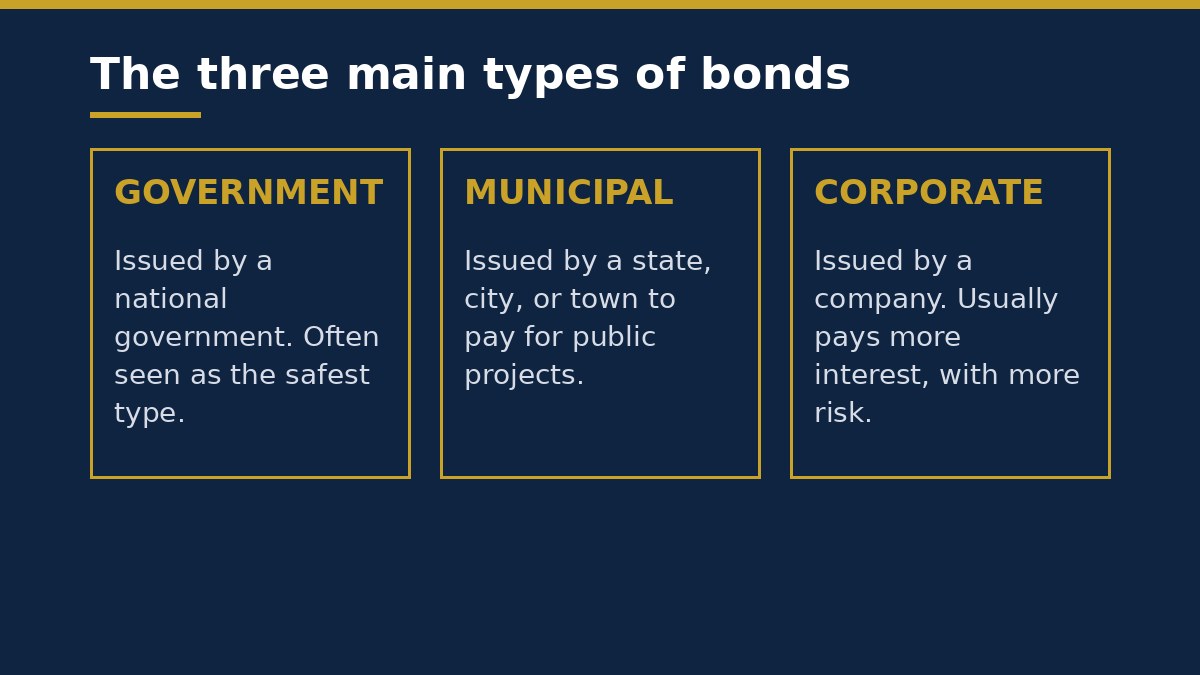
The three main types differ by who borrows the money.
Government Bonds
Government bonds are issued by a national government. In the United States, these are Treasury bonds, notes, and bills. They are often seen as the safest type, because a national government can tax and print money, so it is very unlikely to miss a payment. The trade-off is lower interest than other bonds.
Municipal Bonds
Municipal bonds, often called muni bonds, are issued by a state, a city, or a town to pay for public projects such as schools, roads, and water systems. Their interest is often free from federal income tax, and sometimes free from state tax too, which can matter in a higher tax bracket. They carry a little more risk than government bonds, but defaults are rare.
Corporate Bonds
Corporate bonds are issued by companies. They usually pay more interest than government bonds, because a company is more likely to run into trouble than a government. A strong company pays less interest, while a weaker company must pay more to attract lenders. For a beginner, the safest start is usually a government bond or a bond fund holding many government and high-quality corporate bonds, rather than one single corporate bond. One company can fail, but a fund spreads that risk around.
Three Simple Ways to Buy Bonds
Here are the three simplest ways to start.
Buy a Single Bond Through a Broker
If you already have a brokerage account, you can buy individual bonds through it, much like buying a stock. You pick the issuer, the maturity date, and the interest rate, and you pay the current market price. The minimum is often $1,000. The advantage is control: you know what you own, when it matures, and how much interest you will get. The disadvantage is that one bond is one borrower, so if that borrower fails, your whole investment is at risk.
Buy a Bond Fund or Bond ETF
A bond fund or bond ETF is a basket that holds hundreds of bonds at once. Buy one share and you own a small piece of every bond inside it. Our guide on what an index fund is and why beginners use it explains how this basket idea works, and our guide on what an ETF is and how it is different from a stock explains how ETFs trade during the day like a stock.
This is the simplest way for most beginners: instant diversification, a small starting amount, and shares you can sell any trading day. The trade-off is that a fund has no fixed maturity date, so no day promises your full money back. The fund value moves with interest rates, and the income it pays can change over time.
Buy US Government Bonds Directly From TreasuryDirect
In the United States, you can buy Treasury bonds, notes, bills, and savings bonds directly from the US Treasury through its website, TreasuryDirect, with no broker and no fee. You can start with as little as $100 for most Treasury securities. The TreasuryDirect page on marketable securities lists the types you can buy.
Worked Example: A $1,000 Bond at 4 Percent a Year
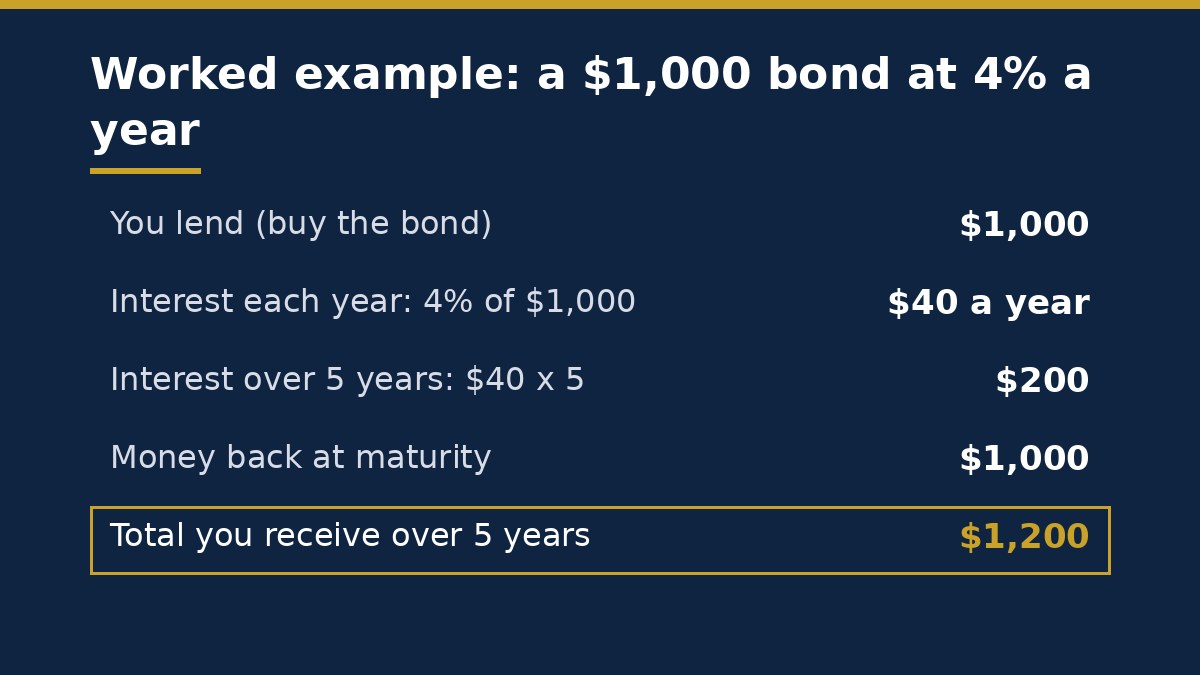
Here is a worked example. The bond has a face value of $1,000, a coupon rate of 4 percent a year, and a maturity of 5 years.
- Amount you lend when you buy the bond: $1,000
- Interest each year: 4 percent of $1,000, which is $1,000 times 0.04, equals $40.
- Interest paid twice a year: $40 divided by 2 equals $20 every six months.
- Interest over 5 years: $40 times 5 equals $200.
- Money back at maturity: $1,000
- Total you receive over 5 years: $200 interest plus $1,000 back at maturity equals $1,200.
Hold this bond to maturity and the borrower pays as promised, and you turn $1,000 into $1,200 over 5 years: a total gain of $200, or 4 percent a year in simple interest.
A Simple Bond Fund Example
Bond funds work a little differently, because there is no single maturity date and no promised payback amount. Suppose you invest $5,000 in a bond fund, and the fund pays income of 4 percent over one year: $5,000 times 0.04 equals $200 for the year. You might receive that income as cash, or reinvest it to buy more shares.
But the value of your shares can also move. If interest rates rise, your $5,000 might fall to $4,800 even while it still pays income. If rates fall, your shares might rise to $5,200. The income is steadier than a stock dividend, but the value is not fixed.
So treat a bond fund as a long-term holding, not a savings account, and only put in money you can leave alone for a few years.
What Are the Risks of Bonds?
Bonds are often called safer than stocks: a bondholder gets paid before a stockholder if a company runs into trouble. But bonds are not risk-free. Our guide on what risk is in investing explains the wider idea of risk in plain terms.
Interest Rate Risk
When interest rates rise, existing bond prices fall. If you buy a bond paying 4 percent and new bonds start paying 5 percent, nobody wants to pay full price for your 4 percent bond, so its price drops. Hold to maturity and the price drop does not matter, because you still get your full face value back. It only hurts if you need to sell early.
Inflation Risk
Inflation is the slow rise in prices over time. If your bond pays 4 percent a year but prices rise 3 percent a year, your real return is only about 1 percent. If inflation rises above your interest rate, your money buys less over time. Long-term bonds carry more inflation risk, because your money is locked in for longer.
Credit Risk
Credit risk is the chance that the borrower cannot pay. A government bond carries very little credit risk. A corporate bond carries more, and the risk grows as the company gets weaker. Bonds from weaker issuers are sometimes called high yield or junk bonds, because they pay high interest to make up for the higher risk. Be careful with high yield bonds: the extra interest is payment for real extra risk.
How Bonds Fit With Stocks and Funds
Bonds are not meant to replace stocks, but to balance them. Stocks grow faster over long periods, but they can fall sharply in a bad year. Bonds grow more slowly, but their prices usually fall less, and their interest keeps arriving even when stocks are down.
A common simple mix is 60 percent stocks and 40 percent bonds. You can build it with funds: a stock index fund covers the stock part, and a bond fund covers the bond part. Our guide on a simple first investment plan walks through the order: emergency fund first, then a simple mix, then regular monthly contributions.
A Simple First Bond Plan
Here is a simple five-step plan.
Step 1: Decide how much you can put in. Our guide on how much money you need to start investing shows you can start small, and a bond fund often lets you start with far less than $1,000.
Step 2: Pick your way in. For most beginners, a bond fund or a bond ETF is the easiest choice. If you want US government bonds only, TreasuryDirect is a direct route with no broker fee.
Step 3: Choose a short or medium term to start. Short-term bond funds move less when interest rates change, so they feel calmer.
Step 4: Set up a regular contribution. A fixed amount every month builds the habit. Reinvest the interest payments so your holding grows over time.
Step 5: Leave it alone and check it twice a year. Checking the price every day only adds worry.
Mistakes to Avoid When You Invest in Bonds
- Buying only one corporate bond. One borrower can fail, so one bond is a concentrated risk.
- Chasing the highest interest rate. A very high rate usually means a weak borrower or a long lock-in.
- Selling in a panic when rates rise. Hold to maturity and a price fall does not change what you get back. Selling early locks in the loss.
- Forgetting inflation. A bond that pays 3 percent while prices rise 4 percent loses buying power.
- Treating a bond fund like a savings account. A fund has no fixed maturity date and its value moves up and down.
- Ignoring fees. A bond fund charges a small yearly fee, and a low fee keeps more of the income in your pocket.
Frequently Asked Questions
How much money do I need to invest in bonds?
You can start with as little as $100 through TreasuryDirect for US government bonds, or with the minimum of a bond fund, often $100 or less. A single corporate or municipal bond usually needs $1,000 or more.
Are bonds safer than stocks?
In general, yes, but they are not risk-free. Bondholders get paid before stockholders if a company fails, and bond prices usually move less than stock prices. But bonds still carry interest rate, inflation, and credit risk, and a bond fund can lose value.
Do I lose money if I sell a bond before maturity?
You can. If rates have risen since you bought, the price will have fallen, so selling early means a loss. If rates have fallen, you might sell at a gain. Holding to maturity avoids this price risk, as long as the borrower pays.
What is the difference between a bond and a bond fund?
A bond is a single loan to one borrower, with a fixed maturity date and a promised payback amount. A bond fund is a basket of hundreds of bonds with no single maturity date and no promised payback amount, and its share price moves up and down with interest rates.
How do I earn money from bonds?
You earn money in two ways: interest payments, which arrive regularly, and the return of your face value at maturity. In the worked example, a $1,000 bond at 4 percent pays $40 a year, $200 over 5 years, plus the $1,000 back, for $1,200 in total.
Can bonds lose value?
Yes. A bond can fall in price if interest rates rise, or if the borrower gets into trouble, and a bond fund can also fall in value. The income payments usually continue, but the market value moves. That is why bonds are a long-term holding, not a place for money you need next month.
Conclusion
Investing in bonds is simple once you know the three numbers: the face value is what you get back, the coupon rate is the interest you earn each year, and the maturity date is when you get your money back. In the worked example, a $1,000 bond at 4 percent pays $40 a year, $200 over 5 years, plus the $1,000 back, for $1,200 in total. A bond fund is the easiest way for most beginners to start. Pick your way in, start small, and reinvest the income.
This article is for general information and education only. It is not legal or financial advice.
