
How Do I Buy Index Funds in Simple Terms?
Buying an index fund is simpler than most beginners expect. You open an investment account, pick a broad index fund, place a buy order, and start with an amount you can afford. You do not need to pick single stocks, watch prices all day, or know everything about the market before you begin. This guide walks you through each step in plain words, with a worked example so you can see the real numbers.
What Is an Index Fund in Plain Words
An index fund is a fund that follows a market index, which is simply a list of companies grouped by a set of rules. The most famous example is the S&P 500, a list of about 500 large companies in the United States, put together by S&P Global. When you buy shares of an index fund, you own a small piece of every company in that list at once, instead of betting on one company alone.
That spread is the main reason beginners like index funds. If one company has a bad year, the other companies in the fund can soften the blow. It does not remove risk, and your money can still fall in value, but it removes the risk of picking one wrong company. If you want the full plain English explanation first, read our guide What Is an Index Fund, and Why Do Beginners Use It?. It explains the idea from the start, and this guide picks up where it leaves off, with the buying steps. An index itself is only a list. The fund is the product you actually buy, and it copies that list.
Index funds also tend to cost less than funds run by a manager who picks stocks by hand. The fund simply follows the list, so there is less work to pay for. Low cost matters more than most beginners think, and we show the exact numbers later in this guide.
Before You Buy: Three Quick Checks
Do these three checks before you place any order. They take a few minutes and they protect you from the most common beginner mistakes.
First, check your emergency savings. An index fund is for money you can leave alone for years. If you might need the money next month for rent or a car repair, keep it in savings instead. Investing works best when you are not forced to sell at a bad time.
Second, check high cost debt. If you carry a credit card balance with a high interest rate, paying that down usually comes first. The interest you save is certain, while investment growth is never certain.
Third, decide how much you can invest each month without stress. Many beginners start with 50 dollars or 100 dollars a month. The exact amount matters less than starting and staying steady. Our guide How Much Money Do I Need to Start Investing? walks through how to pick a starting amount that fits your budget.
How to Buy Index Funds in 5 Simple Steps
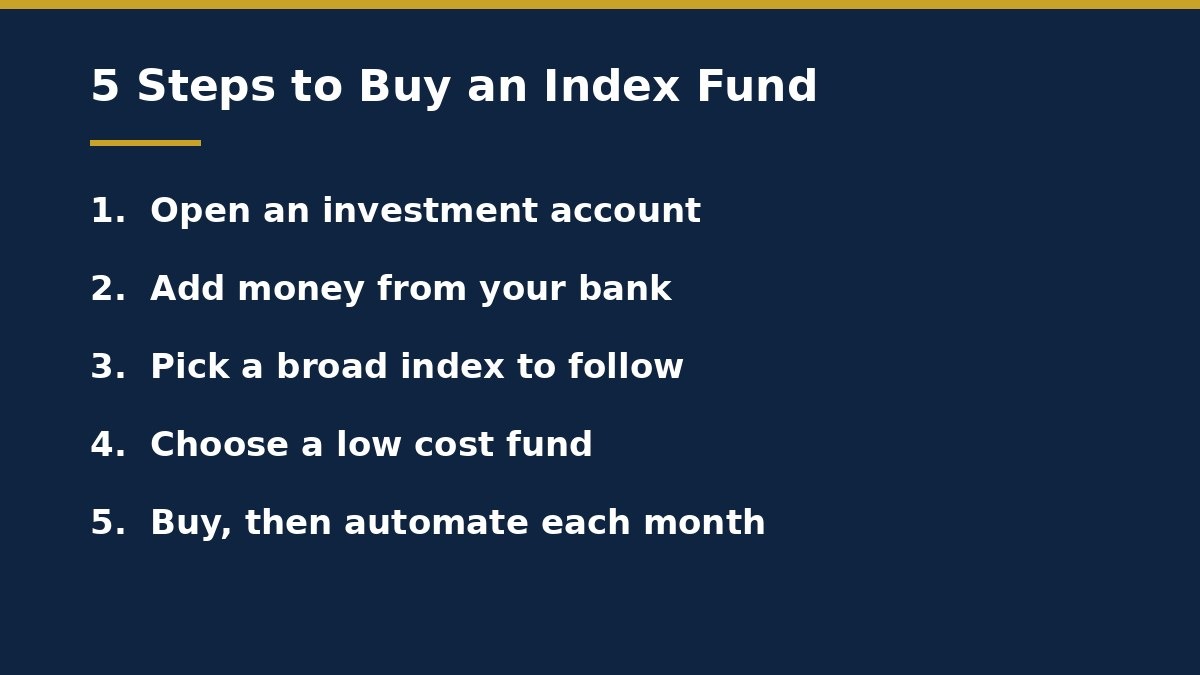
Here are the five steps, in order. Each one is short, and none of them needs expert knowledge.
Step 1: Open an investment account
You cannot buy an index fund without an account that holds it. For most beginners, there are two common choices. A brokerage account is a general investment account you open with a broker, and you can add or take out money at any time. A retirement account, such as an IRA or a 401(k) through work, holds investments for retirement and comes with tax rules and limits. If your job offers a 401(k) with a matching contribution, that match is often worth taking first, because it is extra money from your employer.
You can learn the basics of account types on the U.S. Securities and Exchange Commission investor education site, Investor.gov. It explains accounts and investment products in plain language, with no sales pitch.
Step 2: Add money to the account
Move money from your bank account into the investment account. This is usually a bank transfer, and it can take one to three working days to arrive. Some brokers also let you set up a monthly transfer, so the money moves on its own. Only move money you have already set aside for investing, after your bills and emergency savings are covered.
Step 3: Pick a broad index to follow
For a first index fund, most beginners pick a broad index that covers many companies. Common choices include a total U.S. stock market index, which covers thousands of American companies, or the S&P 500 index, which covers about 500 large American companies. A broad index gives you wide coverage in one purchase, which is exactly what a beginner wants. You can always learn about narrower funds later, once you understand the basics.
Step 4: Choose the fund and check its cost
Once you pick an index, look for a fund that follows it and check three things. First, the expense ratio, which is the yearly fee shown as a percentage. Lower is better, and many broad index funds charge 0.03 percent to 0.20 percent a year. Second, the minimum investment, which is the smallest amount the fund accepts. Many funds now accept 1 dollar, but some still ask for 1,000 dollars or more. Third, whether the fund is an index mutual fund or an index ETF, which is an exchange traded fund. Both follow an index. The main difference is how you buy them, which we explain below.
Step 5: Place the buy order and set up automatic investing
To buy, search for the fund by its name or ticker symbol, enter the amount you want to invest, and confirm the order. A ticker symbol is a short code, usually three to five letters, that identifies the fund. After your first purchase, set up automatic investing if your broker offers it. That means a set amount goes in every month without you having to remember. Automatic investing builds the habit, and the habit matters more than perfect timing.
A Worked Example: $100 a Month
Meet Maya, a beginner who has her emergency savings in place and no high cost debt. She decides to invest 100 dollars a month in a broad index fund. Here is what the numbers look like, step by step.
First, her total contributions. She puts in 100 dollars each month, which is 1,200 dollars a year. Over 10 years, that adds up to 12,000 dollars of her own money. The math is simple: 100 dollars times 12 months times 10 years equals 12,000 dollars. Over 30 years, the same 100 dollars a month adds up to 36,000 dollars, because 100 dollars times 12 months times 30 years equals 36,000 dollars.
Second, a simple growth illustration. This is an illustration only, not a promise and not a prediction. Real funds rise and fall, and no one can promise a set return. Suppose, only as a simple example, that 1,200 dollars put in at the start of a year grew at a plain simple rate of 5 percent for that one year. The growth would be 1,200 dollars times 0.05, which equals 60 dollars, giving a total of 1,260 dollars. That is simple interest style math, shown only so you can see how the numbers move. Real growth compounds unevenly over time, with good years and bad years, so your real result would look different.
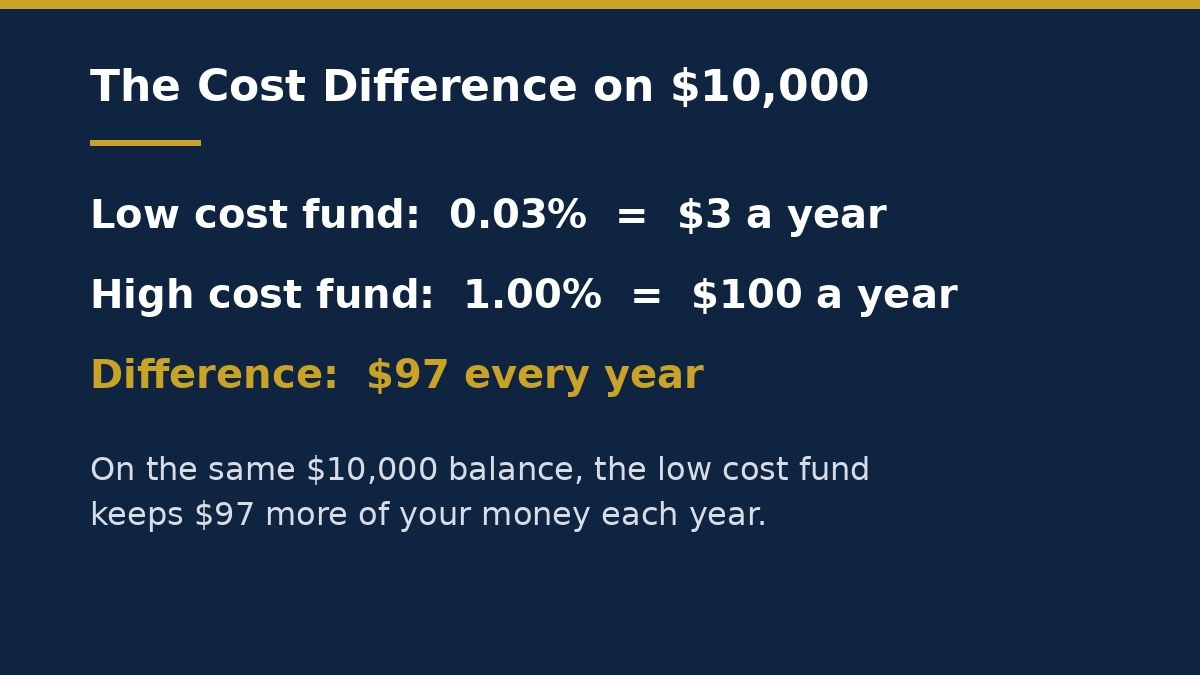
Third, the cost. Suppose Maya picks a fund with an expense ratio of 0.03 percent and her balance is 10,000 dollars. Her yearly fee is 10,000 dollars times 0.0003, which equals 3 dollars a year. Now compare a fund charging 1.00 percent on the same 10,000 dollars. That fee is 10,000 dollars times 0.01, which equals 100 dollars a year. The difference is 97 dollars every year, and over 10 years that simple difference adds up to 970 dollars. Low fees leave more of your money working for you, which is why step 4 tells you to check the expense ratio before you buy.
If you are torn between putting in one larger amount now or a smaller amount each month, read Should I Invest a Lump Sum or a Little Each Month?. It compares the two ways of starting, so you can pick the one that fits your situation.
Index Fund or ETF: Which One Fits a Beginner?
An index mutual fund and an index ETF both follow an index, so the difference is in how you buy and sell them. An index mutual fund is bought directly from the fund company, once a day, at the price set at the end of the trading day. You can usually invest an exact dollar amount, such as 100 dollars, and many funds let you set up automatic monthly investing with ease.
An index ETF trades on a stock exchange during the day, just like a stock. You buy it through your brokerage account, and the price moves up and down while the market is open. Many brokers now let you buy a fraction of an ETF share, so you can still invest an exact dollar amount.
For most beginners, either one works well. If you want simple automatic monthly investing with an exact dollar amount, an index mutual fund is often the easier choice. If you want to buy during the trading day and trade it like a stock, an ETF may suit you better. What matters most is the index it follows, the cost, and whether you keep investing steadily. You can read about how these products differ in our guide How Do I Buy My First Stock?, which explains buy orders in simple terms.
What Does It Cost to Buy Index Funds?
Buying an index fund usually costs less than beginners expect. Many brokers now charge no commission, which means no extra fee for placing the buy order itself. The main cost is the expense ratio, the yearly fee we showed in the worked example. On a 10,000 dollar balance, a 0.03 percent fund costs 3 dollars a year, while a 1.00 percent fund costs 100 dollars a year.
Some funds also have a minimum investment, and a few brokers still charge a fee for certain account services. Always read the fee page before you buy, and keep it simple: pick a broad fund, check the expense ratio, and avoid funds with high yearly fees. Our guide What Are Fees in Investing, and How Do They Hurt Returns? shows how small fees add up over many years, with clear examples.
5 Mistakes Beginners Should Avoid
- Waiting for the perfect time to start. No one can predict the best day to buy. Starting with a small amount and investing each month beats waiting for a perfect moment that never comes.
- Picking a narrow fund first. A fund that follows one small sector or one country is riskier than a broad fund. Start broad, and learn about narrower funds later.
- Ignoring the expense ratio. A high fee quietly takes money every year. Compare the fee before you buy, not after.
- Checking the balance every day. Index funds are for the long term. Daily price moves are noise, and watching them often leads to selling at the wrong time.
- Stopping when the market falls. Falls are a normal part of investing. If your plan is long term and your emergency savings are safe, staying steady usually serves you better than selling in fear. The Financial Industry Regulatory Authority offers free beginner lessons at FINRA Learn to Invest, which cover these basics in plain language.
Frequently Asked Questions
How much money do I need to buy an index fund?
It depends on the fund. Many index funds and ETFs now accept 1 dollar, and many brokers allow fractional shares, so you can start with a small amount. Some index mutual funds still ask for 1,000 dollars or more, so check the minimum before you choose. Starting small is fine. What matters is that the amount fits your budget and that you can keep going.
Do I need a broker to buy index funds?
Yes, you buy index funds through an investment account with a broker or a fund company. The broker holds your account, takes your buy order, and keeps records of what you own. Opening an account online usually takes less than an hour, and you only need basic personal details and a bank account to fund it.
Can I buy index funds in a retirement account?
Yes. Many people buy index funds inside an IRA or a 401(k). These accounts come with tax rules and yearly limits, and the rules differ between account types. If your employer offers a 401(k) match, consider taking the full match first, since that is extra money from your employer.
How do I pick which index fund to buy?
Start with a broad index, such as a total stock market index or the S&P 500, then compare funds that follow it. Check the expense ratio, the minimum investment, and whether it is a mutual fund or an ETF. Pick the low cost fund that fits how you want to invest, and keep it simple for your first purchase.
Do index funds pay dividends?
Many index funds pay dividends, which are small payments from the companies in the fund. You can usually choose to take the dividends as cash or reinvest them, which means they buy more shares of the fund. Reinvesting is a common choice for long term investors, because it keeps the money working inside the fund.
Can I lose money in an index fund?
Yes. An index fund follows the market, so when the market falls, the fund falls too. That is why index funds suit money you can leave alone for years. Over long periods, broad markets have risen and fallen many times, and past growth never promises future growth. Only invest money you do not need soon, and keep your emergency savings separate.
Conclusion
Buying index funds in simple terms means three things: open an account, pick a broad low cost fund, and start with a small amount you can repeat each month. You do not need to time the market, pick winning stocks, or watch prices every day. Start with your emergency savings safe, your high cost debt handled, and a monthly amount that fits your budget. Then let steady investing do its quiet work over time. Your first purchase is the hardest step, and after that, the habit matters more than anything else.
This article is for general information and education only. It is not legal or financial advice.
