
What Is the Simplest Way to Understand the Stock Market?
What Is the Simplest Way to Understand the Stock Market?
The simplest way to understand the stock market is to think of it as a big market where pieces of companies are bought and sold. When you buy a stock, you buy a small piece of a real business. If the business does well over time, your piece is usually worth more. If it does badly, your piece is usually worth less.
That is the whole idea. Everything else, the charts, the news, the daily ups and downs, is detail around that one fact. You own a piece of a business, and the price of that piece moves with what people think the business is worth.
You do not need to predict prices, read charts all day, or understand complex terms to start. You need to understand three things: what a stock is, why prices move, and how beginners usually invest without picking single companies.
What Is a Stock?
A stock is a small share of ownership in a company. When a company needs money to grow, it can sell pieces of itself to the public. Each piece is called a share, and each share is a stock.
If you own one share of a company that has one million shares, you own one millionth of that company. That sounds tiny, and it is, but it still makes you a part owner. As a part owner, you share in the good times, when the company grows and earns more, and in the bad times, when it earns less.
Some companies also pay part of their profit to shareholders. That payment is called a dividend. Not every company pays a dividend, and dividends are never guaranteed. They are simply one way a company can share profit with its owners.
Why Do Stock Prices Move Every Day?
Stock prices move because buyers and sellers keep changing their minds about what a company is worth. If more people want to buy a stock than sell it, the price usually rises. If more people want to sell than buy, the price usually falls.
Prices move for many reasons. A company can report strong sales, and the price may rise. It can report weak sales, and the price may fall. Interest rates, the wider economy, and world news can move the whole market at once.
Here is the key point for beginners. Daily price moves are mostly noise. A company does not become a different business overnight, but its stock price can still jump or fall 5 percent in a day. Long term investors focus on the business over years, not on the price over hours.
The Three Building Blocks: Stocks, Bonds, and Funds
To understand the market, it helps to know the three main building blocks.
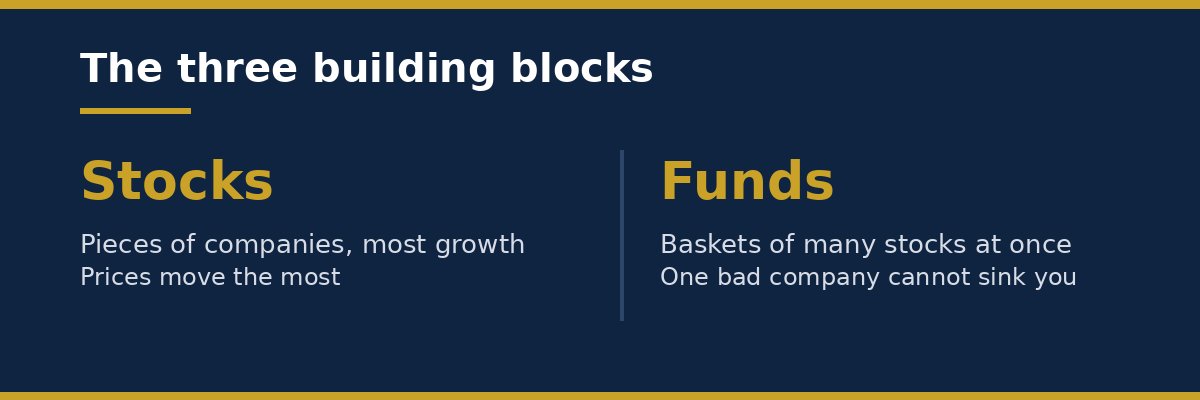
Stocks are pieces of companies. They can grow the most over long periods, but their prices also move up and down the most.
Bonds are loans you make to a government or a company. You lend money, and the borrower pays you interest, then returns the money at the end of the term. Bonds usually move less than stocks, but they also usually grow more slowly.
Funds are baskets that hold many stocks or bonds at once. An index fund, for example, holds a large group of stocks that match a market index. When you buy one fund, you own a small piece of hundreds of companies. That spreads your risk, so one bad company cannot sink your whole investment.
For a full beginner guide to how these three fit together, read How Do Stocks, Bonds, and Funds Work Together?
A Worked Example With Real Numbers
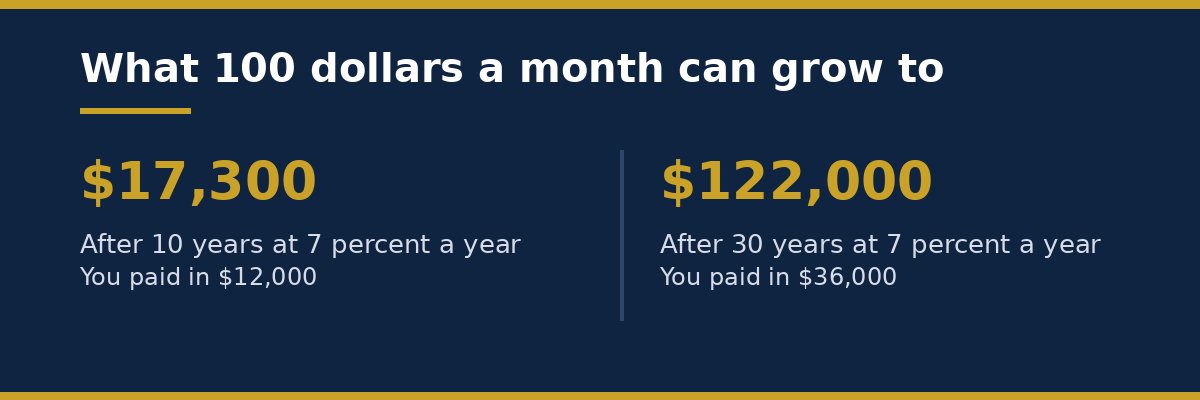
Numbers make the market much easier to understand. Imagine you invest 100 dollars every month, and your investment grows at an average of 7 percent a year. This is not a promise. Some years are better, some are worse. It is simply an example to show how steady saving adds up.
After 10 years, you will have paid in 12,000 dollars (100 dollars x 120 months). At a 7 percent average yearly return, your investment would be worth about 17,300 dollars. The extra 5,300 dollars comes from growth.
After 30 years, you will have paid in 36,000 dollars (100 dollars x 360 months). At the same 7 percent average yearly return, your investment would be worth about 122,000 dollars. The extra 86,000 dollars comes from growth on top of growth, year after year.
That growth on growth is called compound interest, and it is the main reason starting early matters more than starting big. To see how it works in detail, read How Does Compound Interest Work?
How Do Beginners Usually Start?
Most beginners do not start by picking single stocks. They start with a simple plan.
Step 1: Learn the basics, which you are doing right now. Understand what a stock is, what a fund is, and what risk means.
Step 2: Choose a broad fund, such as an index fund, that holds many companies at once. This gives you instant spread, so you are not betting everything on one business. To learn more, read What Is an Index Fund, and Why Do Beginners Use It? and What Is an ETF, and How Is It Different From a Stock?
Step 3: Invest a fixed amount on a regular schedule, such as every month, whether the market is up or down. This is called dollar cost averaging, and it removes the need to guess the right day to buy.
Step 4: Leave it alone and keep learning. Check your investment a few times a year, not every day. Daily checks turn normal ups and downs into stress.
If you are wondering how much money you need to begin, the answer is less than most people think. Read How Much Money Do I Need to Start Investing?
What Is Risk, in Plain Words?
Risk in investing means uncertainty. It means you do not know exactly what your investment will be worth next year. The value can rise, but it can also fall, and there is no guarantee.
The stock market has fallen many times in history, sometimes by 20 percent or more in a single year. It has also recovered from every fall so far and reached new highs over time. That history is reassuring, but it is not a promise about the future.
Beginners manage risk in three simple ways. First, they spread their money across many companies, so no single company can ruin them. That is called diversification, and you can read more in What Is Diversification, and Why Does It Matter? Second, they invest money they will not need for years, so a short fall does not force them to sell. Third, they keep an emergency fund in cash, so a market fall never becomes a personal crisis.
For a fuller plain words guide, read What Is Risk in Investing, in Simple Terms?
Four Beginner Mistakes to Avoid
Mistake 1: Buying a stock because someone online said it will double. Tips are not research. If you cannot explain what the company does in one sentence, do not buy it.
Mistake 2: Checking prices every day. Daily prices are noise. They make people sell at the worst times, out of fear, and buy at the worst times, out of excitement.
Mistake 3: Putting all your money in one company. Even great companies can have bad years. A fund spreads that risk for you.
Mistake 4: Waiting for the perfect time to start. There is no perfect time. A small regular amount, started now and kept going, beats a large amount that never starts.
Frequently Asked Questions
Do I need a lot of money to invest in the stock market?
No. Many funds and apps let you start with 25, 50, or 100 dollars. Some let you buy a fraction of a share, so you can start with even less. The amount matters less than the habit of investing regularly.
Is the stock market the same as gambling?
No, but it can feel that way if you treat it like a game. Gambling is a bet on a random result. Investing is buying a piece of a real business and sharing in its growth over years. The difference is time, research, and spreading risk.
What is an index, and why do people talk about it?
An index is a list that tracks a group of stocks, such as the S&P 500 in the United States, which tracks 500 large companies. People use an index as a yardstick to see how the wider market is doing, and index funds simply copy that list.
How long should I leave my money invested?
The stock market is for long term money, usually money you will not need for at least five years, and ideally ten years or more. Short term money, for rent or an emergency, belongs in a savings account, not in stocks.
What happens if the market crashes the day after I invest?
Your investment falls in value on paper, but you only lose money for real if you sell. If you keep investing regularly and wait, history shows markets have recovered from every crash so far. That is not a promise, but it is why long term investors stay calm.
Should I buy single stocks or a fund first?
Most beginners are better off starting with a broad fund, because it spreads risk across many companies at once. Single stocks can come later, once you understand how to read a company and you can afford the risk.
Conclusion
The simplest way to understand the stock market is to remember one sentence: you are buying small pieces of real businesses. Prices move every day because people keep changing their minds about what those businesses are worth, but the value of a good business grows over years, not hours.
Start by learning the basics, pick a broad fund, invest a fixed amount each month, and give it time. Avoid tips, avoid daily price checks, and avoid betting everything on one company. The market rewards patience far more than it rewards cleverness.
Further reading
This article is for general information and education only. It is not legal or financial advice. Investing involves risk, including the possible loss of money, so consider your own situation and speak to a qualified adviser before you invest.
