
What Is a Pension in Simple Terms?
What Is a Pension in Simple Terms?
A pension is a retirement plan that pays you a regular income after you stop working. In most cases, your employer sets it up, and you receive a set amount of money each month for the rest of your life.
The simplest way to think of it is this. While you work, money goes into the plan. When you retire, the plan pays you back, month by month, like a salary that keeps coming after your last day at work.
A pension is different from a savings account. You do not take out a lump sum and hope it lasts. The plan works out your monthly payment in advance, using your salary and the number of years you worked. That is why many people call a pension a defined benefit plan. The benefit, meaning the payment, is defined by a formula.
How a Pension Works
A pension works in three steps. First, you and sometimes your employer pay into the plan while you work. Second, the money is held and invested by the pension fund. Third, when you retire, the fund pays you a monthly amount based on a formula.
Most traditional pensions use a formula with three parts: a percentage rate, your years of service, and your final average salary. A common formula looks like this:
Monthly pension = percentage rate x years of service x final average salary, divided by 12
The percentage rate is often between 1.5 percent and 2 percent for each year you worked. Your final average salary is usually the average of your pay over your last three to five years of work, not just your last paycheck.
A Worked Example With Real Numbers
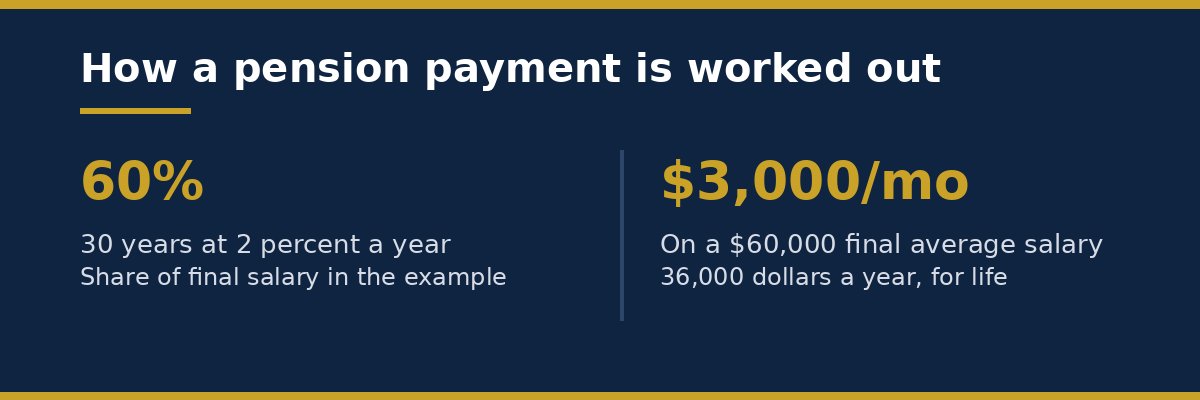
Imagine Maria works as a teacher for 30 years. Her final average salary is 60,000 dollars a year. Her pension plan uses a rate of 2 percent per year of service.
Step 1: Work out the percentage. 30 years x 2 percent = 60 percent.
Step 2: Apply it to her salary. 60 percent of 60,000 dollars = 36,000 dollars a year.
Step 3: Turn it into a monthly payment. 36,000 dollars divided by 12 = 3,000 dollars a month.
So Maria would receive about 3,000 dollars a month for life, before tax. If she had worked 20 years instead of 30, the math would be 20 x 2 percent = 40 percent, 40 percent of 60,000 dollars = 24,000 dollars a year, or 2,000 dollars a month.
The numbers change with each plan, but the idea stays the same. More years of service and a higher final salary mean a larger monthly payment.
Who Gets a Pension?
Not every worker gets a pension. Today, pensions are most common in these jobs:
- Teachers and other public school workers
- Government and civil service workers
- Police officers, firefighters, and other public safety workers
- Military service members
- Some union jobs, such as in construction, transport, and manufacturing
- Some large older companies that kept their pension plans
Most private companies in the United States no longer offer a traditional pension to new workers. Instead, they usually offer a 401(k), where you save from your own paycheck and choose your own investments. If you are not sure what your employer offers, check your employee benefits booklet or ask your human resources department.
In the United Kingdom, most workers now build a workplace pension where money goes into an individual pot, which is different from the traditional formula above. The UK also has a State Pension, which is a separate payment from the government based on National Insurance contributions. This article focuses mainly on the traditional employer pension, because that is what most people mean when they ask what a pension is.
Defined Benefit vs Defined Contribution: What Is the Difference?
There are two main kinds of pension, and the difference matters.
A defined benefit pension is the traditional kind described above. Your monthly payment is set by a formula, and your employer carries the risk. If the investments do poorly, your employer still has to pay the promised amount. This is the kind most people picture when they hear the word pension.
A defined contribution pension is different. You and your employer pay into a personal pot, the money is invested, and what you get in retirement depends on how much went in and how the investments performed. A 401(k) in the United States is a defined contribution plan. Your employer does not promise a set monthly payment.
Here is a simple way to remember it. In a defined benefit plan, the payment is promised. In a defined contribution plan, the payment is not promised, and the final amount depends on the pot.
How Long Do Pension Payments Last?
In most traditional pensions, payments last for the rest of your life. That is one of their biggest strengths. You cannot outlive the payment, because the plan keeps paying each month as long as you live.
Many plans also let you choose a survivor option. With a survivor option, your monthly payment is a little smaller, but after you die, your spouse keeps receiving a share of the payment for the rest of their life. The exact share depends on the option you pick, often 50 percent or 100 percent of your payment.
Some plans offer a lump sum option instead of monthly payments. With a lump sum, you take the money all at once and manage it yourself. That gives you more control, but it also gives you more risk, because the money has to last. Think carefully, and get independent guidance, before giving up a lifetime monthly payment.
What Is Vesting?
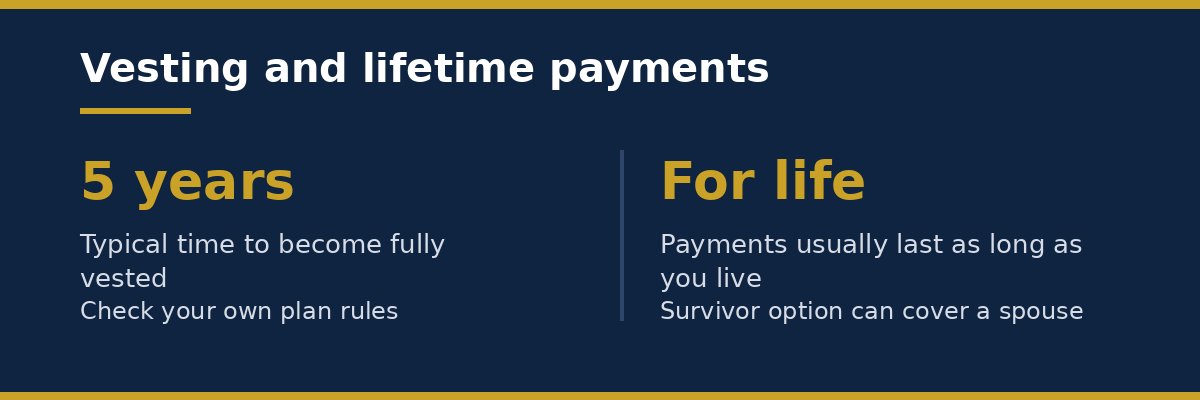
Vesting means earning the right to keep your pension. In many plans, you are not fully vested on your first day. You may need to work for a set number of years, often five years, before the pension is fully yours.
If you leave your job before you are vested, you may lose the employer part of the pension, though you usually keep any money you paid in yourself. If you leave after you are vested, the pension stays yours, even if you change jobs. Always check your plan rules, because vesting schedules differ from plan to plan.
What Happens to a Pension If You Change Jobs?
Changing jobs does not usually erase a pension you have earned, as long as you are vested. What happens next depends on the plan:
- The pension may stay with your old employer, and you claim it when you retire.
- The plan may let you move the value to another retirement account.
- In some cases, if the amount is very small, the plan may pay it out as a lump sum.
Keep records of every pension you earn. People lose track of old pensions more often than you might think. Save your plan statements, note the employer and the dates you worked there, and keep the contact details of the plan administrator.
Can You Lose a Pension?
A pension is not a promise that can never break, but there are protections. In the United States, most private sector pensions are insured by the Pension Benefit Guaranty Corporation, known as the PBGC. If a company pension plan fails, the PBGC steps in and pays benefits up to a legal limit. Government pensions, such as those for teachers and public workers, are backed by the state or local government that runs them.
That said, pension rules can change. A plan can reduce benefits for future service, or a government can change the rules for new workers. Benefits you have already earned are usually protected by law, but the details depend on your country and your plan. This is another reason to read your annual pension statement each year.
Pension vs 401(k): Which Is Better?
There is no single answer, because most people do not get to choose. Your employer offers one or the other, and often only one.
A pension gives you a predictable monthly income for life, and your employer carries the investment risk. A 401(k) gives you more control and the money is yours to take with you when you change jobs, but you carry the investment risk, and you have to decide how much to save and how to invest it.
If you have a pension, that is a strong foundation. If you have a 401(k), saving early and getting the full employer match matters most. Many workers have both, a pension from one job and a 401(k) from another, and the two can work together. To see how a 401(k) works in simple terms, read our guide What Is a 401(k) Match? For a broader look at workplace retirement plans, read What Is a 403(b), in Simple Terms?
How to Check Your Pension in 5 Steps
You do not need to be a finance expert to check your pension. Follow these five steps:
- Find your plan name and administrator. Look at your pay slip, your benefits booklet, or your annual pension statement.
- Check your years of service and your vesting status. Ask the plan if anything is unclear.
- Ask for an estimate of your monthly payment at your planned retirement age. Many plans offer this for free.
- Check what your spouse would receive if you choose a survivor option, and what it costs in a smaller monthly payment.
- Put the estimate next to your other retirement income, such as Social Security or a 401(k). This shows you whether your plan is on track.
If your employer offers a pension, a retirement account such as an IRA can sit alongside it. An IRA is an individual account you open yourself, and it can hold extra savings for retirement. For a step by step plan that brings pensions, savings, and other income together, read Financial Planning for Retirement in Simple Steps
Frequently Asked Questions
How much pension will I get?
It depends on your plan formula, your years of service, and your final average salary. Ask your plan administrator for a written estimate at your planned retirement age. The worked example above shows how the formula works, but only your plan can give you your own number.
Is a pension taxed?
Yes, in most cases pension payments are taxed as income when you receive them. The exact rules depend on your country and your state, and whether any of your contributions were made after tax. A tax professional can explain your own situation.
What is the difference between a pension and Social Security?
A pension comes from your employer and is based on your job, your years of service, and your salary. Social Security is a government program, and it is based on your lifetime earnings across all your jobs. Many retirees receive both. For more on the government side, read What Is Social Security in Simple Terms?
Do I need to save more if I have a pension?
Often, yes. A pension may replace only part of your working income, commonly 40 to 60 percent. Many people save extra in a 401(k), a 403(b), or an IRA to close the gap. Check your pension estimate first, then decide how much extra you need.
What happens to my pension if I die?
It depends on your plan and the option you chose. With a survivor option, your spouse may keep receiving a share. Without one, payments usually stop, though some plans pay a small lump sum to your family. Check your plan rules and make sure your beneficiary details are up to date.
Can I take my pension early?
Many plans let you start payments before the normal retirement age, often from age 55, but the monthly amount is smaller because it has to last longer. Check your plan for its early retirement rules before you decide.
Conclusion
A pension is a promise of a regular monthly income for life after you stop working. Your payment is worked out from a formula based on your years of service and your final average salary, and in most traditional plans it lasts as long as you live.
If your employer offers one, find out your vesting status, ask for a payment estimate, and check the survivor options. Then compare that estimate with your other retirement income, and save extra if there is a gap. A pension is a strong start, but it works best as one part of a full retirement plan.
Further reading
This article is for general information and education only. It is not legal or financial advice. Pension rules differ by plan, employer, state, and country, so check your own plan documents or speak to a qualified adviser before making a decision.
