
How Do I Start an Airbnb?
Short answer: starting an Airbnb means listing a spare room or a whole home for short stays, setting a nightly price, and hosting guests who book through the platform. You need a space that is clean and safe, permission to rent it out, good photos, a fair price, and a plan for cleaning between guests. The income can be real, but it is not free money: there are fees, cleaning costs, extra bills, and tax to plan for. This guide walks through the steps, the costs, and a worked example of what a spare room can earn. It is educational only, not financial advice.
What hosting on Airbnb actually means
An Airbnb host rents out a space for short stays, from one night to a few weeks. Guests find the listing, book, and pay through the platform. The host prepares the space, hands over the keys or a door code, answers questions during the stay, and cleans after the guest leaves.
Most hosts start with one of two setups. The first is a spare room in the home they live in, with shared spaces like a kitchen or bathroom. The second is a whole home or flat that is empty, or lived in only part of the year. A spare room is the simpler start: it costs less to set up, it needs less cleaning, and the host is there if anything goes wrong.
Hosting is a service business, not a passive one. Each stay needs cleaning, fresh linen, restocked supplies, and replies to guest messages. A host who answers slowly or leaves a dirty room will see bookings fall, because reviews drive future bookings. The work is real, but it fits around a day job for many people, because most of it happens between stays.
Airbnb charges hosts a service fee on each booking, usually 3 percent of the booking total for most hosts. Guests pay their own service fee on top. The host fee is taken out before the payout, so the money that arrives is the booking total minus the fee.
To read the platform’s own hosting pages, see: https://www.airbnb.com/host/homes
Check the rules before you list anything
This is the step people skip, and it is the one that causes the most trouble. Before you spend money on linen or photos, check four things.
First, your lease or mortgage. If you rent your home, your lease may forbid short stays. If you own it, your mortgage terms may say something about it too. Ask the landlord or read the agreement before you list.
Second, your building or neighbourhood rules. Some flats, housing associations, and homeowner groups ban short stays. Some cities limit how many nights a year a home can be rented this way, or require a permit or registration. Search your city name plus short-term rental rules, and check the local council site for the real rules.
Third, insurance. A normal home insurance policy may not cover paying guests. Ask your insurer what is covered, and whether you need extra cover. Airbnb offers host protection for damage in many places, but it is not a replacement for your own insurance, and it has limits and conditions.
Fourth, tax. Rental income is usually taxable, and the rules differ by country and by city. Keep records from day one: every booking, every fee, every cost. Set money aside for tax as the income arrives, so the tax bill is never a surprise.
A worked example: a spare room at 80 dollars a night
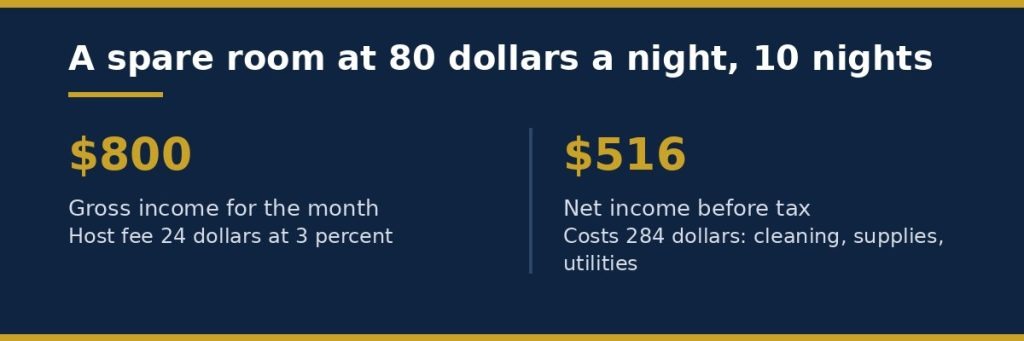
Here is a real example with simple numbers. You rent out a spare room for 10 nights a month at 80 dollars a night.
Gross income is 800 dollars: 10 nights times 80 dollars.
Airbnb takes its 3 percent host fee, which is 24 dollars, leaving 776 dollars.
Now the costs. Cleaning between stays costs 150 dollars for the month, if you pay a cleaner, or it costs your own time if you do it yourself. Supplies like fresh linen, toiletries, and coffee cost 50 dollars. Extra utilities, like water, power, and internet use by guests, cost about 60 dollars. Total costs are 284 dollars: 150 plus 50 plus 24 plus 60.
Net income before tax is 516 dollars a month: 800 minus 284. That is the money the room earns after the real costs, before tax.
Now rent the room for 15 nights instead of 10, at the same 80 dollars a night. Gross income is 1,200 dollars. The host fee is 36 dollars. Cleaning and supplies rise a little with more stays, but the room still earns much more, because the fixed costs do not rise as fast as the bookings. More nights is where the income grows, if you can keep the room full without burning out on cleaning.
Tax is the part beginners forget. If you set aside about 25 percent of the net income for tax, that is about 129 dollars from the 516 dollars, leaving about 387 dollars after the tax set-aside. The exact tax depends on your country, your total income, and what costs you can deduct, so treat the 25 percent as a planning figure, not a tax promise, and check your local rules.
To keep the tax side clean, read: How Do I Track Side Income for Tax in Simple Terms?
How to start, step by step
Step 1: Check the rules. Lease, building rules, city limits, insurance, and tax. Do this first, before spending money. If the rules block you, a different side income is a better use of your time.
Step 2: Prepare the room. A clean bed with fresh linen, a place to hang clothes, a mirror, a bedside light, and a lock on the door are the basics. Add a small welcome note with the Wi-Fi password, the house rules, and a phone number for problems. You do not need luxury, but the room must look cared for in photos.
Step 3: Take honest photos. Clean the room, open the curtains, and photograph in daylight. Show the bed, the desk or chair, the bathroom, and the outside of the building. Photos that hide problems lead to bad reviews. Ten honest photos beat twenty flattering ones that mislead.
Step 4: Set the price. Look at similar rooms in your area on the platform, and note their nightly price, how full their calendars look, and what guests say in reviews. Price a little below similar rooms for your first few bookings, to win reviews fast, then raise the price once you have five good reviews. A price that is too high leaves the room empty, and an empty room earns nothing.
Step 5: Write the listing. Say plainly what the room is, who it suits, what is included, and what the rules are. Mention the bed size, the bathroom setup, the distance to transport, and check-in times. Honest detail prevents most guest complaints.
Step 6: Publish and answer fast. Reply to questions within an hour when you can. Fast replies raise your place in search results and win bookings. Keep the calendar up to date, so no one books a night you cannot host.
Step 7: Clean, review, repeat. After each stay, clean properly, restock, and check for damage. Leave a review for the guest, and ask the guest to leave one for you. Good reviews are the engine of future bookings.
To pick a side income that fits your life, read: How Do I Choose a Side Income That Fits My Skills?
What it costs to start
Starting costs are modest for a spare room, but they are real. Budget for fresh linen and towels, basic toiletries, a lockbox or smart lock for key handover, cleaning supplies, and a few photos. Most hosts spend a few hundred dollars to get started, not thousands.
Ongoing costs are the ones that eat the income if you ignore them. Cleaning is the biggest, whether you pay a cleaner or count your own time. Supplies, laundry, extra utilities, and the platform fee come every month. Repairs happen too: a broken kettle, a stained sheet, a chipped mug. Put a small share of each payout aside for repairs, so one broken item never wipes out a month of income.
Price the room so the costs are covered even in a slow month. If the room earns 516 dollars in a good month and 200 dollars in a slow one, the costs still have to be paid in the slow month. A price that only works when the room is full is a price that fails in winter.
Five mistakes new hosts make
Mistake 1: Listing before checking the rules. A host who is fined, or told to stop, loses the setup money and the bookings. Check the lease, the building rules, and the city limits first.
Mistake 2: Pricing too high at the start. A new listing with no reviews and a high price stays empty. Start a little lower, win five good reviews, then raise the price step by step.
Mistake 3: Using misleading photos. Photos that hide a small room or a shared bathroom lead to disappointed guests and bad reviews. Honest photos bring guests who know what they booked, and they leave better reviews.
Mistake 4: Forgetting tax. Rental income is income. If you spend it all and the tax bill arrives months later, you will be short. Set aside about 25 percent as the income arrives, and keep records of every booking and cost.
Mistake 5: Doing all the cleaning yourself forever. At first, cleaning yourself saves money. As bookings grow, it eats evenings and weekends. Price the room so a cleaner fits, and hand the cleaning over once the income covers it. Your time is part of the cost, even if no money changes hands.
For more low-cost starting ideas, read: What Is the Simplest Side Income for Beginners?
How to grow it, or when to stop
Growth comes from three things: more nights booked, a higher price, or a second space. More nights means better photos, faster replies, and good reviews. A higher price comes after reviews prove the room is worth it. A second space only makes sense once the first one runs smoothly without eating all your free time.
Watch the numbers each month. Gross income, fees, cleaning, supplies, utilities, and net income after the tax set-aside. If the net income is falling while the work is rising, something is wrong: the price is too low, the cleaning costs too much, or the room is empty too often. Fix one thing at a time, and check the numbers again next month.
Stop or pause if the rules change, if the work takes over your evenings, or if the net income after costs is less than a simpler side income would pay for the same hours. Hosting is one option among many, not a duty. A pause costs nothing, and the listing can restart when life allows.
To compare other side income ideas, read: Side Income Ideas for Beginners: Filter by Time, Cost, and Skill
FAQ
Do I need to own the home to host on Airbnb?
No, but you need permission. If you rent, your lease must allow it. If you own, check mortgage terms and building rules. Some cities also require a permit or limit the nights per year. Check all four before you list.
How much can I earn from a spare room?
It depends on your city, the room, and how many nights you book. The worked example shows 516 dollars a month before tax from 10 nights at 80 dollars, after fees and costs. A room in a busy city can earn more, and a room in a quiet area can earn much less. Check similar rooms near you for a realistic price.
What does Airbnb charge hosts?
Most hosts pay a 3 percent service fee on each booking, taken from the payout. Guests pay their own fee. The fee is small, but it is part of the cost, so include it in your monthly math.
Do I have to pay tax on Airbnb income?
In most places, yes. Rental income is usually taxable. The rules differ by country, so check your local tax authority. Keep records of every booking and cost from day one, and set money aside for tax as the income arrives.
What if a guest damages something?
Report it through the platform as soon as you find it, with photos and a record of the cost. Airbnb offers host protection for damage in many places, but it has limits, and it is not a replacement for your own insurance. Check what your own policy covers before your first guest.
Can I host only on weekends?
Yes. You control the calendar, and you can open only the nights you choose. Weekend-only hosting earns less than full-time hosting, but it fits around a day job and keeps the work small. Start with the nights you can handle, and add more when the routine works.
Conclusion
Starting an Airbnb is a practical side income for anyone with a spare room and permission to rent it. Check the lease, building rules, city limits, and insurance first. Prepare a clean room with honest photos, price a little below similar rooms until you have reviews, then raise the price step by step. The worked example shows the math: 10 nights at 80 dollars brings 800 dollars gross, and after the 3 percent fee, cleaning, supplies, and utilities, about 516 dollars is left before tax. Track every booking and cost, set aside money for tax, and review the numbers each month. If the net income beats the hours it takes, keep going. If it does not, pause and try a simpler side income. The room is an asset. Hosting turns its empty nights into income, one booking at a time.
This article is for general information and education only. It is not legal or financial advice.
