

What Is a Balance Transfer?
Short answer: a balance transfer moves debt from one credit card to another card, usually a new card that offers a low or 0 percent interest rate for a set time, often 12 to 18 months. The debt does not disappear. It moves to a cheaper place for a while, so more of each payment goes to the balance instead of to interest. A transfer fee applies, usually 3 to 5 percent of the amount moved. It helps only if you pay the balance off, or most of it, before the low rate ends. This guide explains how it works, what it costs, and the mistakes that make it backfire. It is educational only, not financial advice.
How a balance transfer works
You apply for a new credit card that offers a balance transfer deal. If you are approved, you ask the new card company to pay off some or all of the balance on your old card. The old card balance falls to zero, or close to it, and the same amount now sits on the new card. The new card charges a low or 0 percent rate on that transferred amount until the intro period ends. After that, the normal rate applies to whatever is left.
The new card company sets a limit on how much you can transfer. It may be less than your full balance, especially if your credit limit on the new card is low. In that case you move what you can, and the rest stays on the old card, still charging its old rate.
You cannot usually transfer a balance between two cards from the same bank. The point of the deal is to win your business from another lender, so the old card and the new card must be from different banks.
The fee is charged when the transfer is made. At 3 percent, moving 5,000 dollars costs 150 dollars, and the new balance becomes 5,150 dollars. At 5 percent, the same move costs 250 dollars. Some cards charge no fee, but those deals are less common, and they often come with a shorter low-rate period.
For general guidance on credit cards, see the Consumer Financial Protection Bureau: https://www.consumerfinance.gov/consumer-tools/credit-cards/
A worked example: 5,000 dollars at 24 percent
Here is a real example with simple numbers. You owe 5,000 dollars on a card charging 24 percent APR. You pay 350 dollars a month, every month, and you add no new spending to the card.
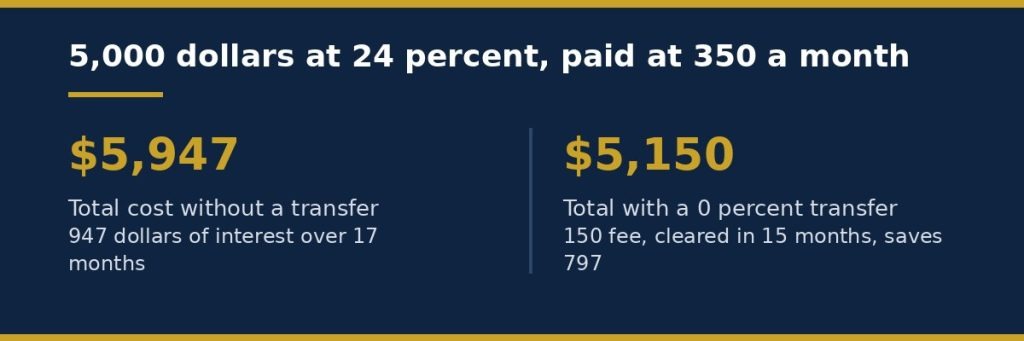
Without a transfer, the first month alone adds 100 dollars of interest, because 5,000 dollars times 24 percent, divided by 12 months, is 100 dollars. Your 350 dollar payment covers that 100 dollars of interest and cuts the balance by 250 dollars. Month after month, the interest shrinks as the balance falls. It takes 17 months to clear the debt, and you pay 947 dollars of interest in total. The full cost is 5,947 dollars.
Now use a balance transfer. You move the 5,000 dollars to a new card offering 0 percent for 15 months, with a 3 percent transfer fee. The fee is 150 dollars, so the new balance is 5,150 dollars. Divide 5,150 dollars by 15 months, and the payment needed to clear it in time is 343.33 dollars a month. Pay that every month, and the balance reaches zero in the 15th month, just before the low rate ends. The full cost is 5,150 dollars.
The saving is 797 dollars: 5,947 dollars without the transfer, minus 5,150 dollars with it. The monthly payment is also slightly lower, 343.33 dollars instead of 350 dollars. The transfer only works because the balance is cleared inside the low-rate period. If 1,000 dollars were still left after 15 months, that 1,000 dollars would start charging the new card’s normal rate, which is often 20 percent or more, and the saving would shrink fast.
When a balance transfer helps
A transfer helps when four things are true.
First, the intro rate is 0 percent, or close to it, and it lasts long enough to clear the balance. A 15 month window for a 5,150 dollar balance needs about 343 dollars a month. Check that you can afford that payment every month before you apply.
Second, the fee is small compared with the interest you save. A 3 percent fee on 5,000 dollars is 150 dollars, while the interest saved is 947 dollars. That trade is clearly worth it. If the fee were 5 percent and the intro period were only 6 months, the saving would be much smaller, and it might not be worth it at all.
Third, you stop adding new spending to the cards. A transfer fixes the old balance, not the habit that built it. If you keep spending on the old card while paying off the new one, the total debt grows, and the transfer has made things worse, not better.
Fourth, your credit is good enough to be approved with a useful limit. A transfer deal needs a new card, and the lender checks your credit first. If you are turned down, or the limit is too small to move much of the balance, the plan cannot work as hoped. A failed application also leaves a mark on your credit record, so do not apply for several cards at once hoping one will approve you.
When a balance transfer hurts
A transfer hurts when the balance is still there after the intro rate ends. That is the most common failure. The low rate is a deadline, not a discount. If you pay only the minimum during the intro period, the balance barely moves, and when the normal rate starts, you are back where you began, plus the fee.
It also hurts when new purchases are charged to the new card. Many transfer cards charge the normal rate on new purchases from day one, even while the transferred balance sits at 0 percent. Payments may go to the transferred balance first, leaving new purchases to gather interest. The safe rule is simple: do not use the new card for spending until the transferred balance is gone.
A missed payment can hurt too. Some card agreements end the low rate early if a payment is late. One missed payment can turn a 0 percent deal into a 20 percent rate overnight, with the fee already paid and no way back. Set the payment to go out automatically, a few days before the due date, so this cannot happen by accident.
How to use a balance transfer step by step
Step 1: Write down the full picture. Note the balance, the APR, and the monthly payment on the old card. Work out how long it takes to clear at that payment, and how much interest that costs. That is the number the transfer has to beat.
Step 2: Compare transfer offers. Look at three numbers for each offer: the intro rate, how many months it lasts, and the fee. A 0 percent rate for 15 months with a 3 percent fee is usually better than 0 percent for 6 months with a 5 percent fee. Divide the balance plus the fee by the number of months, and check you can afford that monthly payment.
Step 3: Apply for one card only. One application, for the best offer you found. Do not apply for several at once, because each application can lower your credit score a little.
Step 4: Move the balance as soon as the card arrives. The intro period usually starts when the account opens, not when the transfer is made, so do not leave the old balance sitting for weeks while the clock runs.
Step 5: Set up the monthly payment. Divide the new balance by the months left, and set that amount to go out automatically each month. Pay a little extra if you can, so the balance clears before the deadline, not on it.
Step 6: Do not spend on either card until the transfer is paid off. Use a debit card or cash for daily spending. Keep the old card open, because closing it can hurt your credit score, but leave it unused.
Balance transfer vs other ways to cut interest
A balance transfer is one tool, not the only one. Two other common methods are worth knowing.
The debt snowball method pays the smallest balance first, whatever its rate, to build momentum with quick wins. It works well for people who need to see progress fast to keep going.
To learn it, read: What Is the Debt Snowball Method?
The debt avalanche method pays the highest interest rate first, whatever its size, to save the most money. It is usually the cheapest method in total interest, but it can feel slow if the highest-rate debt is also the biggest one.
To learn it, read: What Is the Debt Avalanche Method, and When Is It Better?
A balance transfer can sit alongside either method. It cuts the rate on one balance, while the snowball or avalanche order decides which balance to attack first. A consolidation loan is another option, and it suits people who want one monthly payment instead of several card payments.
To weigh that choice, read: Should I Consolidate My Debt?
The right method is the one you will actually follow for months. The cheapest plan on paper is worthless if you stop after two months.
Five mistakes that waste a balance transfer
Mistake 1: Paying only the minimum during the intro period. The minimum barely covers the fee and a little of the balance. At the end of the intro period, most of the debt is still there, now charging the full rate. Pay the balance divided by the months, not the minimum.
Mistake 2: Treating the empty old card as free money. The old card balance is zero, but the debt is not gone. It moved. Spending on the old card while paying off the new one means the total debt grows, and the transfer was pointless.
Mistake 3: Missing a payment. A late payment can end the low rate early and add a late fee. Set the payment to automatic, and check each month that it went out.
Mistake 4: Ignoring the fee. A 5 percent fee on a large balance is a large amount. Always add the fee to the balance before you work out the monthly payment, or the balance will still be there when the low rate ends.
Mistake 5: Closing the old card straight away. Closing a card can shorten your credit history and raise your credit use ratio, both of which can lower your credit score. Keep the old card open and unused until the transfer is paid off, then decide.
To see why minimum payments are a trap on their own, read: What Happens If I Only Pay the Minimum on a Credit Card?
FAQ
How long does a balance transfer take?
Usually a few days to two weeks from the day you ask for it. The intro period often starts when the account opens, so ask for the transfer as soon as the card arrives. Keep paying the old card until the transfer shows as complete, so you do not miss a payment by mistake.
Does a balance transfer hurt my credit score?
It can dip your score a little at first, because a new account is opened and a credit check is made. Over time, paying the balance down can help, because your credit use falls. The effect is small if you pay on time and do not apply for several cards at once.
Can I transfer a balance from the same bank?
Usually no. A balance transfer moves debt between different banks. If both cards are from the same bank, the transfer is normally refused. Check the card terms before you apply.
What happens if I do not pay it off in time?
Whatever is left starts charging the card’s normal rate, which is often 20 percent or more. The low rate does not extend, and the fee is not refunded. That is why the monthly payment must be the balance divided by the months, not the minimum.
Is a balance transfer the same as a consolidation loan?
No. A balance transfer moves card debt to another card, with a low rate for a set time. A consolidation loan is a separate loan that pays off the cards, and you repay the loan in fixed monthly amounts over a set term. Both cut the rate, but they work differently, and the loan suits people who want one fixed payment.
How much can I transfer?
It depends on the credit limit the new card gives you. The limit may be less than your full balance. You can transfer what fits, and the rest stays on the old card. Ask the new card company what the transfer limit is before you apply, if that detail is shown.
Conclusion
A balance transfer moves card debt to a cheaper rate for a set time, so more of each payment cuts the balance. The worked example shows the saving: 5,000 dollars at 24 percent, paid at 350 dollars a month, costs 947 dollars of interest over 17 months, while a 0 percent transfer for 15 months with a 3 percent fee costs 150 dollars and clears the debt for 5,150 dollars in total, a saving of 797 dollars. The deal only works if you pay the balance, plus the fee, divided by the months, every month, before the low rate ends, and if you stop spending on both cards until it is done. Compare the rate, the months, and the fee before you apply, set the payment to automatic, and treat the intro period as a deadline. Used that way, a balance transfer is a real shortcut out of card debt.
This article is for general information and education only. It is not legal or financial advice.
