
What Is a 401(k) in Simple Terms?
Short answer: A 401(k) is a retirement account your employer offers, named after section 401(k) of the United States tax code. You put part of your pay into it before tax, your employer may add matching money, and the money is invested, usually in funds you choose from a short list. It grows over the years, and you pay tax when you take it out in retirement. It is the most common way American workers save for retirement, and for many people it is the first investment account they ever open. This guide explains how it works, what it costs, the 2026 limits, and the real math, in plain words. It is educational only, not financial advice.
How a 401(k) works, step by step
You sign up through your employer, usually when you start the job or during an enrolment window. You choose a percentage of your pay to contribute, for example 5 percent. That money comes out of your pay before income tax is taken, so your taxable pay is lower. If you earn 60,000 dollars a year and put in 5 percent, that is 3,000 dollars a year into the 401(k), and your taxable pay falls to 57,000 dollars.
Your employer may add a match. A common match is 100 percent of the first 3 percent you put in, plus 50 percent of the next 2 percent. On a 60,000 dollar salary, putting in 5 percent (3,000 dollars) would earn a match of 3 percent (1,800 dollars) plus 1 percent (600 dollars), which is 2,400 dollars of free money a year. The exact match depends on your plan, so read your plan’s rules.
The money is invested. You pick from a list of funds, usually a mix of stock funds, bond funds, and a target date fund that adjusts itself as you get closer to retirement. If you do not choose, most plans put you in a target date fund by default, which is a sensible starting point for a beginner.
The account grows over time from your contributions, the employer match, and investment growth. You do not pay tax on the growth each year. You pay tax when you take money out in retirement, when your income and tax rate are usually lower than during your working years.
To see how retirement accounts fit together, read: What Is a Retirement Account, in Simple Terms?
Traditional 401(k) vs Roth 401(k): the tax choice
Most plans offer two versions, and the difference is only about when you pay tax.
In a traditional 401(k), you pay no income tax on the money you put in this year. You pay tax when you take it out in retirement. This suits most people, because their tax rate in retirement is often lower than while working.
In a Roth 401(k), you pay income tax on the money now, and you take it out tax free in retirement, as long as the rules are met. This suits people who expect their tax rate to be higher later, often younger workers early in their careers.
If your plan offers both, you can split your contributions between them. There is no single right answer for everyone. The important step is to contribute at all. A traditional 401(k) with a 5 percent contribution beats a perfect Roth plan you never start.
The employer match: free money with one condition
The match is the best part of a 401(k), and the most commonly missed. If your employer matches contributions and you do not contribute enough to get the full match, you are leaving pay on the table. Getting the full match is the first goal for almost every worker with a 401(k).
There is one condition, called vesting. Your own contributions are always yours. The employer’s matching money may take time to become fully yours. A common schedule gives you full ownership after three to six years with the company. If you leave earlier, you may keep only part of the match. Your plan document states the exact schedule, so check it before you change jobs.
If you are self-employed, the matching idea works differently. Read: Solo 401(k) for Self-Employed Explained
2026 contribution limits: the numbers
The IRS sets the limits each year. For 2026, under IRS news release IR-2025-111 and Notice 2025-67:
You can put in up to 24,500 dollars of your own pay in 2026, if you are under 50. That is up from 23,500 dollars in 2025.
If you are 50 or older, you can add a catch-up contribution of 8,000 dollars, for a total of 32,500 dollars.
If you turn 60, 61, 62, or 63 during 2026, the catch-up is larger: 11,250 dollars instead of 8,000, for a total of 35,750 dollars. This larger catch-up comes from the SECURE 2.0 Act and applies only in those four years.
Employer matching money does not count against your 24,500 dollar limit. Your contributions plus your employer’s contributions together are capped separately, at 72,000 dollars for 2026, not counting catch-up money.
You do not need to reach the limit. Most people contribute a percentage of pay, not the maximum. The limit is a ceiling, not a target. For a full limits table, see the Schwab guide to 401(k) contribution limits, which cites IRS figures:
For the other main retirement account, read: What Is an IRA in Simple Terms?
A worked example: what 500 dollars a month becomes
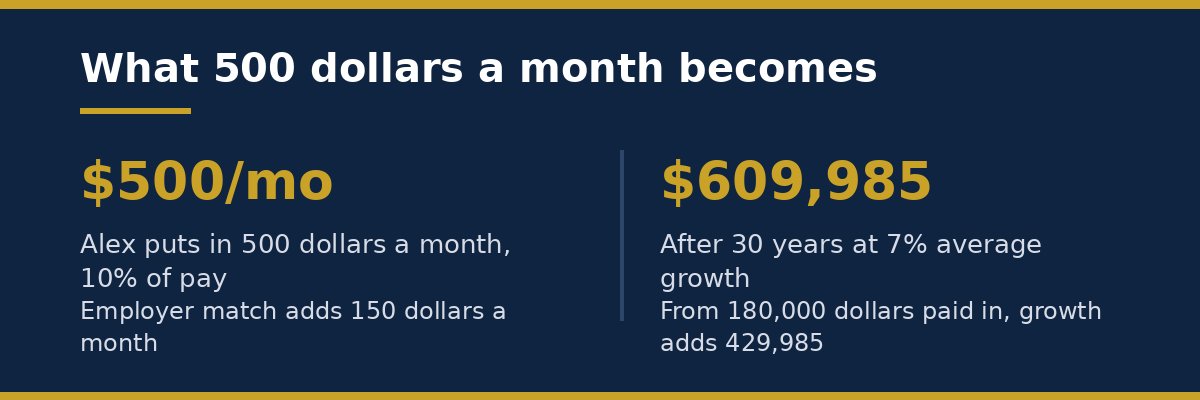
Here is the math on one steady saver, so you can see why starting early matters more than the amount. Meet Alex. Alex earns 60,000 dollars a year and puts 500 dollars a month into a 401(k), which is 10 percent of pay. The employer matches 3 percent of pay, which is 1,800 dollars a year, or 150 dollars a month. So 650 dollars a month goes into the account in total, but Alex only pays 500 dollars of it.
Assume the investments earn an average of 7 percent a year. That is not a promise. Real returns move up and down every year, and some years are negative. But 7 percent is a common figure used to show long-term growth.
After 10 years, Alex’s own 500 dollars a month has grown to about 86,542 dollars. Alex put in 60,000 dollars over those ten years. The extra 26,542 dollars is growth.
After 30 years, Alex’s own 500 dollars a month has grown to about 609,985 dollars. Alex put in 180,000 dollars over thirty years. The extra 429,985 dollars is growth, and that figure does not even count the employer match, which would add more.
Cut the amount in half, to 250 dollars a month for 30 years at the same 7 percent, and the result is about 304,993 dollars, from 90,000 dollars of contributions. The lesson is not that you must save 500 dollars. It is that time does most of the work. Starting ten years earlier beats saving twice as much for ten fewer years, because growth builds on growth.
To understand that growth, read: How Does Compound Interest Work?
What it costs, and what happens when you leave a job
A 401(k) is not free. The funds inside it charge fees, usually shown as an expense ratio. A broad index fund often charges around 0.03 to 0.20 percent a year. Some funds charge 1 percent or more. On a 100,000 dollar balance, 1 percent is 1,000 dollars a year, every year. Check the fees in your plan and favour the low-cost funds when the choice is otherwise similar.
When you leave a job, you have choices. You can leave the money in the old plan, move it to your new employer’s plan, or roll it into an IRA. Cashing it out is usually the worst choice: you pay income tax plus a 10 percent early withdrawal penalty if you are under 59 and a half, with limited exceptions. A rollover to an IRA or a new plan avoids that tax hit if done correctly.
You can also borrow from some 401(k) plans, but think hard before doing it. A loan takes money out of growth, and if you leave the job, the loan often becomes due at once. It is not free money. It is your own retirement money, with a deadline.
How much should you put in?
A common starting point is to contribute at least enough to get the full employer match, then raise the percentage by 1 percent each year, or each time you get a raise. Many plans let you set automatic increases, so the rise happens without you thinking about it.
A widely used long-term target is 15 percent of pay, including the employer match, for retirement. If you earn 60,000 dollars, that is 9,000 dollars a year in total, or 750 dollars a month. If you are starting late, the target is higher. If you are starting at 22, the target is easier to reach, because time does more of the work.
Do not let a big target stop you starting small. Five percent with a full match beats zero percent while you wait for the perfect plan. Raise it when you can, and let the automatic increase do the work.
To set the habit on autopilot, read: How Do I Automate Saving and Investing?
Five mistakes that cost beginners money
Mistake 1: Not getting the full match. This is free pay. Contribute at least enough to get all of it, before you save anywhere else.
Mistake 2: Cashing out when changing jobs. The tax and penalty can take a third or more of the balance. Roll it over instead.
Mistake 3: Ignoring fees. A fund charging 1 percent a year quietly takes far more over thirty years than a fund charging 0.05 percent. Check the expense ratio.
Mistake 4: Leaving it all in cash or a single stock. A 401(k) is for the long term. A spread of low-cost funds, or a target date fund, is the usual beginner choice. Putting everything in your employer’s stock ties your job and your savings to the same company.
Mistake 5: Never raising the percentage. A 3 percent contribution set at age 25 and never changed will not be enough at 65. Raise it by 1 percent a year, or with each raise, until you reach your target.
For a full retirement plan around the 401(k), read: Financial Planning for Retirement in Simple Steps: Savings, Income, and Withdrawals for Beginners
FAQ
Is a 401(k) the same as a pension?
No. A pension pays you a set amount in retirement, funded by your employer. A 401(k) is an account you fund yourself, with help from your employer, and the amount you get depends on what you put in and how it grows.
What happens to my 401(k) if I change jobs?
The money stays yours. You can leave it in the old plan, move it to the new employer’s plan, or roll it into an IRA. Cashing it out usually means tax plus a 10 percent early withdrawal penalty if you are under 59 and a half.
Can I take money out before retirement?
Yes, but it is usually costly. Withdrawals before age 59 and a half generally face income tax plus a 10 percent penalty, with limited exceptions for hardship, disability, and a few other cases. Loans from some plans are possible, but they reduce growth and can become due if you leave the job.
What is the difference between a 401(k) and an IRA?
A 401(k) comes through an employer, with a higher limit and often a match. An IRA is an account you open yourself, with a lower limit: 7,500 dollars for 2026 if you are under 50. Many people use both, starting with the 401(k) match first.
How much do I need to retire?
That depends on your spending, not your salary alone. A common rough guide is 25 times your yearly spending, but your own number depends on when you retire, your costs, and other income like Social Security. For the simple version, read: How Much Do I Need to Retire
Is my 401(k) safe if my employer goes out of business?
Your contributions and vested matching money are held separately from your employer’s money, in a trust, so a company failure does not take your account with it. The investments inside can still fall in value, as any investment can.
Conclusion
A 401(k) is simple at its core: part of your pay goes in before tax, your employer may add matching money, it is invested in funds you choose, and it grows over decades. The three moves that matter most are to get the full employer match, to start early even with a small percentage, and to raise the percentage a little each year. The 2026 limit is 24,500 dollars of your own pay, but you do not need to reach it. Start with the match, set an automatic increase, keep the fees low, and let time do the heavy work. If your employer offers a 401(k) and you have not joined yet, signing up this week is the single most valuable money step you can take.
This article is for general information and education only. It is not legal or financial advice.
