
What Is Passive Income?
Short answer: Passive income is money you earn with little ongoing work after the setup is done. You do the work once, or you put money in once, and the income keeps coming with only small upkeep. Rent from a property, interest from savings, dividends from shares, and sales of a digital product you made once are all common examples. The key word is “little” ongoing work, not “no” work. Almost nothing is fully passive. Everything on this list needs either money upfront, time upfront, or both, and most of it needs some care to keep going. This guide explains the real types, the honest math, and the traps, so you can judge an idea on facts, not on a sales pitch. It is educational only, not financial advice.
Active income vs passive income: the real difference
Active income pays you for time you spend right now. You work an hour, you get paid for an hour. Stop working, and the pay stops. A job, freelance work, and driving for a delivery app are all active income.
Passive income pays you after the work is done. You build something once, or you invest money once, and it keeps paying in small amounts. You still did work, or you still risked money, but the pay is not tied to each hour you spend.
The difference matters because it changes what you are trading. Active income trades time for money, and your time is limited. Passive income trades upfront effort or upfront money for a stream that can run while you do other things. That is why people want it. But it is also why so many passive income pitches are misleading: they show the stream and hide the upfront cost.
If you need money this week, active income is the honest answer. Passive income is a slow build, measured in months and years. For a fast start, read: What Side Income Can I Start in One Weekend?
The main types of passive income
There are only a few real types, and most ideas fit into one of them.
Money from money. Interest from a savings account, dividends from shares, and interest from bonds. You put money in, and it pays you a share of what it earns. This needs money to start, and the return is small unless the amount is large.
Money from property. Rent from a room or a property you own. This needs a large amount of money upfront, and it comes with real work: repairs, tenants, and empty months. It is passive only in the sense that you are not paid by the hour.
Money from something you made once. A book, a course, a template, a photo, or a piece of music. You make it once and sell copies. This needs time and skill upfront, and it needs people to find it. Sales do not happen on their own.
Money from a business that runs without you. A small business with staff or systems that keep it going. This is the hardest type to reach, because building it takes years, and it is rarely passive in the early years.
Money from lending or renting things you own. Lending money through a platform, or renting out equipment, a car, or a spare room. The income is real, but so are the risks: the borrower may not pay, and the thing you rent out can be damaged.
Notice what is not on the list: watching adverts, clicking links, or joining a scheme that pays you for signing up other people. Those are not passive income. They are either tiny payments for your time or schemes that collapse when new people stop joining.
To compare ideas before you pick one, read: Side Income Ideas for Beginners: Filter by Time, Cost, and Skill
A worked example: what passive income really pays
Here is the math on two honest examples, so you can see the scale.
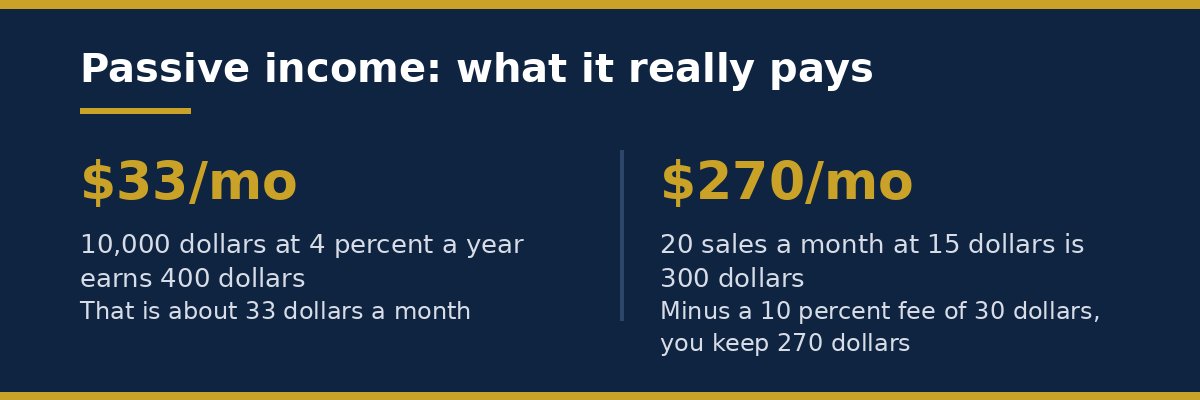
Example 1: interest. You have 10,000 dollars in an account that pays 4 percent a year. In one year it earns 400 dollars, which is about 33 dollars a month. That is real passive income, and it needs no work at all. But notice the scale: to earn 400 dollars a month this way, you would need about 120,000 dollars saved, because 120,000 times 4 percent is 4,800 dollars a year, which is 400 dollars a month. The income is safe and steady, but it takes a large pot to matter.
Example 2: a digital product. You spend 40 hours making a simple budget template and sell it for 15 dollars. In a good month you sell 20 copies. That is 300 dollars in sales. The platform takes 10 percent, which is 30 dollars, so you keep 270 dollars that month. In a slow month you sell 5 copies, which is 75 dollars in sales and about 67 dollars after the fee. The product keeps selling while you are at work, but only if people can find it, and finding it takes listing it well and answering buyer questions. The 40 hours upfront were not paid. If you count them, the first 270 dollar month pays about 6.75 dollars an hour for that work, and it only improves if sales keep coming for many months.
Both examples are real. Neither makes anyone rich quickly. Passive income works best as a second stream that grows slowly beside active income, not as a replacement for a job in the first month.
To start with no money upfront, read: How Can I Start a Side Income With No Money?
The honest limits: what nobody puts in the advert
First, the setup is real work. A course takes weeks to make. A rental property takes a deposit, a mortgage, and repairs. A dividend portfolio takes years of saving. Anyone who says an income is passive from day one is selling something.
Second, the income is usually small at first. Ten dollars a month from a first product, or three dollars a month in interest, is normal. Small is fine. It proves the idea works. But it is not a living, and treating it like one leads to disappointment and debt.
Third, nothing stays passive without upkeep. A property needs repairs. A product needs updates and customer replies. A portfolio needs checking. Plan for a few hours a month of care, even for the most passive idea.
Fourth, risk is real. Investments can fall. Tenants can leave. A platform can change its rules and cut your sales in half. Never put money you cannot afford to lose into a passive income idea, and never borrow to start one.
Fifth, tax still applies. In the United States, side income is generally taxable, even when it feels passive. Interest, dividends, rent, and product sales all count as income. Set aside part of every payment for tax, or the tax bill will arrive as a surprise. For the simple rules, read: How Do I Track Side Income for Tax in Simple Terms?
How to start: pick one idea and test it small
Step 1: Choose by what you already have. If you have savings, interest and dividends fit. If you have a skill, a digital product fits. If you have a spare room, renting fits. Do not pick an idea that needs money you do not have or skills you would need a year to learn.
Step 2: Work out the upfront cost in time and money, in writing. Hours to build it, money to start it, and hours a month to keep it going. If the numbers do not fit your life right now, pick a smaller version of the same idea.
Step 3: Test it small before you scale it. Make one product, not ten. Rent one room for one month, not a whole property. Put a small amount into a savings account and watch the interest arrive. A small test tells you the truth about demand, effort, and return, before you commit real money or months of evenings.
Step 4: Keep your job or main income while you test. Passive income should grow beside your active income, not replace it before it is ready. The test period is usually months, not days.
Step 5: Review every three months. How much did it earn, how many hours did it take, and is it growing? If an idea earns little and takes many hours, stop it and try another. If it earns steadily with little care, keep feeding it slowly.
To fit a test beside a full-time job, read: Can I Start Side Income While Working Full Time?
Passive income ideas ranked by upfront cost
Low money, high time: a digital template, a short guide, a set of photos, or a simple course. You pay with evenings and weekends. The risk is your time, not your savings.
Low money, low time: a high-yield savings account, or a small amount in a broad fund. The return is small, but so is the effort. This is the safest first step, and it teaches you how interest and dividends actually arrive.
Medium money, medium time: renting a spare room, or buying equipment to rent out. The income is bigger, but so are the duties and the risks.
High money, ongoing care: a rental property, or a business with staff. These can pay well, but they are not beginner first steps. They need capital, knowledge, and a buffer for empty months and repairs.
Start at the level that matches what you have today. A small stream that is real beats a big plan that never starts.
To choose by your own skills and time, read: How Do I Choose a Side Income That Fits My Skills?
Five traps to avoid
Trap 1: Paying to learn a secret. A course that costs hundreds of dollars and promises passive income is itself the seller’s passive income. You are the customer, not the partner. Free guides from banks, tax offices, and investing educators cover the basics.
Trap 2: Income screenshots with no costs shown. A screenshot that shows 5,000 dollars in sales hides the adverts, the fees, the refunds, and the months of work. Ask for profit after costs, not sales.
Trap 3: “No work at all” promises. There is no income with zero work and zero risk. If someone says otherwise, they are hiding the work, the risk, or both.
Trap 4: Borrowing to start. A loan for a passive income idea turns a slow stream into a monthly bill. If the idea fails, the loan remains. Start with money you already have.
Trap 5: Quitting your job too early. A stream that pays 200 dollars a month is a good start. It is not a salary. Keep the job until the stream has paid steadily for at least a year and covers your costs with room to spare.
For the honest picture on high earners, read: Highest Paying Side Hustles Explained Honestly
FAQ
Is passive income really passive?
Almost never, fully. The honest meaning is little ongoing work after setup, not no work. Setup takes time or money, and upkeep takes a few hours a month. Anything sold as zero work is hiding something.
How much money do I need to start?
It depends on the type. A digital product needs time, not money. Interest and dividends need savings, and the income is small until the pot is large. Property needs a large amount upfront. Start with the type that matches what you already have.
How long until passive income pays?
Expect months, not days. A product needs time to be found. Savings need time to grow. A realistic first goal is a small monthly amount, like 20 to 50 dollars, inside a few months, then slow growth from there.
Is passive income taxed?
Yes, in most cases. Interest, dividends, rent, and product sales are income, and tax rules apply. Keep records from the start and set aside part of every payment for tax. Rules differ by country, so check your own tax office.
Can teenagers earn passive income?
Yes, in small ways, like selling a digital product or earning interest on savings, with a parent or guardian involved where the law needs it. For teen-specific ideas, read: How to Make Passive Income as a Teen
What is the safest passive income for a beginner?
Interest from a savings account is the safest, because the money is protected and the return is steady. It is also the smallest return, so treat it as a first step and a lesson, not as a living.
Conclusion
Passive income is real, but it is slow, small at first, and never free. You trade time or money upfront for a stream that keeps paying with little care. The honest way to start is to pick one idea that fits what you already have, test it small, keep your main income, and review it every three months. A 33 dollar month from interest, or a 67 dollar month from a first product, is not a failure. It is proof the stream works, and streams grow when they are fed steadily. Start with one small test this week, and judge it on profit after costs, not on promises.
This article is for general information and education only. It is not legal or financial advice.
